

If the missile you’re launching at the enemy is easy to take down because it’s not very fast or stealthy, the least you can do is pack it with so much explosives you basically guarantee complete destruction if just one of them breaks through enemy lines.
This, at least, is the basic logic behind the FP-5 Flamingo — Ukraine’s new heavy hitter missile.
Officially unveiled and used in action in August of 2025, this missile marks a change of direction in Ukraine’s missile strategy. Experts, both domestic and foreign, hailed its arrival, but they warn against obsessive optimism because while the Flamingo packs a hell of a punch, it leaves a lot to be desired.
This missile, constructed mostly of recycled ordnance and aircraft parts, is threading a thin line between success and failure.
Design
The Flamingo excels in two key areas — warhead capacity and range. The missile is armed with a 1.15-ton, or 2,500-pound warhead which is just a comically large amount of explosive material for a single missile.
For comparison, the BGM-109 Tomahawk Land Attack Missile, which is a reliable American long-range missile, packs about 450 kilograms or 1000 pounds of explosives, and the Flamingo comes with 2.5 times that. Because of its incredibly heavy warhead, some experts believe that the missile utilizes a BLU-109/B bunker buster, which was used by Israel to kill Hezbollah leader Hassan Nasrallah in 2024.
This bomb is filled primarily with tritonal, a mixture consisting of 80% TNT and 20% aluminium powder which increases the complete heat output and impulse of the TNT, improving the bomb’s destructive performance. The bomb doesn’t go off immediately upon impact. Instead, the hardened steel casing allows it to penetrate into the ground first, after which the fuse triggers and the payload detonates.
Of course, to carry this massive warhead, you need to equip your missile with a massive, powerful engine, and the engine used with the Flamingo is believed to be Ivchenko AI-25. This engine is comparably much larger than engines on similar missiles, and it’s used with several aircraft, including Turkey’s combat drone Bayraktar Kizilelma.
The use of a large engine — one that measures 3.3 meters in length and 62 centimeters in diameter with a weight of 350 kilograms or 770 pounds — allowed the engineers to skip miniature turbojets and turbofans. These propulsion systems are usually preferred for long-range cruise missiles, but they’re expensive, unlike the AI-25.
The AI-25 was, incredibly, available for Fire Point to purchase in huge numbers from stockpiles. Fire Point officials also said that they found thousands of these engines at dumps and landfills around Ukraine.
In a very practical and literal showcase of the adage “one man’s trash is another man’s treasure”, Fire Point did not restore these engines to full usage, which would allow them a maximum flight time of ten hours, but only enough to power the Flamingo onward for a maximum of four hours.
They replaced the titanium parts with cheaper materials to save both time and money and engines that were deemed too damaged for use were scrapped for parts.
Since undertaking this project, Fire Point established its own plant to produce engines, but it’s still unclear whether they’ll make AI-25s or if they’ll opt for something smaller and more appropriate.
The biggest advantage of such a powerful engine, which is usually used with much heavier aircraft, is the incredible range of this missile, which is reported at 3,000 kilometers or about 1,850 miles. This is almost double the range of the Block 5 Tomahawk missile mentioned earlier, and it’s more than enough to strike Russia anywhere in the European part of the country, while it could reach as far east as Novosibirsk — this is an important point that we’re going to return to later.
That range is only claimed — Ukraine has not, at the time of recording, attempted to launch the Flamingo at such a distant target, so the claim is yet unverified. The range was not tested either as Ukraine is simply not big enough of a country to test that claim. The 3,000-kilometer claim is a result of calculations based on the amount of fuel and the engine’s consumption of it. If that claim proves to be true, though, that will make the FP-5 one of the world’s largest and longest-range ground-launched cruise missile systems.
The missile travels at a speed of about 900 kilometers or 560 miles per hour, which is comparable to the speeds of western missiles.
Despite that, as we could see with the reused warheads and the reused engines, it was designed on a budget.
This is further seen if we take a look at the guidance system and the missile’s electronics. The Flamingo does not have a complex visual guidance system, such as terrain contour matching systems or digital scene-matching area correlation systems, which are very common with western missiles which are also more expensive.
It does, however, use satellite navigation to guide itself toward the target.
The Flamingo uses a jamming-resistant, controller reception pattern antenna layout. What does that word salad mean? It means that the antenna layout is designed to resist radio jamming and spoofing, keeping the missile on its course. To differentiate, jamming is the disruption of GPS signals, and spoofing is feeding counterfeit signals to send the missile off-course.
The system uses 4 to 7 antennas arranged in a circular pattern, with each antenna receiving signals independently. These signals are then processed by a digital processor that applies predetermined algorithms to control the reception pattern. All in all, it is a cheap, but still somewhat reliable way of ensuring that the missile stays on course and that enemy jammers don’t affect it. This antenna system is very easy to build, which only improves production speed.
However, the Flamingo lacks any technology to hide from radars — this is a very unstealthy missile. Flying at a low altitude that follows the curvature of the landscape could keep the Flamingo safe from ground radars and anti-air weapons, but airborne radars installed aboard fighter jets are more than capable of spotting targets of that size, no matter how low they fly.
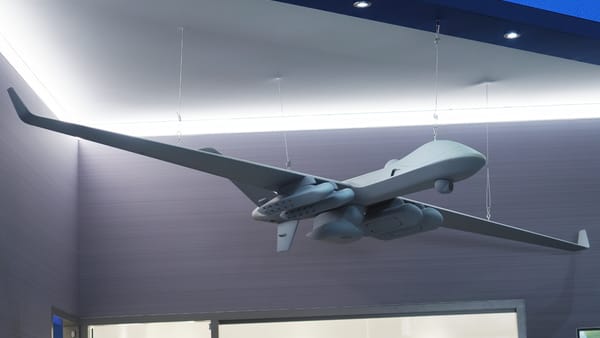
Similar to how the A-10 Warthog is an aircraft built around a 30-millimeter rotary cannon, the FP-5’s airframe is built around its massive warhead. At first glance it might remind you of the V-1, but the Flamingo is much larger at a length of between 12 and 14 meters and a wingspan of 6 — the official numbers were not yet disclosed.
The airframe uses a fiberglass monocoque fuselage with implemented filament winding, which creates a lightweight, but still strong body that can carry a load as heavy as the 1.15-ton warhead. The body is reinforced with external ribs, and since fiberglass is radar-transparent, as well as the classified materials used with the nose cone and the tail fairings, the missile’s radar visibility is lower in comparison to similarly sized weapons built with metal.
Development and Manufacturing
Ever since the Russian invasion of Ukraine in February of 2022, Ukrainian forces desperately needed a terrorizing weapon that was going to make Russia think twice before engaging any further, and they finally got it with the FP-5.
So far, Ukraine has built up an arsenal of long-range missiles, but it still lacks heavy missile capacity. Up until summer of 2025, Ukraine couldn’t rely on much more than Storm Shadow missiles and ATACMS as its heavy hitters, and it’s clear that the military leadership decided to patch this hole, because Ukraine is now producing the FP-5 Flamingo, as well as the Hrim-2 and Korshun missiles, all of which pack a very heavy punch.
While Ukraine did possess missiles that could strike deep inside Russian territory, the payloads they carried were relatively small — usually between 10 and 100 kilograms, which is laughably small in comparison to the Flamingo. On top of that, most of Ukraine’s long-range weapons, especially its drones, are slow, which makes it easier for Russian air defences to take them out.
The Flamingo resolves the destruction potential issue — it may not be fast, and it may be large enough to be relatively easily taken down, but if just one missile passes through Russian defences, the target could be completely destroyed, or at the very least severely damaged.
After the official unveiling on August 17th, 2025, production rolled on at a rate of about 50 missiles a month, and Fire Point announced that they plan to increase production to seven missiles a day by the end of the year. Experts assume that Ukraine could, in theory, scale production up to more than 2,500 Flamingos a year if they secure funding.
That unveiling, by the way, is the source of the missile’s name. Apparently, a journalist with the Associated Press reported that the early units had a pink color because of a coloring error at the production facility. Fire Point denies these claims, but the name Flamingo stuck with it.
The fact that Flamingo is a sort of Frankenstein missile only helps Ukraine’s cause as Russia is known to target weapons manufacturing sites. In July of 2025, Russia conducted a successful attack on several sites used for the production of Ukrainian Sapsan ballistic missile program. The manufacture of the Flamingo, on the other hand, doesn’t need new parts that require production plants — the majority of the missile is created from already existing components that can be put together in a factory that’s relatively safe. Even if the factory were to be destroyed, the Flamingo is so easy to put together, the entire manufacturing process can be moved as long as the warheads and the engines are kept safe.
Ukraine is not alone in this task either. To help streamline production, Denmark announced that a Fire Point subsidiary would start solid fuel production in Denmark by the end of the year — Denmark, which recently was the victim of a Russian drone incursion, had to suspend 20 laws and regulations to open this plant.
Aside from simply scaling up production, Fire Point is working on diversifying its FP-5s. Cluster warheads are currently in development, with other types of warheads also planned.
The question remains — how good is the Flamingo in practice, and how could it potentially be used?
Operational History and Potential Use
At the time of recording, there is only a single documented use of Flamingo missiles by Ukraine, and their effectiveness is, to quote the Chernobyl TV show — not great, not terrible.
Three missiles were launched on a poorly defended target in Northern Crimea and yet only two arrived on site, proving that the Flamingo is fairly easy to shoot down. One of the missiles that actually arrived missed the target by about 100 to 200 meters. The second missile, however, caused significant damage to the building, also damaging six hovercraft despite landing between 15 and 40 meters away from the target.
This shows that there are still a lot of kinks for Fire Point to work through to perfect these missiles. The claimed accuracy of the Flamingo is 14 meters, but neither of the two missiles hit within that mark. However, the missile that hit the closest still managed to cause enough damage to deem it a successful strike, showing that the massive warhead can compensate for the lack of accuracy.
Another issue that Ukraine is bound to face sooner or later is Russia’s air defence. The Flamingo is a very large, non-stealth missile travelling slower than the speed of sound, which makes it relatively easy to shoot down, diminishing its survivability in comparison to advanced cruise missiles. For example the Beriev A-50U, one of Russia’s long-range radar detection and control aircraft, is equipped with the Bumblebee radar system, which could detect the Flamingo up to 200 kilometers away, giving air defences and fighters more than enough time to intercept.
This, however, could be solved by relying on the missile’s incredible range. Since it can fly for so long, you could, in theory, enable indirect routing to target. Instead of picking the shortest flight path from the launch site to the target, operators could plot a path that exploits identified gaps in Russian air defence networks and sensor coverage.
This is, in fact, something Ukrainian forces have a lot of experience with as they demonstrated a high level of proficiency with attack planning during their one-way attack drone campaign. The Ukrainians planned their drones so well they were able to deal much more damage to Russia than anyone had expected. According to independent estimates, the damage these drones caused to Russian oil facilities have cost Russia more than $700 million dollars from late 2024 to early 2025 alone. To add insult to injury, the FP-5 Flamingo makes the drones used in those attacks look like firecrackers.
With this in mind, it’s almost guaranteed that Ukraine won’t be mindlessly launching Flamingos at Russia, but will instead carefully plan the flight routes to maximize their effectiveness.
Just like with its questionable accuracy, the lack of survivability is also compensated by sheer explosive power.
Ukraine plans to use these missiles in combined strikes — several of them will be launched, most likely alongside other weapon systems, and Ukrainian leadership is fully expecting Russia to intercept some of them. However, if just one makes it to target, it will most likely destroy it simply due to how much devastation the warhead can cause.
A large drawback of the Flamingo when compared to some western missiles is the long pre-launch preparation time of at least 20 minutes. You usually want your missiles in the air as soon as possible, as they’re at their most vulnerable on the ground. The Flamingo is, first and foremost, preposterously large for a quick launch, and it’s a brand new missile, meaning that the units using it are learning as they go, so it’s to be expected that crews will become more efficient in launch prep over time.
Yet another issue arising with the Flamingo is its price. As explained in the recently published video on the Shahed drone, which I invite you to take a look at if you haven’t done so already — the great thing about it, from a military perspective, is that the countermeasures used to shoot it down are often more expensive than the drone itself, which means that Russia wins small economical battles with its launch.
The same can’t be said for the Flamingo, which is estimated to cost between half a million and a million dollars per unit. This means that Ukraine has to rely on foreign financing to continue production, and moreover, in a practical sense, that means that if hypothetically four out of five Flamingos make it to target during an attack, Ukraine is effectively spending $4,000,000 on four decoys. However, if that single Flamingo destroys a crucial enemy structure, such as a missile depot, the accumulated $5,000,000 price point might be worth it.
Russia has an arsenal of countermeasures for missiles like the Flamingo, including the MiG-31B aircraft — the fastest known combat aircraft capable of both look-up and look-down engagement, more or less specializing in intercepting low-flying cruise missiles. A four-bird squadron of these can oversee a 600-kilometer wide line in Russian airspace, and they could easily destroy any Flamingo that tries to break through.
Speaking of destruction, because of its warhead, there’s a lot of pressure on the Flamingo’s wings — pun intended. Ukrainian President Volodymyr Zelenskyy called it “the most successful weapon in Ukraine’s arsenal to date” after its successful trial launch, and according to Fire Point’s officials, the warhead can pierce at least two meters of concrete and it can penetrate at least ten meters under ground.
It’s capable of this because it uses bunker buster warheads, as mentioned earlier, and as the name implies, bunker buster munition was specifically designed to penetrate hardened targets or targets that are buried under the ground. The warhead used with the Flamingo is actually one of the weaker modern bunker buster warheads as it can only penetrate through two meters of reinforced concrete. In comparison, the American BLU-127, also known under the sketchy name “Massive Ordnance Penetrator”, can break through 18 meters of reinforced concrete, which is just insane — that’s breaking through about six building floors under the ground.
Modern bunker busters are also helped by the extra speed provided by the engine, which generates a greater penetrative force.
With this in mind, the Flamingo will most likely be used for two purposes. Its intended purpose is, of course, destroying armored and well-fortified structures, such as bunkers, siloses, and depots. The other intended purpose is the destruction of large compounds, plants, and factories which may not be fortified, but they are large enough to require a huge explosion to destroy, and they may be far enough to warrant the use of Ukraine’s longest-range weapon.
Valery Romanenko, a leading aviation expert and researcher with the Ukrainian State Museum of Aviation, says that upon exploding, the Flamingo will destroy any production plant. The facility will be impossible to rebuild because the explosion will result in complete destruction, leaving behind itself a 20-meter crater. He believes that the Flamingo’s preferred targets are going to be Russian oil refineries.
Ryazan and Kstovo refineries, which are Russia’s third and fourth largest, respectively, are all well within the Flamingo’s range. In fact, seven of Russia’s ten biggest oil refineries are within Flamingo’s claimed 3,000-kilometer range.
Now we must return to what we said before about the Flamingo’s alleged capacity of reaching Novosibirsk. It’s interesting how all the news outlets used Novosibirsk as the designation point of Flamingo’s range capabilities, because Novosibirsk just happens to be close to Biysk, the home of the Biysk Oleum Plant.
The Biysk Oleum Plant Russia’s largest producer of military-grade explosives and artillery shells. Every month, Russia supplies its forces with about 120,000 artillery shells. Normally, those shells are produced in Nizhny Novgorod, which is about 1,300 kilometers away by road from Ukrainian borders, which means that the shipments are well within reach of Ukrainian weapon systems.
Because of this, Moscow decided to move their production to the Biysk Oleum Plant, thinking their production would be safe there. Que, the Flamingo — a huge missile that could, in theory, destroy the entire plant with one strike and it has a 3,000 kilometer range.
Biysk is just outside of the Flamingo’s range by a few hundred kilometers, but both Ukrainian and Russian forces are well aware that Flamingo is a huge threat for their production plant. What if the Ukrainians managed to break through and launch from further inland? What if they launched the Flamingos at the train convoys?
These are the questions that Russian logisticians are asking themselves at this very moment, and this was, ultimately, one of Ukraine’s biggest goals in a war that’s been largely defined by the destruction of supply routes, depots, and production plants in the past year.
Ukraine has previously used old Soviet drones, such as the TU-143, and modified aircraft, such as the A-22 Foxbat, to penetrate more than 1,000 kilometers into Russian airspace. The Flamingo could potentially penetrate three times deeper, which means that Russia could lose the advantage of territorial depth — something the country has been relying on ever since the start of the war.
The Biysk Oleum Plant isn’t the only arms manufacturing factory at risk. Shahed drones, which Russia has adopted from Iran, are produced in Yelabuga and Izhevsk factories, which are well within range for the FP-5, and the same can be said for the Oreshnik missile factory in Votkinsk. In fact, 90% of Russia’s defence industry is within the Flamingo’s range, and according to Romanenko, this will create a strategic imbalance in Ukrainian favour.
“The Ukrainian rear areas that are unreachable for Russian attacks are protected by Europe, but Ukraine, for its part, obtains the capability to destroy virtually any defense-industrial facility on the Russian territory… this entails a fundamental change in the balance of power.” says Romanenko.
Despite that, experts warn against blind, excessive optimism, as there are yet a lot of things to work through.
The Flamingo is still very vulnerable, easy to detect, and slow enough for most Russian air defence systems to shoot down. Ukrainian aviation experts agree that Russian systems will intercept the majority of missiles, but since no system guarantees complete protection, even that single missile breaking through the lines could deal significant damage.
Even if five out of 50 missiles reach the target, that’s enough to destroy three large Russian enterprises, such as refineries or weapon plants, Romanenko says. The key to the Flamingo’s success will be the reliance on combined weapon attacks and sheer numbers of other drones and missiles to be used as decoys.
However, how well will Ukrainian forces use this new weapon and is the appearance of the Flamingo on the horizon going to turn the tide in Ukraine’s favour are questions that only time will answer.
Key Takeaways
- The FP-5 Flamingo missile is Ukraine’s new heavy hitter, designed with a massive 1.15-ton warhead.
- The Flamingo’s range is claimed to be 3,000 kilometers, potentially reaching deep into Russian territory.
- Ukraine plans to use the Flamingo for destroying fortified structures and large industrial targets.
- The missile’s large size and lack of stealth make it vulnerable to Russian air defenses.
- The Flamingo’s success relies on combined strikes and exploiting gaps in Russian defense networks.

Simon Whistler
Simon Whistler hosts MegaProjects, bringing engineering, infrastructure, and military-machine stories into clear narrative focus for viewers who want the systems, tradeoffs, and human decisions behind the build.
Frequently Asked Questions
What is the FP-5 Flamingo?
The FP-5 Flamingo is Ukraine’s new heavy hitter missile, officially unveiled and used in action in August 2025. It is designed to carry a massive warhead and has a significant range.
What is the warhead capacity of the FP-5 Flamingo?
The FP-5 Flamingo is armed with a 1.15-ton (2,500-pound) warhead, which is a comically large amount of explosive material for a single missile.
What type of engine does the FP-5 Flamingo use?
The FP-5 Flamingo is believed to use the Ivchenko AI-25 engine, which is comparably much larger than engines on similar missiles and is used with several aircraft.
What is the range of the FP-5 Flamingo?
The FP-5 Flamingo has a reported range of 3,000 kilometers (about 1,850 miles), which is almost double the range of the Block 5 Tomahawk missile.
How does the FP-5 Flamingo’s guidance system work?
The FP-5 Flamingo uses satellite navigation to guide itself toward the target and a jamming-resistant, controller reception pattern antenna layout to resist radio jamming and spoofing.
What is the operational history of the FP-5 Flamingo?
At the time of recording, there is only a single documented use of Flamingo missiles by Ukraine. Three missiles were launched on a poorly defended target in Northern Crimea, with two arriving on site and one causing significant damage.
What are the potential uses of the FP-5 Flamingo?
The FP-5 Flamingo is intended for destroying armored and well-fortified structures, such as bunkers, silos, and depots, as well as large compounds, plants, and factories.
What are the vulnerabilities of the FP-5 Flamingo?
The FP-5 Flamingo is vulnerable due to its large size, lack of stealth, and relatively slow speed, making it easier to detect and intercept by Russian air defense systems.
How does Ukraine plan to use the FP-5 Flamingo effectively?
Ukraine plans to use the FP-5 Flamingo in combined strikes, launching several missiles alongside other weapon systems, and carefully planning flight routes to maximize effectiveness.
What is the cost of the FP-5 Flamingo?
The FP-5 Flamingo is estimated to cost between half a million and a million dollars per unit, making it expensive and reliant on foreign financing for continued production.
Sources
- Original MegaProjects video: FP-5 Flamingo: Ukraine’s New Missile
- Hero image source by PRESIDENT OF UKRAINE VOLODYMYR ZELENSKYY Official website / openverse, by.