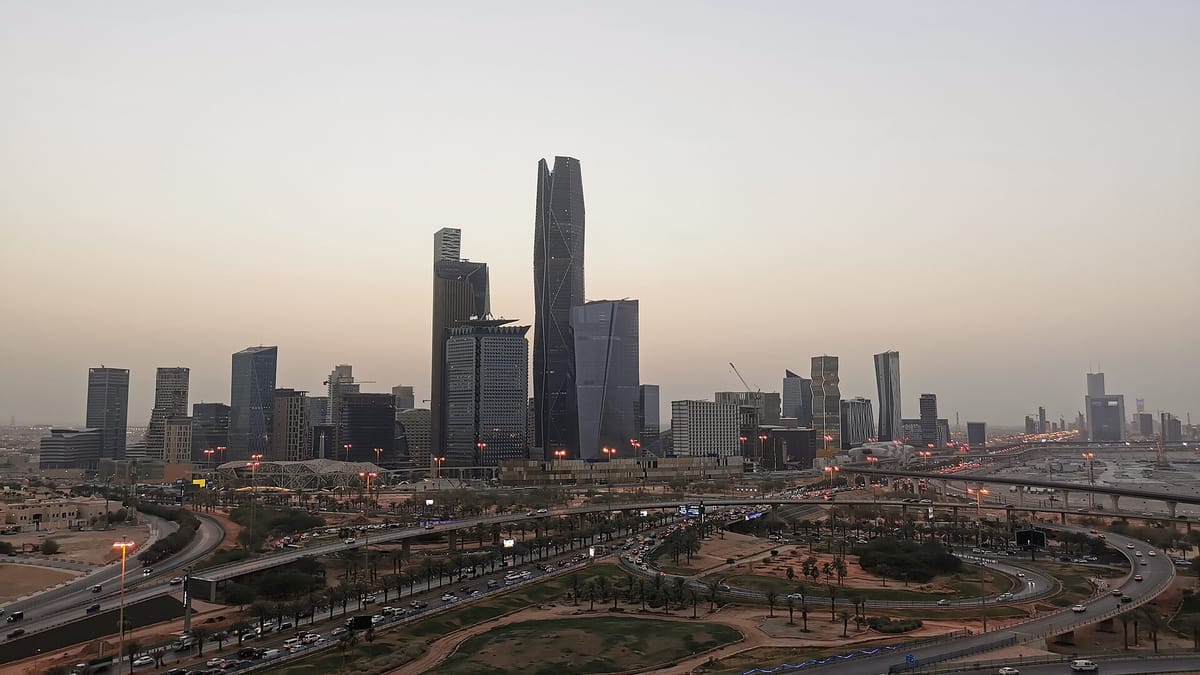
On April 25th, 2016, the government of Saudi Arabia announced Vision 2030 — a massive series of MegaProjects that placed the country at the center of global development.
The list of projects includes unbelievably ambitious engineering ideas. There’s The Line, a multimillion-resident linear city built from scratch; Jeddah Tower, the soon-to-be tallest structure in the world that will pierce the skies, literally; and vast energy plants that plan to supply half the country with green energy.
All of these projects require terraforming at a scale never before seen in human history, while the plans themselves are pushing the limits of engineering and development as we know it.
Although formally designed to diversify the economy and culture, the not-so-secret intention of Vision 2030 is to present Saudi Arabia as a technologically futuristic giant and improve the perception of the country as a place people actually want to live in.
Now, almost ten years into the project, it’s high time we took a proper look into how well it’s doing.
Headlines have already been written about how only some of the elements have been successfully completed, or are otherwise on track for completion. The biggest projects, however, have been stalling for years. And day after day, that 2030 number seems to be getting closer and closer.
Will the Saudis finish on time? Or will the richest Middle Eastern country embarrass itself in front of the entire world?
Section 1: Overview and Criticism
Saudi Vision 2030 is a supercharged development plan aimed at three specific goals — diversification of Saudi Arabia’s economy, social structure, and culture.
The economy lies at the heart of the issue, but unlike most countries, it’s not the lack of revenue that presents a problem. Saudi Arabia has the 19th highest GDP in the world, which makes it by far the highest ranking Middle Eastern country in that regard. The problem the Saudis are facing is their overreliance on black, liquid gold. Oil exports account for about 40% of the country’s GDP and about 75% of its fiscal revenue.
This isn’t that surprising — Saudi Arabia is the world’s biggest oil exporter after all, but the government is aware that it’s not smart to keep all your eggs in the same oily basket. Other Middle Eastern countries are doing this as well — Kuwait’s Vision 2035 and Qatar’s Vision 2030 projects have, among others, economic diversification as one of their main goals.
In fact, Saudi Arabia has been trying to decrease its dependence on oil resources since the 1970s, and in 2016, Vision 2030 was announced — a project so important, it’s supervised by Mohammed bin Salman, the Prime Minister and Crown Prince himself.
If delivered, this plan would diversify Saudi Arabia’s economic portfolio, but it would also greatly affect the society and culture of the Middle Eastern giant.
The three pillars, as officially stated in the document, are to: make the country the “heart of the Arab and Islamic worlds”; become a global investment powerhouse; and to transform the country into a hub connecting Africa and Eurasia.
If the plan works out, it would provide the government with alternative sources of revenue, which is, after all, the top priority. It would also lower the dependency on public spending as all of these innovations would provide employment opportunities, instantly boosting the private sector. There are also plenty of projects aimed at lowering the country’s carbon footprint and improving sustainability, with the main goal being that half of all power in 2030 comes from green sources. Some of the projects are aimed at improving the country’s visibility and introducing its culture to the rest of the world, as it’s still a bit abstract to many people.
In terms of megaprojects, it is by far the most ambitious project cluster in the Middle East, and nothing epitomizes that more than NEOM.
Section 2: NEOM
We’ve already covered this artificial city in two videos and you’re invited to take a look if you want a detailed breakdown of why the sole idea of NEOM is ridiculous. For those of you who are just hearing about NEOM, this planned city is located in the Tabuk province, between the Gulf of Aqaba and the Red Sea, and it might go down in history as the greatest megaproject ever. It might also go down in history as the greatest example of “don’t bite more than you can chew” idiom, but more on that later.
Spanning over an area of 26,500 square kilometers, which is roughly the size of Albania and Massachusetts, this city will cost a whopping $8.8 trillion dollars to build, which is 25 times the annual Saudi national budget. In return, NEOM will supposedly generate almost half a million jobs and add an estimated 48 billion dollars to the country’s GDP annually.
The most ambitious parts of this project are the Sindalah island, and, of course, the infamous Line.
The Line is a planned linear settlement, designed quite literally as a line — a single, comically long building. 170 kilometers long, to be precise.
Stretching from the Red Sea to the city of Tabuk, it could, in theory, accommodate 9 million inhabitants, which is a quarter of Saudi Arabia’s population at the time of this video’s recording. This would, in turn, result in a population density of 260 thousand inhabitants per square kilometer.
That would make it by far the world’s most densely populated city, with a population density almost six times greater than that of Manila, the world’s currently most densely populated city.
It’s not all bad, though.
The city is supposed to be entirely powered by renewable energy. If this goal is met, it would make The Line the world’s largest renewable city.
The city itself would also have no need for cars or streets, thus further limiting carbon emissions. All services needed in daily life will be no further away than five minutes on foot, rendering cars useless. And if someone needed to see their friend who also made the terrible decision of buying a spot in the real life version of The Highrise, they can always use the metro.
You would think that arguably the most famous project in Vision 2030 would be the most advanced one, but you’d be sorely wrong. Ever since the construction of The Line started in late 2022, the developers kept stumbling upon hurdle after hurdle like an Olympic athlete.
Ungodly amounts of soil had to be moved to make room for The Line, and at one point, the developers were excavating about a million cubic meters of earth every week. For comparison, that’s like moving 400 Olympic swimming pools — filled with water, of course — each week. Or, if you’re interested in a more personal comparison, about 15 million people. By 2024, barely more than a year since the construction had started, a reported 90 million cubic meters of soil had been moved or, roughly 1,350,000,000 people, which is almost the population of China.
All of this to say that this is a massive terraforming job, certainly one of the greatest in human history, and once the developers started working, it started becoming apparent that the job before them was bigger than initially thought.
It was originally planned that the first 5 kilometers of The Line, which is barely 2.9% of its entire planned length, would be finished by 2030, allowing the first inhabitants to move in. However, The Wall Street Journal and Bloomberg both reported that the project was scaling back amid developmental uncertainty and that only 2.4 kilometers would be finished by 2030, while the entire Line would be finished by 2045. Saudi officials are denying this, but it’s difficult to overlook the fact that a lot of key members of the project are jumping ship.
At least two major architects have left the project because of ecological and human rights concerns. On the ecological side, the entire project would have a 1.8 gigaton CO2 carbon footprint because of all the steel, concrete, and glass used. On top of that, The Line itself, when finished, would function as a huge barrier to migratory species, not to mention that the entire exterior facade is supposed to be mirrored, which would be very harmful for birds.
As for human rights, Saudi Arabia has a very poor track record with the abuse of workers. If that isn’t enough, at least 20,000 people will be evicted out of the few villages that stand in the way of The Line, and those villages will be destroyed. Saudi security forces already killed one person who refused to move, and the Criminal Court sentenced three people to death for the same reason.
Although it is certainly the preposterous epicenter of NEOM, The Line isn’t the only part of this grotesque megaproject. Another well known piece of this puzzle is the Sindalah island.
This luxurious 20-acre island was no less of an apparent disaster than The Line. It should have officially opened in 2021, but it was only finished in 2024, and at the cost of 4 billion dollars, which is nearly three times the planned budget. This, however, isn’t that surprising when you consider that the opening party cost a whopping 45 million dollars — the shrimp were to die for, I hear.
What’s particularly impressive about Sindalah, despite all its drawbacks and issues, is its marina. To accommodate its guests, the Sindalah relies on 85 berths for yachts up to 50 meters, while the buoys outside the harbor can accommodate yachts up to 170 meters.
Additionally, Marriott International and Four Seasons are opening properties on the island, and although everything seems glorious on the outside, the island is, after all, a disappointment. It was too expensive and too slow to develop, and the Crown Prince Mohammed bin Salman — the de facto ruler of the country and the main sponsor of the project — fired NEOM’s CEO after seeing the island.
Aside from those major projects, NEOM will also include Oxagon. This floating industrial city is designed to focus on manufacture, industrial research, and development.
There is also Trojena — a ski resort. That’s right! A ski resort in Saudi Arabia. Actually the first ever ski destination in the Arabian Peninsula, which will host the Asian Winter Games in 2029.
All of these projects are key components of the NEOM megaproject, but at this stage, the finish line is nowhere in sight. Ideally, this utopia would provide its citizens with a finely balanced life in a green, clean environment, but worldwide experts are criticising it as a laboratory of false solutions. Saudi Arabia itself is criticized for trying to artificially create a society where there isn’t one, while NEOM’s price is being paid in human lives and clean air.
According to a recent audit, there’s also clear evidence of deliberate financial manipulation by some project managers, while former managers have come out saying that the entire project is completely unrealistic. In fact, the Saudi Arabian Prince has a very Back-to-the-Future-esque idea for NEOM, one that includes flying cars, robot maids, and an artificial moon. The project managers, however, don’t want to say “You’re deluded.” to the wealthiest and most powerful man in a country that deals death penalties quicker than Oprah gives cars.
With all of that being said, the proposed deadlines and the final results we were all told we would see should be taken with a huge grain of salt.
Section 3: The Red Sea Project
There are, however, some much more grounded and realistic projects than building a city in the middle of nowhere.
Since the main goal of Vision 2030 is the diversification of Saudi Arabia’s income, it was to be expected that a huge chunk of the budget would be allocated to touristic projects. Saudi Arabia is, after all, the most visited country in western Asia with around 30 million visitors in 2024, which secured it the 11th spot on the ‘most visited countries in the world’ list.
Nevertheless, there is much room for growth, and by far the biggest project is the Red Sea Project. Developed by Tabuk-based Red Sea Global, this massive resort will, once it’s open, attract more than a million visitors annually.
Located on the west coast, it will spread along 200 kilometers of the Red Sea’s coastline. Aside from endless beaches, according to reports, the resort will envelop a desert, mountains, volcanoes, and 92 untouched islands. Those islands, of course, won’t be untouched once development wraps up, but who cares about factual correctness when you can use sensationalism to attract visitors, right?
When completed, the resort will include 50 hotels with around 8000 rooms, which would make it by far the largest resort in the world, snatching the title away from the First World Hotel & Plaza in Malaysia. This would make Saudi Arabia the country with two of the world’s top five biggest resorts, with the second one being The Clock Towers complex. That complex deserves a video of its own, but in short, it’s the largest Clock Tower in the world and the second most expensive building ever built.
Anyway, these 8000 rooms will be scattered across 22 islands and 6 sites on the mainland. The largest of the islands, Shura Island, will be connected to the shore with a 1.2 kilometer-long bridge, which makes it Saudi Arabia’s longest bridge. It will host a dozen international hotel chains. Another resort section called the Six Senses Southern Dunes will include 40 villas hidden in the Alnesai Desert. Saudi Arabia’s granite mountains will also host villas and hotels as part of the Desert Rock section.
The biggest crux of this huge development feat is transportation. With locations so isolated from one another, and most of them separated by sea, the big question is how will the resort transport its guests.
Saudis don’t shy away from massive projects, so they built an entire airport just to accommodate the Red Sea project. The Red Sea International Airport opened its tarmac in September 2023, and it was specifically designed to serve amphibious seaplanes. In fact, one of its runways was designed for hydrogen-powered seaplanes, which are used to transport guests from the airport to the island they’re staying on. Aside from the planes, the islands are only accessible by yachts, while the inland locations are integrated into Saudi Arabia’s road network.
All in all, the Red Sea Project cost around 17 billion dollars, and it’s expected to contribute around 5 billion to Saudi Arabia’s GDP annually. The 28,000 square kilometer resort, which is roughly the size of Hawaii, will create around 70,000 job opportunities, and it’s overall expected to handle around a million tourists per annum.
Section 4: Qiddiya
Aside from tourism, Vision 2030 includes a massive entertainment center. Qiddiya, located in Riyadh, is well on its way to become one of the largest entertainment centers in the entire world. According to the developers, it will certainly become the largest tourist destination worldwide, although that’s pure speculation on their part.
Qiddiya will consist of three major components, the most interesting one being the Qiddiya Speed Park.
The racing circuit will allow the drivers to reach a top speed of over 325 kilometers per hour and it will include the world’s first cantilevered track section called The Blade. The Blade will stand at 70 meters above the ground and, if the Speed Park does host its first Formula 1 race in 2027 as planned, it will become the first elevated racetrack in F1 history. The track was designed by former F1 driver and 24 Hour Le Mans two-time winner Alex Wurz, and the legendary Hermann Tilke. Tilke is, for those of you who may not know, the designer behind Austria’s A1-Ring, the circuits in Bahrain, Shanghai, Istanbul, Valencia, and many more.
The racetrack will wrap around and go through some of the other attractions of Qiddiya, which will allow other visitors and guests to take a look at the races held there.
One of those other attractions is the planned Six Flags park. Currently under construction, it will become the Middle East’s largest theme park at 79 acres. It will include the world’s tallest drop tower ride and the world’s fastest, tallest, and longest rollercoaster ride. Dubbed “The Falcons Flight”, the ride will be more than 4 kilometers long and it will reach a top speed of almost 250 kilometers an hour.
At one point, the ride goes over the F1 race track, allowing the riders to take a look at the race while they’re speeding down the tracks at incredibly high speeds themselves.
On top of that, Qiddiya will include a Dragon Ball theme park — the world’s only, in fact. It will include more than 30 attractions, the most popular one presumably being the statue of Shenron which will reportedly stand tall at 70 meters. In a world where we have dictators erecting even larger monuments for themselves, who would’ve guessed we’d see one of a cartoon character, eh?
Unfortunately, as it’s become common with Vision 2030 projects, there’s no smooth sailing for Qiddiya, specifically the racetrack.
It was announced in 2020 that the inaugural Saudi Arabian Grand Prix would be held at the circuit in 2021. The construction, however, was unfinished, and the event took place at the Jeddah Corniche Circuit instead. According to some reports, the Saudi government then paid tens of millions of dollars to retain hosting rights until the racetrack is completed — presumably in 2027.
Because of this, both Saudi Arabia and F1 found themselves at the center of a controversy with hundreds of organizations accusing them of using sports to turn attention away from human rights violations, or simply — sportswashing.
The racetrack’s construction is still well underway, though, and according to latest reports, it should be finished in time for the inaugural 2027 race.
Aside from Qiddiya, Riyadh is also home to four other megaprojects that are yet to be finished.
Section 5: Riyadh’s Four Mega Projects
Riyadh’s Sports Boulevard, New Murabba, the Mukaab, and the Mohammed Bin Salman Nonprofit City are four megaprojects that will entirely reshape the outlook of Saudi Arabia’s capital.
The Saudis have an obsession with linear design, and if The Line wasn’t evidence enough, take a look at Sports Boulevard.
When finished, this linear park will extend an incredible 135 kilometers and connect all parts of Riyadh and the Riyadh Province. The entirety of the park will be covered with cycling tracks, and about 123 kilometers of horse riding tracks. If building one of the largest parks in the world wasn’t enough, the park will also include a 130 meter tall sports tower. With more than 30 sports facilities occupying the 84 thousand square meter tower, it will be by far the largest sports tower in the world.
By sheer size, the Sports Boulevard project is one of the largest projects in the world, and at this point, it’s not far-fetched to assume that the list of the world’s largest projects is predominantly made up of Saudi projects.
If one of the world’s largest parks isn’t enough, Riyadh is also building the world’s largest downtown project. New Murabba, however, would be nothing without the Mukaab — the 400 meter tall cube-shaped skyscraper and the world’s second indoor city.
By volume, the Mukaab will become the world’s largest building once it’s finally completed. Not much is known about the design, but we know it’s perfectly cubical, and it will also take the title of the world’s largest single-built structure with around 2 million square meters of floor space. Yes — two million — you could fit 20 Empire State Buildings in there.
The final of Riyadh’s projects is the Mohammed Bin Salman Nonprofit City — the first of its kind in the world. First unveiled in 2021, the city features a technology and science center, a massive academic center, and an art gallery, among other things.
Surprisingly, there’s no controversy here, be it from an engineering, human rights, or ecological standpoint. The development of the longest park in the world and the largest building in the world is well underway, and it seems, at least at this time, that they’ll both be finished by 2030. These projects should, once they’re finalized, breathe some fresh air into the lungs of Saudi Arabia’s capital.
They are, however, sort of tame, so to say, in comparison to other projects of Vision 2030. There’s no dredging of the seas and moving of the earth, there’s no overzealous design that goes against all laws of architecture, common sense, and good taste. Therefore, not even their collective ambition can rival the plans for Jeddah Tower.
Section 6: Jeddah Tower
“The building piercing the skies” — that’s what they called Jeddah Tower when the project was first announced in 2010, long before Vision 2030 ever existed. The construction of the tower, however, took so long that it was introduced into the plans as part of the Jeddah Economic City Project. Jeddah Tower will, in fact, become the city’s centerpiece once it’s finalized.
If we take a trip back in time to 2010, we can witness the day the Jeddah Economic Company, the developer of the modern day Tower of Babel, appointed Adrian Smith to design it. Although the initial plan was to build a precisely one mile, or 1.6 kilometer long building, soil testing proved that it would be impossible. The developers would have to be satisfied with a building that’s barely a kilometer long. What an embarrassment, right?!
This would make it not only the tallest building on the planet, but the tallest manmade structure of any kind in human history! Once finished, it will stand tall over the Burj Khalifa by at least 180 meters. It will be at least three times taller than the Eiffel Tower, and it will be visible from another zipcode — only when the skies are clear, though, so the developers should be happy they’re not building in England.
In 2011, reports said that the design was finalized and approved. The actual height of the tower, however, will only be revealed once the building is finalized, but we know for certain that it will be at least a kilometer tall.
Skyscraper developers are obsessed with the height of their buildings — you could say they have a sort of building measuring contest. They also have a knack for keeping the real height of their buildings hidden until they’re finished. For example, during New York’s “World’s Tallest Building” competition, the Chrysler Building’s architect, William Van Alen, had a 38 meter long spire secretly built inside the frame of the building.
The spire was constructed in absolute secrecy, with no media reporting on it, and it was only installed once the rest of the building was finished around it. The true height of the Chrysler Building wasn’t officially known until it was unveiled.
In a similar way, we won’t really know the height of Jeddah Tower until it’s finalized.
What we do know, though, is that the building will weigh more than 900,000 tons. In comparison, the Burj Khalifa, which is currently the world’s tallest building, weighs half that.
To climb the tallest building in the world, visitors will have a total of 59 elevators and 12 escalators at their disposal, traveling at a maximum speed of 36 kilometers an hour. Since it would be impossible for an elevator to travel a full kilometer — from the ground floor to the top — the building will also include three sky lobbies for elevator transfers. The guests will use these elevators to get to the highest observation deck in the world. The deck, located in the top third of the building, will provide the visitors with exquisite views.
It will be at least a few years until we can properly analyze this monstrosity of a building, though. Ever since its inception, the Jeddah Tower Project has been getting bogged down by delay after delay.
Construction officially started on April 1st, 2013, and even though it was supposed to be finished within five years, the building is currently nowhere near done.
The reason for this is purely political. Two major investors; the owner of Kingdom Holding, which owns a third of the tower, and the chairman of the Saudi Binladen Group, which owns 17% of the tower, were both arrested during the 2017 Saudi purges.
In very short terms — these purges were led under the facade of fighting corruption, but the truthfulness of that remains to be proven. What they resulted in is the detainment of royals, politicians, military officers, scholars, and businessmen, as well as the centralization of political and financial power in the hands of Mohammed bin Salman.
At the time of these purges, the construction was only about a quarter-way finished, and all work had to halt because of labour issues with a contractor following the purge. Then after barely restarting, the entire world came to a halt in 2020 because of the COVID-19 pandemic, which put an almost permanent stop in the works.
It would take until 2023 for the project to restart by looking for new contractors, and the work only resumed very recently, in January 2025, and by June, the Tower reached the 70th floor.
After years of designs, redesigns, delays, and disputes, it seems that Jeddah Tower is finally on track to fulfill its destiny and become the world’s tallest building.
Once finished, possibly an entire decade behind schedule, it will stand at the forefront of Jeddah Economic City, also known as Kingdom City. There, it may capitalize on its simplistic design as some experts believe it could truly become a self-sustainable entity, very close to the concept of a vertical city. Additionally, there’s a critical lack of real estate in Saudi Arabia, and real estate development surrounding the Tower will provide the area with a significant boost to meet the demand of a rapidly growing population.
Section 7: Diriyah Gate
In stark contrast to the futuristic Jeddah Tower, Diriyah Gate is the world’s biggest cultural preservation project. Located only 15 minutes from Riyadh, the former capital of the Emirate of Dirriyah — which was the first Saudi state — finds itself at the center of a project aiming to forever preserve the renowned UNESCO site.
Although the historic district is generally well kept, a lot was lost during the Siege of Diriyah in 1818. It is the goal of this project to eternalize that which was preserved, and rebuild that which was lost as authentically as possible. This way, Diriyah’s visitors will step into a time capsule and they’ll be able to experience what life was like in the city hundreds of years ago.
The general plan of the project combines urban development with cultural and recreational facilities, focusing particularly on At-Turaif. At-Turaif is the historic district of Diriyah and it’s widely regarded as one of the most important historical sites in the entire country.
As part of the plan, the district will be restored, the archeological sites will be documented, and then, the district will be transformed into an open museum. The stunning ancient architecture won’t be the only reason to visit, though, as the King Salman University and the House of Saud Museum are going to be incorporated into the ancient district. The developers will also build a traditional Turaif market to add to the experience.
To ensure an authentic experience, Diryiah was separated into three sections by the designers. Everything mentioned so far is Section D1 — a section devoted to history. All three sections will be connected by the Wadi Hanifah, which is another major piece of this puzzle.
This seasonal river used to play a massive part in the lives of the locals, with farms depending on it for survival. The Diriyah Gate project plans on reviving the river with walking tracks and gathering areas, while there’s also talk of development of farms and palm groves. The palm groves are actually a huge chunk of this project. The plan is to plant hundreds of thousands of trees that are natural to the Wadi Hanifah, but have been eradicated from the area over time.
To accommodate millions of guests a year, a monstrously large underground car park is also part of the plan. According to some sources, it will have the capacity of 10,500 vehicles, which will make it the largest underground parking garage in the world. The car park will sit just underneath Diriyah Square, stretching over nearly 1 million square meters at three levels, which actually makes it larger than Diriyah itself!
New real estate developments have also been green lit, and they’ll be part of Diriyah’s Section D2 and D3.
It’s difficult to combine new real estate so close to an ancient site, but the development projects will reportedly blend traditional Najdi styles with modern urbanism. The design is also allegedly akin to Parisian development with five-floor buildings with courtyards. In fact, the designers leaned into Parisian influence so much that Diriyah will feature a main boulevard similar to the Champs-Élysées.
Section D3 will merge with the city of Riyadh, and it’s going to be a completely modern area from an architectural standpoint.
Once finished, Diriyah will be connected to Riyadh — the modern center of the Kingdom tied to its historical identity.
It’s anticipated that Diriyah will become one of Saudi Arabia’s main tourist attractions, quite possibly more popular than the Red Sea Resort, as the planners are expecting 50 million visits by 2030. Add 200,000 new jobs and about 100,000 residents to that, and Diriyah looks to be a good solution to financial diversification and Saudi Arabia’s real estate problem.
Section 8: Riyadh Metro
One of the few Vision 2030 projects that was actually successfully completed is the Riyadh Metro. Although ground was broken in 2014, the 176 kilometer transport system wasn’t finalized until 2024, once again because of the Saudi Purges and the COVID-19 pandemic. Once it was finalized, however, it more than proved its worth.
The Metro consists of six lines and integrates an 85 kilometer bus network as well. It is by far the world’s longest driverless metro, covering the entire area of Riyadh, and quite frankly doing a great job in fighting pollution.
According to some calculations, the metro is reducing the number of car trips by nearly 250,000 a day! This translates to about 3.6 million passengers a day, and reduces fuel consumption by about 400,000 liters on a daily basis! To paint a better picture, the average car in the United States burns through about 1800 liters of gasoline every year. The metro will ensure that 222 times more than that is saved EVERY - SINGLE - DAY.
Maybe even more impressively, all of the metro stations, some of which are true architectural beauties, are saving energy in remarkably high numbers. For example, 33% of the West Train Depot’s power comes from solar energy, while about ⅕ of all materials used in the construction of the Metro are recycled.
The trains themselves rely on top of the line power saving technologies. For one, they use a regenerative braking system to slow down. This technology converts the trains’ kinetic energy into electricity and reroutes it to the supply network, effectively saving on energy to brake. Additionally, the entire Metro line, including the depots, is partially powered by solar energy, and the panels generate enough electricity each day to power 15,000 homes.
Another major positive about the Metro is the relief it provides for traffic. Riyadh is an incredibly fast-growing city. Currently, its population ranges between 7 and 8 million, but just twenty years ago it was barely 4, and twenty years before that it wasn’t even at a million people. If all goes according to Vision 2030’s plan, Riyadh will reach 15 million citizens in less than five year’s time.
The rapidly growing population results in more vehicles, more vehicles result in more daily trips, and the city’s roads simply couldn’t keep up before the metro.
In 2018, Riyadh witnessed almost 9 million car trips every single day. For comparison, there are less than 5 million car trips a day in London, which is a slightly bigger city in terms of population. So, with traffic jams being as common an occurrence in Riyadh as rain in Scotland, the Metro was desperately needed to thin the traffic out. With close to 4 million passengers taking the Metro instead of driving every day, Riyadh’s roads are noticeably less congested.
At peak hours, a train will arrive at each station every 150 seconds, and in normal conditions, you can travel from the north to the south end of the city in under an hour. This is comparable to London, which is almost identical in size to Riyadh, as it can take the Tube anything from half an hour to an hour from north to south.
During the initial design phase, there were almost 100,000 design drawings of the Metro, with the system’s doors alone receiving more than 10,000 mock up designs.
Once construction had finished, the architectural surfaces measured in 7.3 million square meters, which is larger than London’s Gatwick Airport. To make way for the Metro, a huge chunk of man hours was devoted to earthworks. The developers moved almost 19 million cubic meters of soil, which is like moving more than 6 Giza’s Great Pyramids. 13,000 meters of electric cables were installed, which is just barely longer than the Earth’s diameter, and with more than 2 million square meters of roadworks, the developers essentially paved an area the size of Monaco.
This great project, however, might gain another layer in the near future. The head of the Riyadh Metro said that there are concrete plans of an expansion. The proposed seventh line would link the King Khalid Airport with Qiddiya, New Muraaba, Diriyah, and King Abdullah Gardens, connecting some of Vision 2030’s projects.
Section 9: King Abdullah Gardens
Speaking of King Abdullah Gardens, this project is, alongside Jeddah Tower and the Riyadh Metro, one of the three projects which were planned long before Vision 2030. However, due to how long it’s been in development, the project was formally incorporated into the megaproject cluster.
KAGA, as it’s often referred to, is going to become one of the world’s largest botanic gardens once it’s finally completed. Quite literally an oasis in the midst of Saudi’s arid central region, the Gardens will spread over an area of 210 hectares, which will make them the largest temperature-controlled gardens in the world.
The core idea behind KAGA is to dive back into history, to a time when the area was lush with life. Aside from its symbolic purpose, the Gardens will be a world-leading center for climate change study. The centerpiece of the Gardens are the two 10 hectare crescents, which will host the 400 million year-old recreation of the evolution of plant life on Earth.
A dedicated portion of the Gardens, called “The Garden of Choices” will depict nature in the future if radical climate change isn’t stopped, which is a bit ironic considering Saudi Arabia is among the world’s ten biggest greenhouse gas emitters per capita.
This project, like so many other Vision 2030 projects, did not go according to plan. It was originally supposed to be open in 2023, but delays caused by poor organization resulted in the project still being incomplete at the time of writing. The gardens are, however, aiming to formally open this autumn.
Section 10: Energy and Sustainability Projects
Saudi Arabia is investing billions of dollars into a few huge energy projects, the biggest of which is the King Salman Energy Park.
Described by its developers as an industrial ecosystem, this megaproject will provide services in the energy industry, such as production, refining, drilling, and water treatment.
SPARK, as they call it, should create an additional 100,000 jobs and boost the GDP by about 6 billion dollars annually. It is, however, far from the only project in this sector.
The Al Khafji Desalination Plant is another impressive project, and actually one of the first Vision 2030 projects to complete. Formally launched in 2018, this desalination plant is the world’s largest solar desalination plant.
The plant has the capacity to produce up to 90,000 cubic meters of clean water per day, which would easily supplement the water needs of 80,000 average American households. Since the plant is entirely relying on solar power, it witnessed a 14,000 ton reduction in carbon dioxide emissions, and a 16,000 barrel reduction in crude oil consumption.
The Rabigh Desalination Plant is another major project, in fact the second most expensive energy project in Vision 2030. Another desalination plant focused on lowering its carbon footprint, it relies on crystalline absorption cooling. This technology increases the efficiency of the process, while reducing negative environmental impacts.
Unlike the Al Khafji Plant, the Rabigh Plant also produces salt. It produces around 700 kilograms of salt and 5000 cubic meters of water a day, while consuming fairly little thermal and electrical energy. Although not as green as Al Khafji, the Rabigh Plant is a leading example in simultaneous production of salt and drinkable water.
For our next example, we have to return to NEOM, which is the host city of the Middle East’s largest solar panel factory. Launched in 2021, the almost 200 million dollar worth solar panel factory is spread over 27,000 square meters, about three times the size of a Manhattan city block. Aside from producing solar panels, it’s the first Saudi laboratory for testing solar panels, and the panels produced there are used in the Al Khafji Desalination Plant.
There is also the Sakaka solar power plant, with more than 1.2 million solar panels, lowering the cost of energy by selling it at 2.3 cents per kilowatt-hour. Since Saudi Arabia is such a sunny country, Sakaka produces 930 gigawatt-hours of electrical power and reduces carbon emissions by about 530,000 tons annually.
Being the force that it is, Saudi Arabia was naturally interested in nuclear power as well, and built the Low Power Research Reactor. Although the main purpose of the country’s first nuclear reactor is research and education, the reactor still garnered a lot of negative attention from the international community. Saudi Arabia refused to accept a strict inspection regime, one that would be conducted by international experts, and things got a little heated — pun intended — between them and the rest of the world.
At this time, Saudi Arabia doesn’t have a nuclear power plant. However, this research reactor is a major stepping stone toward building one, and since the country isn’t exactly well known for engaging with international laws and restrictions, experts fear that building a nuclear power plant without oversight could result in disaster.
The final project worth mentioning is the Dumat Al Jandal wind farm. One of the largest wind farms in the Middle East is capable of generating enough electricity to power 70,000 Saudi homes, and save around 1 million tons of carbon dioxide annually. Located around 900 kilometers north of Riyadh, the wind farm counts 99 of Dutch Vestas units, which will go a long way towards one of Vision 2030’s main goals — to have half the nation’s power come from renewable sources.
Section 11: Expo 2030 Site
The Saudis cheered when their country was chosen as the host for World Expo 2030, beating South Korea and Italy to the title by quite a margin. Saudi Arabia hopes to use the global showcase event to display the success of project Vision 2030, and nothing would encapsulate that success more than a banging expo site.
Development is currently in process for what’s bound to become the largest World Expo site ever, but that’s one of the very few things we know about it. In order to truly shock the world, almost everything is kept in complete secrecy.
What we do know, however, is that the expo site itself stretches over 6.6 square kilometers, making it significantly larger than Shanghai’s 2010 expo site, which will lose the title of the largest expo ever after twenty years.
We also know that at least 197 countries have confirmed their participation at this time, and that every country will have a pavilion for itself. Well, almost every country — Croatia has three and Gabon has two pavilions in the official brochure for some reason.
It’s a bit absurd because no other country’s flag appears more than once.
Anyway, returning to the topic at hand, the Expo opens on October 1st, 2030, and closes on March 31st the following year. The largest expo of all time will also be the most expensive expo of all time in terms of energy expenditure, and to power this massive mingling of countries, the expo relies on solar power. As part of Vision 2030, Saudi Arabia aims to generate half of all its electricity from solar power, and all of that energy will be used to power the expo.
The budget of 7.8 billion dollars makes this expo the second most expensive of all time — the one in Shanghai cost at least six times that. This meeting, however, is more than just a World Expo — it’s overall a great opportunity for Saudi Arabia to show the successes of Vision 2030, provided that they actually reach all the bars they had set for themselves.
Other than that, we don’t really know much about what this expo will feature. As I said before, it’s all very hush-hush and the vast majority of the gathering and everything that goes along with it will be revealed in a few years.
Section 12: Other Projects
To wrap up, we’re left with some of the smaller projects that make up Vision 2030. While still interesting, they can’t compare to the sheer size and ambition of the projects discussed so far.
One of the more interesting ones is The Rig. A theme park on an offshore oil platform about 40 kilometers offshore in the Persian Gulf is going to be a one of a kind attraction. This park will likely attract close to a million guests by the year 2032, cutely poking at Saudi Arabia’s oil dependence.
New housing developments are also part of the plan. Several real estate developers are currently building huge neighborhoods, such as Sedra in Riyadh, to tackle Saudi Arabia’s real estate problems. Once they’re finished, hundreds of thousands of housing units will be available for sale.
A redevelopment of Mecca is also underway with Masar at the core of the project. This 3.65 kilometer long cluster of mix-use buildings will completely revamp the ancient city, and once again prove the Saudis’ affection for linear design.
al-Ula Vision and Soudah Peaks projects are well underway to eternalize and promote culture. al-Ula, a city with a vast number of ancient sites, will become a hotspot for lovers of ancient history, while the project will also focus on the revitalization of the critically endangered Arabian leopard. The Soudah Peaks project is aimed at mountain tourism and it should bring millions of visitors to Saudi Arabia’s highest peak in the Asir Province.
Finally, we have to mention the Islamic Civilization Village Project in Medina, which aims to promote Islamic culture and present its heritage with the rest of the world.
Section 13: Vision 2030: Success or Failure?
In 2016, when Vision 2030 was first announced, the country communicated to the entire world that it’s dead-set on getting a seat at the high-end, luxurious table, next to the world’s elite. Announcing that before 8 billion people was a monumental PR gamble, and the reputation of the entire country is riding on the delivery of the project.
Now, after this painfully long deep dive into Vision 2030, one question begs for an answer — will the project succeed or fail?
Anyone telling you that they know anything with absolute certainty is lying. What can be said with certainty, though, is that for the moment, Vision 2030 is not quite on the right path. It would be incorrect to say that it’s definitely going to achieve all its goals.
Out of the four truly monumental projects — NEOM, Qiddiya, Jeddah Tower, and the Riyadh Metro — only one was successful, and even the Metro’s launch was behind schedule. A lot of time was spent idle during the COVID-19 pandemic, which nobody can blame Saudi Arabia for, but the country can be blamed for slowing the projects down with the Saudi Purges.
Additionally, some of the ideas for some of the projects were wildly unrealistic. However, the Crown Prince made his bed when he announced that NEOM, for example, would have flying cars and an artificial moon, and he now has to sleep in it.
As first-hand development of the plans started, it became clear that more often than not, these projects were dreams fueled by vanity. They were all style and very little substance.
Sure, some of these Gigaprojects – like Riyadh Metro, the energy projects, and Diriyah Gate – are smart, feasible, and planned out with the engineer’s heart in the right place. Most of them, however, give off the impression of a new, shiny toy that the rich boy in class wants to impress his peers with. The toy is cool now, but it will soon lose its shine, become obsolete, and the boy will have to learn that there’s more to friendship and social hierarchy than linear neocities.
It seems that despite the initial idea of improving the country’s image, which was one of the covert goals of Vision 2030, the project seems to have garnered only more negative press.
Hundreds of journalists, world leaders, activists, and managers of major organizations have criticized Saudi Arabia’s ambitions. Some of them accused the country of focusing on high-tech projects in an attempt to make everyone forget their terrible human rights record. Others highlight the irony of the absurd amount of carbon Saudi Arabia will release in order to build plants that will, over time, lower the country’s carbon footprint. Human rights activists don’t forget the dozens of assassinations, which are only the ones we know of, the country committed to secure its political and financial goals.
And everyone seems to be asking the same question; how will it all end? How many more assassinations, deaths, and human rights violations will the world witness in a rich country’s petty attempt to improve its reputation?
That we cannot answer.
What can be said, though, is that not all of Vision 2030 is a failure. Some of its biggest projects will check that box, and it doesn’t seem like the successful ones will rebrand the country, but it would be untrue to say the project failed in its entirety.
The energy and sustainability projects are running well, the capital’s traffic network finally got much-needed relief, and by the looks of it, the 2030 World Expo might be the most impressive one yet.
But when you draw the line, will Saudi Arabia’s economy, social structure, and culture reach the levels of diversification they aimed for? Most likely not.
NEOM and The Line will most likely never get even close to full capacity — the world’s elites, who are the only ones that can afford the newly built, luxurious resorts, will probably grow tired of them soon — and Jeddah Tower, while certainly an impressive feat of engineering, probably won’t stand at the forefront of a huge economic and demographic boom in the City of Jeddah.
Can you call that a success? After you’ve invested about $1.3 trillion dollars, and you’re likely to double that by the time all projects are finalized? After you told literally the entire world that everything would be finalized by 2030, and after you’ve spent years saying that these projects would turn your country into one of the most developed cultures and sought-after places on the globe?
No — that doesn’t sound like success. While it won’t go down in history as a total failure, Vision 2030 will most likely be remembered as an overwrought development plan that was too ambitious for its own good, and one that never had a chance to begin with.
Key Takeaways
- Saudi Arabia’s Vision 2030 aims to diversify the economy and culture, reducing reliance on oil.
- The project includes ambitious megaprojects like NEOM, Jeddah Tower, and the Red Sea Project.
- Many of the projects have faced significant delays and challenges, including ecological and human rights concerns.
- The Riyadh Metro is one of the few successful projects, reducing car trips and pollution.
- Vision 2030 is likely to fall short of its goals, with some projects deemed unrealistic and others facing criticism.
Simon Whistler
Simon Whistler hosts MegaProjects, bringing engineering, infrastructure, and military-machine stories into clear narrative focus for viewers who want the systems, tradeoffs, and human decisions behind the build.
Frequently Asked Questions
What is Saudi Vision 2030?
Saudi Vision 2030 is a massive series of megaprojects announced by the government of Saudi Arabia on April 25th, 2016. The plan aims to diversify the country’s economy, social structure, and culture, and includes ambitious engineering ideas such as The Line, Jeddah Tower, and vast energy plants.
What are the three main goals of Saudi Vision 2030?
The three main goals of Saudi Vision 2030 are to make Saudi Arabia the ‘heart of the Arab and Islamic worlds,’ become a global investment powerhouse, and transform the country into a hub connecting Africa and Eurasia.
What is NEOM and what are its key components?
NEOM is a planned city in the Tabuk province of Saudi Arabia, spanning over 26,500 square kilometers. Key components include The Line (a 170-kilometer-long linear settlement), Sindalah Island, Oxagon (a floating industrial city), and Trojena (a ski resort).
What is The Line and what are its challenges?
The Line is a planned linear settlement in NEOM, designed to accommodate 9 million inhabitants. Challenges include massive terraforming, ecological concerns, human rights issues, and delays in construction.
What is the Red Sea Project?
The Red Sea Project is a massive resort developed by Tabuk-based Red Sea Global, spanning 200 kilometers of the Red Sea’s coastline. It includes 50 hotels with around 8,000 rooms and aims to attract over a million visitors annually.
What is Qiddiya and what are its main attractions?
Qiddiya is an entertainment center in Riyadh that includes the Qiddiya Speed Park (a racing circuit with a cantilevered track section), a Six Flags theme park, and a Dragon Ball theme park.
What is Jeddah Tower and what are its delays?
Jeddah Tower is planned to be the world’s tallest building, with a height of at least 1 kilometer. Delays have been caused by political issues, including the Saudi purges and the COVID-19 pandemic.
What is Diriyah Gate and what does it aim to preserve?
Diriyah Gate is a cultural preservation project aimed at preserving the historic district of Diriyah, including the restoration of At-Turaif and the development of cultural and recreational facilities.
What is the Riyadh Metro and what are its benefits?
The Riyadh Metro is a 176-kilometer transport system that integrates a bus network. It reduces car trips, pollution, and traffic congestion in Riyadh, and is partially powered by solar energy.
What are some of the energy and sustainability projects in Vision 2030?
Energy and sustainability projects include the King Salman Energy Park, the Al Khafji Desalination Plant, the Rabigh Desalination Plant, and the Sakaka solar power plant, among others. These projects aim to create jobs, boost GDP, and reduce carbon emissions.