
Ah, Sweden. Land of pine forests, lakes and wooded cabins. Think of Sweden and you probably think of moose, meatballs; maybe even Ikea.
You probably don’t think of Shaolin monasteries, Buddhist statues and Kung Fu schools. Or a 200-strong army of terracotta soldiers.
But bizarre as it sounds, that’s exactly what you’ll find in the Älvkarleby Municipality, around 150 kilometres outside Sweden’s capital, Stockholm.
This is Dragon Gate: one of the strangest ghost towns you’re likely to encounter. Because although this was imagined as a meeting place for Chinese and Swedish culture, and although it has the Terracotta Army ready and waiting to welcome guests, nobody is actually here.
In fact, the site of Dragon Gate has been cursed by a string of bankruptcies and bad investments dating right back to the 1980s. Owner after owner has come and gone, while its echoing buildings remain eerily empty – built for crowds that never came.
A Chequered Past
In Uppsala County, on Sweden’s east coast, Älvkarleby is known for its fishing waters, which attract anglers from all over Europe. Here, the Dalälven River flows down to the sea, creating waterfalls, rapids and islands on its way.
For travellers on the European route E4 highway, it’s a great destination to stop off, get outside, and spend some time in nature. You can walk, kayak, and even go on horseback tours.
I know what you’re thinking. A motorway hotel would be handy here. A place to rest, recharge, and explore the local area.
Well, someone else had the same idea back in 1986, when the company Östanå – which was really owned by the Älvkarleby Municipality – built Hotel Älvkarlen.
Affectionately known by locals as “Sweden’s toilet”, it was tacked on to the same complex that already housed a restaurant and information centre, built two years earlier.
The hotel’s appearance was distinctly “municipal”, with a pretty heart motif doing little to soften its slab-like image. Despite this, local politicians hoped to capitalise on its placement to draw tourists into Älvkarleby.
In short, their plan wasn’t a success. The hordes of motorists dreamed of by municipal planners never materialised. Worse still, the property company’s CEO, Kjell Hillgren, who also served as a local councillor, became caught up in a scandal when it came out that he’d accepted a free trip to Budapest from the project’s winning contractor.
Hillgren was forced to resign and was later convicted and fined for taking bribes. In 1988, just two years after its unveiling, Hotel Älvkarlen went bust.
But that was just the opening act for this troubled site.
Enter phase two. In 1989, the hotel reopened – this time, as a refugee centre. Three years later, in 1992, it was sold for five million Swedish kronor (around half a million dollars) to Erland Ågren and Eriks Friis. They renamed the complex Checkpoint Dalälven, as a nod to the nearby Dalälven River. And so it continued until 2004, when the site was sold to the Chinese investor Li Jingchun.
He rebranded it Dragon Gate.
The Vision
Hailing from Zhejiang, businessman Li Jingchun grew his fortune selling mosquito repellent. With capital to spare, he set about making plans for a vast East-meets-West stronghold on the Älvkarleby site.
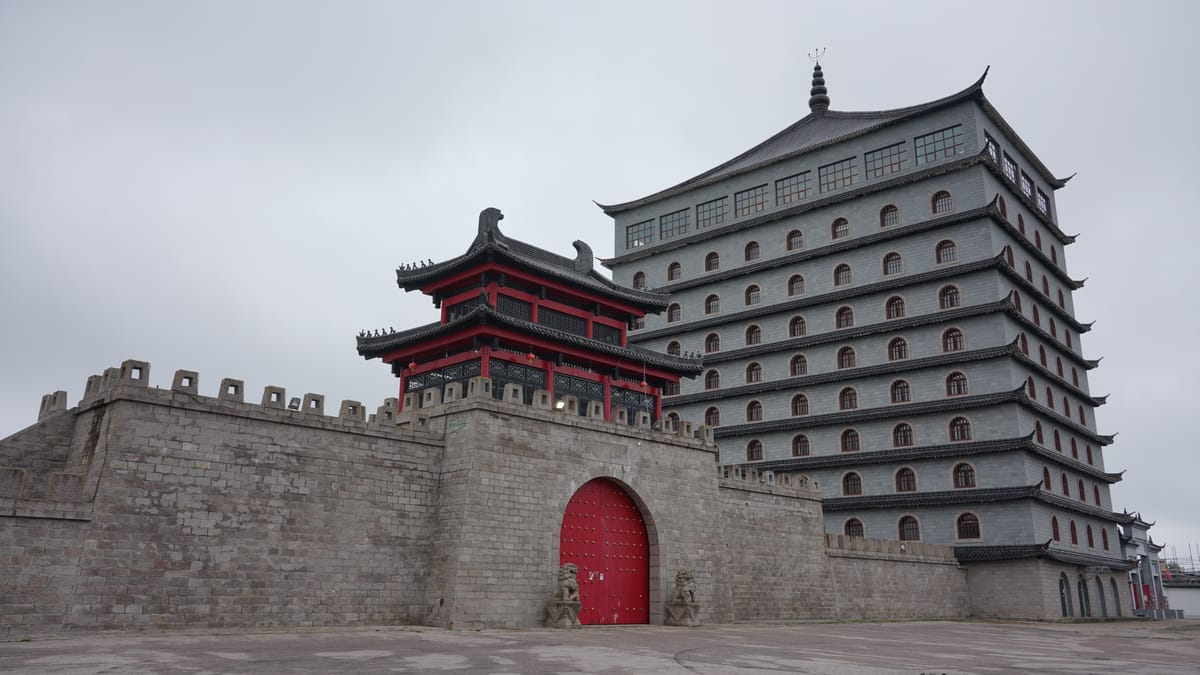
This included completely reimagining the hotel in the style of a Chinese temple, with 56 rooms, a restaurant, museum and gift shop. The complex would also include replicas of the Great Wall of China and Tiananmen Square.
If you’re thinking that the Chinese-Swedish fusion feels strange, you’re not alone. With over 4,000 miles (or around 6,500 kilometres) between their capitals Stockholm and Beijing, the two countries aren’t ones our minds would naturally match up.
Yet this approach was devised to echo some apparently historic touchpoints between Chinese and Swedish cultures. A Dragon Gate website pointed to several “meetings” between the countries, from early forays made by the Swedish East India Company in the 1730s to expeditions led by the Swedish archaeologist Johan Gunnar Andersson in the 1920s.
These links became the premise for what followed. That original Dragon Gate website, which is still live, states, “The man behind the Dragon Gate building, Mr. Li, aims to create a cultural bridge between Sweden and China at the dawn of the 21st century. Visit us and be a part of this!”
The cultural bridge Dragon Gate boasted included sizeable Chinese statues and architectural elements. We’ve mentioned the Terracotta Army and the Great Wall already, but to that list we can add a giant statue of the Buddhist saint Guanyin, two lion statues representing Yin and Yang, and even plans to import a real panda.
Even the name, Dragon Gate, was rich in symbology. In Chinese mythology, the “Dragon Gate” or Longmen is found at the top of a legendary mountain waterfall. For carp swimming upstream, it’s the final gate that must be leaped to transform into a powerful dragon. For Chinese students in particular, the idiom is used to encourage wealth and success through dedication and perseverance.
While the complex would be open to welcome tourists, the main aim was to use Dragon Gate as an actual gateway of sorts. It would be a place for European businesses to be tempted across to China, and a base for Chinese businesses looking to set up operations in Europe. Both would, in theory, find that much-sought-after success through the Dragon Gate.
Jingchun’s “unique concept” also included the prominent inclusion of Chinese staff in all departments, keeping knowledge of Chinese culture close at hand. At the same time, there would be others with expertise in Swedish culture to solidify the sense of union. In a neat link with the past, former owner Erland Ågren became Dragon Gate’s first CEO.
In a 2007 interview for the Gefle Dagblad newspaper, hosted over a lunch that included fermented eggs, Jingchun waxed lyrical about his vision. He was, his interviewer Kerstin Monk wrote, “absolutely convinced that it is his destiny to build Dragon Gate in Älvkarleby. He is equally convinced that it will be a great success, for the region, for Sweden, for relations with China. And not least for himself.”
Jingchun comes across as an emphatically work-driven man with a strong belief in Dragon Gate’s value and potential.
At this time, the project was celebrated as one that would hugely benefit the region. Jingchun was even invited to dinner with the king at the royal palace in Stockholm.
However, the build had its fair share of sceptics. In an interview, Lars Skytt, a former municipal councillor, commented, “It was an exciting project. He [Jingchun] had a few ideas, but in retrospect you can see that he wanted to move money to Europe, that’s what it was about.”
And if Jingchun wanted to move his money, Sweden was only too happy to take it. As Erik Hemström, former municipal architect at Älvkarleby Municipality said, “You don’t say no to someone who wants to invest and you don’t just say no to 60 Chinese people.”
The project also gained support from Invest in Sweden (now called Invest Sweden): an agency created to encourage foreign investment in the country. As well as bases in Stockholm and Gothenburg, Invest in Sweden had offices in Japan, India and China, placing people on the ground in those countries to encourage projects just like this. Dragon Gate was one of around 130 annual investments made.
Interestingly, another agency-backed project was the China Europe Business and Exhibition Center. This was planned as a sort of wholesale market, where foreign companies – mainly from China – could rent space to show off their products. Alongside this, there were plans for a four-star hotel, restaurants, 300 apartments, and a spa, with promises of 800 new jobs coming Sweden’s way.
But this was another project doomed to failure. The centre hit a number of controversies over claims it was luring Chinese businessmen to Sweden with the promise of residence permits and social benefits. There were also investigations into the treatment of Chinese construction workers, and concerns over safety violations. This is a theme we’ll definitely circle back to in a few minutes.
In autumn 2008, the project finally fell apart due to unpaid debts. A year later, the company behind it – Fanerdun Group AB – filed for bankruptcy.
It wasn’t a great sign for Chinese developments in Sweden. And the centre wasn’t the only build raising eyebrows. Jingchun had a comprehensive vision for Dragon Gate, but bringing it all to life wasn’t so easy. The project was barely off the ground before it ran into some serious pitfalls.
A Troubled Execution
Construction work began not long after Dragon Gate’s 2004 purchase, with the giant Buddhist statue distracting E4 drivers by 2005. With this erected, the first phase encompassed the building of Dragon Gate’s museum and cultural centre.
According to an early press release by Invest in Sweden, work was due to be completed in October 2007.
But just two years into the project, cracks began to show. In October 2006, Jingchun’s building firm, Latep AB, was hit with a 1.1-million-kronor fine after repeated inspections of the site by the Swedish Work Environment Authority uncovered major safety issues.
These were centred on the use of a construction elevator by workers. Swedish authorities had already vetoed the elevator’s use in a previous inspection, branding it unsafe. But on returning, they found that restrictive seals had been removed and the equipment was again in operation.
Work environment inspector Lars Nordström was on the warpath, threatening that the authority would pursue the dangerous practices as vigorously as it could. “We will possibly contact the Swedish Migration Board and question the workers’ work permits”, he said. “We don’t think they should be able to act like this.”
But act like it, they did. In total, Nordström’s team banned operations four times during 2006, prompting the exasperated official to declare it the first case he’d witnessed of its kind in his 30-year career.
In December, the newspaper Byggnadsarbetarenarens awarded Dragon Gate the dubious badge of Sweden’s worst construction project.
Chinese workers had been brought in especially for the job, with Jingchun praising their time-honoured skills and expert knowledge of Chinese construction styles. But inspections found that these workers were operating in conditions that fell far below Swedish standards.
For one thing, they were reportedly earning just 17 kronor per hour: around $1.80. This figure was later negotiated on their behalf to an hourly rate of 130 kronor, or around $13.74.
The newspaper pointed to an argument that “cultural differences” informed the on-site practices. But these didn’t hold much truck in a tightly regulated environment such as this. In his interview with Kerstin Monk, Jingchun waved away the controversy, saying:
“Today I can state that it is ignorance on our part that has led to these conflicts. Now we want to correct the whole thing, adapt and follow Swedish regulations.”
The ceasefire wouldn’t last. Bad publicity began sticking to Dragon Gate like dust to a demolition site.
In May 2008, reports circulated that parts of the complex had been built without planning permission. This rather dampened the mood when, just a month later, the project’s first phase was completed and Dragon Gate’s museum opened to the public.
There, visitors could see a replica Terracotta Army, sourced through the museum’s links with a partner museum in Xi’an. These made up just part of an exhibition about China’s first emperor, Qin Shi Huangdi. Another exhibition featured the world’s longest wooden relief, displayed in a 160-metre-long arcade.
This opening became a very brief hiatus in Dragon Gate’s otherwise troubled trajectory. In 2009, its new CEO, Jonas Jonsson, resigned after just a year when the promised hotel didn’t open.
Alongside this, the Älvkarleby Municipality was forced to file eight police reports against Dragon Gate. These included claims that workers had been burning and burying environmentally hazardous waste.
The following year, several of the companies involved in Dragon Gate – including Latep AB, which had recently changed its name – filed for bankruptcy, effectively halting development. The environmental cases were later closed and those whopping fines from the Swedish Work Environment Authority would never be paid.
Instead, a new company named Eastern Expo Center took over the site’s tourism and cultural operations. A fresh CEO, Kenny Li, was appointed. However, the much-vaunted construction work had massively slowed.
Despite all this, the minds and money behind Dragon Gate were still trying to drum up good publicity. On a freezing cold December day in 2010, a journalist from Sweden’s Gefle Dagblad was invited for a private tour of the site by Museum and Conference Manager Henrik Sundin.
Reading this now is slightly uncomfortable, as Sundin leads his interviewer around the deserted site.
“We will reopen when the hotel is up and running,” he says. “But I don’t really know when that will be.” As they reach the Chinese restaurant, completely empty at lunchtime, Sundin explains that it’s the low season. “In the summer we have 1,000–2,000 guests per day”.
A date of summer 2011 was later mooted for the hotel, but with the vague qualifier that this was an intentionally long-term project. Two completed rooms featured lavish golden wallpaper and hand-carved beds. A stateroom, slated for use as a meeting and event space, was similarly decked in gold, with a gleaming marble floor.
Yet from the elevator, the journalist wrote, it was still possible to see the blue plastered sheet metal of the original hotel. All that grandeur was just a façade.
Things continued in this strange, semi-closed vein for the next few years. Despite a couple of false starts, the hotel never opened, and diners lucky enough to find the restaurant staffed often had the place to themselves. Dragon Gate became a destination for the curious, described as sad, bizarre, and “almost amusingly bad”.
Not much to show for a 250-million-kronor – or almost 26.5-million-dollar – investment.
Far from being a cultural landmark, Dragon Gate had become a horribly embarrassing millstone.
Even Jingchun and Sundin’s sunny optimism couldn’t hold out forever. In August 2018, after almost a decade spent on hiatus, Dragon Gate was sold.
The new buyer, real estate company Sisyfos AB reportedly paid 25 million kronor, around 2.6 million dollars. It was a huge loss for Jingchun. But even with this relatively small outlay, Sisyfos couldn’t make Dragon Gate pay its way.
In the late 2010s, the venue was used for conferences and occasional events, including a techno music festival. While the new owners decided what to do with the site, they set about selling off the weird and wonderful merchandise that had been left behind under Jingchun’s ownership. A warehouse was found to contain around a million items, including toothbrushes, slippers, lamps, and T-shirts, which were all set up in a temporary shop.
Clearly, Sisyfos didn’t sell enough toothbrushes. Dragon Gate continued in the same underwhelming vein for another six years, with things winding down even further with the arrival of Covid-19. The hotel and restaurant occasionally opened, but daytime visitors again found it an eerily empty place.
The blog writer ‘Explore Sweden with Alex’ dryly observed, “Only the gas station feels alive.”
In June 2024, the whole site went back up for sale.
All Roads Lead Here
Sisyfos put Dragon Gate on the market with a starting price of 40 million kronor, around 4.2 million dollars. Announcing the sale, co-owner Thomas Sonesson quipped, “We need someone who is as crazy as we were”.
And it seems they found them. Just five months later, the site changed hands again, although the eventual sale price is still under wraps. The new owner, Arosslätten Properties, is owned by Lars-Gunnar Andersson and Ted Rundquist, who also own other developments in Uppsala.
Under their umbrella, Dragon Gate is being reimagined as less of a Chinese cultural destination and more an upmarket rest stop for weary travellers.
As we’re writing this in September 2025, work is still ongoing, but the new Dragon Gate website gives a flavour of what’s coming up. Now, the focus seems to be on practical needs: rest, commerce and services.
With 15 hectares of land at their disposal, that’s a lot of potential services. To draw in crowds from the estimated 30,000 vehicles passing Dragon Gate every day, refuelling is high on the list of priorities. The new complex will have a 24-hour fuel station and electric car charging points, as well as an Italian gelato shop.
It’s hard to know exactly how the development’s Chinese architecture and embellishments will be incorporated into this new vision. Under the headline “All roads lead here”, marketing materials describe the original Dragon Gate as “ahead of its time”.
“We are breathing new life into a place that has already captivated thousands of passersby, yet until now has only whispered the beginning of its story.”
Elements of the original are still firmly in place. For now, at least, the museum and its Terracotta Army are staying, and the hotel façade remains visible. But there are also plans to build here, on a bigger scale.
A sustainable heating system, powered by woodchip boilers, is now under construction, with the potential to heat 35–40,000 square metres of new buildings. This heating plant will be housed in a wing-shaped glulam – that’s glued laminated timber – building. Set for completion in spring 2026, the structure will also feature a vehicle hall, likely to be for caravan and motorhome sales.
Arosslätten hopes to find other commercial partners keen to develop their own businesses on the site, stating that there’s “strong interest” already.
“We are in very good dialogue with Älvkarleby Municipality for the entire area,” says Lars-Gunnar Andersson. “The common interest is to get the area up and running where business opportunities and jobs will be created in the long term”.
After twenty years as a static roadside oddity, it seems that Dragon Gate might, at last, be on the move. The eventual outcome is likely to be a far cry from Li Jingchun’s original plans for the site. But if the latest round of vision boards and sales copy is to be believed, Älvkarleby could finally have a rest stop that drivers actually stop at.
Now there’s a novel idea.
Key Takeaways
- Dragon Gate in Sweden is a failed attempt to create a cultural bridge between China and Sweden.
- The site has a history of bankruptcies and bad investments since the 1980s.
- Li Jingchun’s ambitious vision for Dragon Gate included replicas of Chinese landmarks and cultural elements.
- The project faced numerous issues, including safety violations and environmental concerns.
- Dragon Gate is being reimagined as a rest stop and commercial hub for travelers.
Simon Whistler
Simon Whistler hosts MegaProjects, bringing engineering, infrastructure, and military-machine stories into clear narrative focus for viewers who want the systems, tradeoffs, and human decisions behind the build.
Frequently Asked Questions
What is Dragon Gate?
Dragon Gate is a cultural and tourist site located in Älvkarleby Municipality, Sweden, approximately 150 kilometers outside Stockholm. It features Chinese cultural elements such as the Terracotta Army, replicas of the Great Wall of China, and a giant statue of the Buddhist saint Guanyin.
What was the original purpose of Dragon Gate?
The original purpose of Dragon Gate was to serve as a cultural bridge between Sweden and China, attracting tourists and facilitating business between the two countries. It was envisioned as a place where European businesses could be tempted to China and vice versa.
Who was the original investor behind Dragon Gate?
The original investor behind Dragon Gate was Li Jingchun, a businessman from Zhejiang, China, who made his fortune selling mosquito repellent.
What were some of the issues faced during the construction of Dragon Gate?
During the construction of Dragon Gate, there were several issues including major safety violations, use of unsafe construction equipment, and poor working conditions for Chinese workers. The site was fined multiple times and faced legal actions for these violations.
What happened to Dragon Gate after its initial failure?
After its initial failure, Dragon Gate went through several ownership changes and periods of inactivity. It was used for occasional events and conferences but largely remained a ghost town. In 2024, it was put up for sale again and eventually acquired by Arosslätten Properties, who plan to reimagine it as a rest stop for travelers.
What is the current status of Dragon Gate?
As of September 2025, Dragon Gate is undergoing redevelopment by Arosslätten Properties. The new owners plan to transform it into a practical rest stop with services like a 24-hour fuel station, electric car charging points, and commercial partnerships.
What was the significance of the name ‘Dragon Gate’?
The name ‘Dragon Gate’ is rich in symbology. In Chinese mythology, the Dragon Gate is a legendary waterfall that carp must leap over to transform into dragons. It symbolizes wealth and success through dedication and perseverance.
What was the initial reception of Dragon Gate in Sweden?
Initially, Dragon Gate was celebrated as a project that would benefit the region and Sweden’s relations with China. It received support from local authorities and investment agencies, but it also faced skepticism and criticism due to its ambitious and unusual concept.
What are some of the unique features of Dragon Gate?
Some of the unique features of Dragon Gate include replicas of the Terracotta Army, the Great Wall of China, a giant statue of the Buddhist saint Guanyin, and plans for a real panda. The site also includes a museum and cultural center with exhibitions about Chinese history and culture.
What was the impact of Dragon Gate on the local community?
Dragon Gate had a mixed impact on the local community. While it promised economic benefits and job creation, it also faced controversies and legal issues that tarnished its reputation. The site remained largely empty and underutilized for many years, becoming a roadside oddity rather than a thriving cultural landmark.
Sources
- Original MegaProjects video: Dragon Gate: China’s Failed Stunt in Sweden
- Hero image source by Lukas Beck / openverse, by.