

Every few decades, science stumbles across something that sounds impossible but refuses to go away. The details might be disputed, the data might fall apart, but the idea lingers, waiting for another chance.
Cold fusion is one of those ideas.
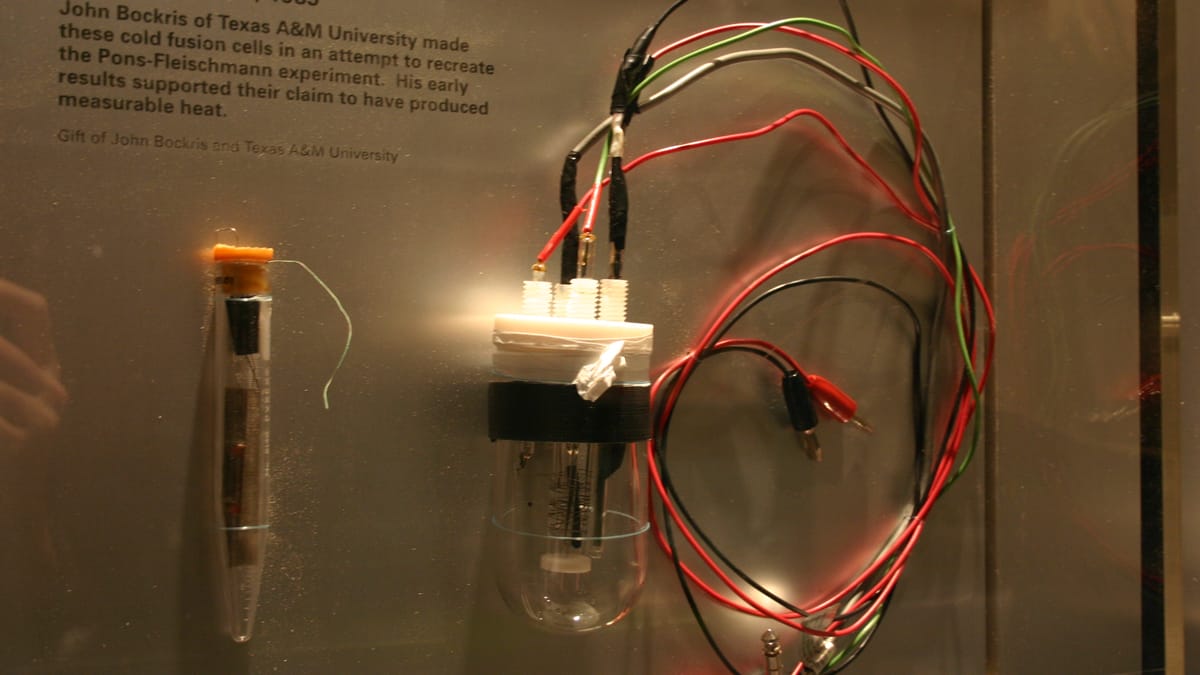
In March of 1989, two electrochemists from the University of Utah, Stanley Pons and Martin Fleischmann, stood in front of reporters and made a claim that caught everyone off guard. They said they had triggered a nuclear reaction in a laboratory using heavy water and a palladium electrode. The process took place at room temperature, without radiation, and it produced more heat than they could explain.
If the claim was accurate, the implications were enormous. It meant nuclear power without reactors, without high temperatures, and radioactive waste. It suggested that clean, abundant energy could be produced using equipment that fits on a table, not a power plant.
For a few weeks, the news cycle ran wild. Newspapers called it a scientific revolution, investors showed up, and political leaders paid attention. Then the replication efforts began, and the results were not encouraging.
Most labs could not reproduce the effect. Leading physicists expressed doubt almost immediately and within months, the story shifted from triumph to embarrassment.
Cold fusion became a warning about poor experimental controls and premature publicity.
But even as the headlines faded, a few researchers kept working quietly. Some of them reported unusual results that never made it past peer review. Others claimed to measure heat that they could not explain. Over time, the phrase “cold fusion” was replaced with something more cautious, low-energy nuclear reactions, or LENR.
Fast forward to 2025, and the conversation has started again. This time, it includes military labs, government grants, and serious scientists who believe the topic deserves another look. There is still no consensus, but there is no longer universal dismissal either.
So what exactly is cold fusion?
Why did it attract so much attention, and why did it fall apart so quickly?
And most importantly, is there any reason to believe it might work?
Let’s go back to where it began.
The Promise
Cold fusion proposes something extraordinary: a nuclear reaction that happens near room temperature. Unlike traditional fusion, which takes place in the heart of stars and inside experimental reactors using ultra-hot plasma, cold fusion would occur in small lab environments, with no massive heat, no glowing chambers, and no radiation burns. That contrast is at the heart of its appeal.
Traditional fusion forces atomic nuclei together by blasting them with energy. You need magnetic fields, vacuum systems, and machines the size of buildings. Even then, most experimental reactors consume more energy than they produce. Fusion works, but scaling it for energy production has proven slow, expensive, and unpredictable.
Cold fusion suggests a shortcut.
It begins with hydrogen, often the isotope called deuterium, absorbed into a metal such as palladium. As the hydrogen atoms settle into the spaces within the metal’s structure, something unusual may happen. Some researchers believe that under the right conditions, the atoms interact in a way that produces heat. This heat, they claim, is far greater than what could come from ordinary chemistry.
What makes these claims intriguing is that, in some experiments, the excess heat appears alongside helium or trace particles that hint at nuclear reactions. However, these reactions do not release the harmful radiation one would expect. That gap, the presence of possible nuclear effects without typical nuclear side effects, is what continues to puzzle researchers.
If the effect is real and can be understood, the consequences would be far-reaching.
It would mean energy production without smoke, fuel combustion, or waste byproducts. It would require no uranium, no radioactive decay, and no massive turbines. Instead of needing a grid fed by power plants, each home or building could, in theory, become its source of power. Energy infrastructure would shift from centralized megaprojects to small, efficient systems that serve local needs.
This has implications beyond cost or convenience. Cold fusion, if proven, would upend existing assumptions about energy security, development planning, and international competition. Countries with little access to fossil fuels or nuclear facilities could generate energy independently. Climate targets would be easier to meet without painful tradeoffs. Emergency power systems could become far more reliable and compact.
The materials involved are not rare. The setups, if viable, would not require billion-dollar investments. Instead, power could be drawn from devices the size of a suitcase or smaller, with few moving parts and no toxic emissions. That includes use cases for rural hospitals, disaster zones, space stations, and underwater operations, anywhere traditional grids cannot reach.
The science remains unsettled. But the potential scale of the reward is what keeps interest alive. Few ideas offer a return this large for an investment this small, if it works.
That is the reason cold fusion has not disappeared. It explains why some scientists continue the search. And it shows why the announcement in 1989 triggered such an overwhelming wave of excitement.
People were not responding to the hype. They were responding to the scale of the promise.
After the announcement, the momentum kicked in. Cold fusion made headlines around the world, with major newspapers calling it the most important scientific discovery since the splitting of the atom. Cameras followed the two chemists from lecture halls to TV studios. Journalists asked whether it would solve the energy crisis.
Commentators speculated that oil and coal might become obsolete within a decade. The idea caught fire, not just because of what it claimed, but because of how much it seemed to promise. A low-cost, clean energy source that could be built on a lab bench was hard to ignore.
But inside the physics community, the mood was different. Physicists who worked with fusion every day were skeptical. Fusion, as they understood it, came with unmistakable signs. It gave off gamma radiation. It produced neutrons. It left clear, often dangerous footprints. The Utah announcement mentioned none of this. There were claims of heat, yes, but no hard nuclear signatures.
That immediately raised questions.
In labs across the world, scientists began to test the idea for themselves. Universities and national labs attempted to recreate the experiment. Some had access to similar materials. Some even spoke directly with Fleischmann and Pons. The early attempts were promising enough to keep going. But as the replications increased, the results became harder to defend.
Many labs found nothing, others measured small amounts of excess heat but could not rule out measurement error. Some teams saw fluctuations that seemed interesting but never appeared again. The effect was inconsistent and fragile. There was no clear recipe, no pattern, and no way to tell when or why it might work. Without reproducibility, confidence collapsed.
Then came the public response from government and academic institutions.
The Department of Energy organized a special panel to investigate. Scientific journals declined to publish the original data, citing a lack of peer review. Physicists criticized the decision to go public before the science had been vetted. The announcement had skipped every normal safeguard. That looked less like a discovery and more like a publicity stunt.
As the scrutiny deepened, more problems surfaced. The experimental setup lacked proper calibration. Control experiments were missing. Some of the reported heat may have come from chemical reactions, not nuclear ones. The instruments used to measure temperature were not accurate enough to detect the small changes being claimed. The theory behind the reaction was vague at best.
Then, the entire case began to unravel.
Within months, the story had reversed. Media outlets that once praised the announcement were now highlighting the backlash. The same journalists who called it a breakthrough were asking how such a mess had made it to national headlines. The shift in tone was harsh because public interest disappeared and research dollars vanished.
By the early 1990s, cold fusion had become a cautionary tale. Fleischmann and Pons, once celebrated, were now avoided. They continued to defend their results for a time but stopped making public appearances. Scientific conferences would not host cold fusion panels and major labs stopped investigating. The term itself became a punchline in some circles.
To most of the academic world, the case was closed.
Cold fusion had started as a possible revolution. It ended, at least for the moment, as a warning about rushing science into the spotlight before it was ready.
Even after the collapse of cold fusion’s reputation, the idea did not completely disappear. While most of the scientific community moved on, a handful of researchers continued the work.
They tested small setups, refined their methods, and collected data. Their labs were underfunded, often overlooked, and rarely part of any major institution.
But the experiments kept going.
What they found was not proof, but it was not nothing either. From time to time, they recorded temperature increases that did not align with known chemical reactions. The setups were often similar: palladium electrodes soaked in deuterium, monitored for changes. In many cases, the heat levels were minimal. But in a few cases, the results were strange enough to prompt further testing.
Because the term “cold fusion” had become a scientific red flag, these researchers began referring to the work with a new name: low-energy nuclear reactions, or LENR. It was more neutral, more descriptive. It left space for uncertainty. Rather than claiming a breakthrough, it referred to a collection of unexplained observations that might involve nuclear behavior.
For many years, LENR research remained on the margins. Peer-reviewed journals rarely published it. Funding was difficult to secure.
But a slow shift began to take place.
By the early 2000s, a few government agencies started paying attention. The U.S. Navy and DARPA supported small investigations into LENR-related heat effects. These studies focused on understanding whether the observed signals were real and what mechanisms might be responsible. Laser stimulation, metal loading ratios, and isotope measurements became common areas of focus.
In Europe, interest emerged through research frameworks like Horizon 2020. Projects like CleanHME, based in Poland, brought together universities and private labs to study LENR phenomena using improved tools. These efforts emphasized better calibration, more rigorous data collection, and an emphasis on eliminating noise. In Japan, university labs received backing from tech companies to conduct controlled experiments on hydrogen absorption and thermal anomalies.
In the United States, ARPA-E began allocating funds to investigate possible LENR signatures in solid-state systems. These experiments were tightly focused, framed as inquiries into basic physical mechanisms. Rather than chasing energy applications, researchers aimed to understand if nuclear-level interactions were possible under low-energy conditions. The outcomes were cautious, but the interest was real.
By 2025, LENR was still far from mainstream, but it had carved out a narrow space in scientific inquiry. It existed in small labs, in specialty conferences, and in government-backed programs that preferred to ask questions rather than declare conclusions. The headlines were gone, but the experiments had never fully stopped.
And slowly, the field began to rebuild its footing, one cautious paper at a time.
The Evidence
So far, the strongest recurring observation in LENR research has been the detection of excess heat. These experiments typically involve palladium or nickel lattices loaded with deuterium or hydrogen. Under the right conditions, some of these systems generate more thermal energy than can be explained by chemical reactions alone. The results vary widely in strength, and they are not always repeatable. Even so, the number of reports over the years has kept interest alive.
In some cases, researchers have measured small amounts of helium, minor traces of tritium, or subtle shifts in isotope ratios. These are possible nuclear byproducts, and they sometimes accompany the reported heat. However, the signals are often faint, and independent confirmation has been difficult. At the same time, another detail remains puzzling. Traditional nuclear fusion releases high levels of neutron radiation. LENR experiments, in contrast, show neutron levels that rarely exceed background readings.
That gap continues to divide opinion. The presence of heat and helium suggests that a nuclear process could be involved. But the absence of neutron radiation makes that conclusion harder to defend. For many physicists, this mismatch remains a barrier to acceptance.
Despite the doubts, research continues across several countries.
At MIT, scientists have used calorimetry to study deuterium-loaded palladium cells. Their experiments focus on eliminating error margins and testing for repeatable patterns. In Japan, CleanPlanet and affiliated university groups have partnered with private companies to examine small LENR devices. These teams are working in carefully monitored conditions, using advanced detection tools and strict protocols.
In Europe, the CleanHME project remains active under the European Commission’s funding structure. Their objective is to explore the physical mechanisms behind LENR-like effects. They are not developing reactors. Instead, they are running controlled tests with improved instrumentation, including neutron detectors and isotope analysis tools.
In the United States, the Army’s Cold Regions Research and Engineering Laboratory has taken a particular interest in LENR systems. Their work involves hydrogen and palladium setups, stimulated with lasers and observed using high-resolution monitoring. These projects are supported by internal Department of Defense funding and are designed to remove ambiguity from the measurements.
Meanwhile, several companies have moved into early-stage development. ENG8 in the United Kingdom, Aureon in Canada, and Prometheus in Italy all claim to be building LENR-based energy devices. Most of these involve nickel and hydrogen systems. However, few have released peer-reviewed data, and most remain in prototype form.
As of 2025, the call for renewed investigation is gaining momentum. Brian Josephson, a Nobel laureate in physics, has repeatedly supported LENR research. He and others from institutions like MIT and Cambridge have signed public letters encouraging further inquiry. These appeals do not claim that LENR has been proven. Instead, they argue that the observed anomalies are too consistent to dismiss outright.
The mystery remains unresolved. But the recurring signals, the slow expansion of interest, and the gradual return of institutional support all point to the same conclusion. While the science is still far from settled, the question is no longer ignored.
Even with all the skepticism, a few theoretical paths have remained open. One of the most discussed models is muon-catalyzed fusion. In this scenario, a muon, which is similar to an electron but heavier, replaces an electron in a hydrogen atom.
Because of its mass, the muon brings the atomic nuclei much closer together than an electron would. This proximity increases the likelihood of fusion without requiring extreme temperatures. The effect has been demonstrated in laboratory settings since the 1950s, but it has never been practical.
Muons are unstable particles that decay quickly, and producing them in sufficient quantities requires more energy than they could generate through fusion. That energy imbalance makes muon-based fusion unsuitable for real-world power generation, despite the elegance of the concept.
Because of that limitation, most of the serious interest in recent decades has turned toward solid-state systems. These studies focus on what happens when hydrogen or deuterium is loaded into certain metals, especially palladium or nickel. These metals can absorb large volumes of hydrogen atoms into their crystal lattices.
When this happens, the hydrogen atoms become densely packed inside the metal, held in place by its internal structure. Some researchers believe that under specific thermal, electrical, or magnetic conditions, the arrangement of atoms within the lattice could create a low-energy environment where nuclear interactions are possible.
The reason this attracts attention is that the metal lattice might reduce the natural repulsion between atomic nuclei. In normal conditions, two positively charged nuclei push each other away, which physicists call the Coulomb barrier. But in a solid, tightly packed structure, some think quantum effects may allow atoms to tunnel through this barrier more easily, creating rare opportunities for fusion-like behavior.
This is not conventional nuclear physics. The theory here is that the metal lattice does more than just hold the hydrogen. It may cause collective quantum effects that allow the atoms to behave differently than they would in a gas or plasma. These effects might lower the barriers that usually prevent nuclei from getting close enough to fuse.
In traditional fusion, overcoming this barrier requires extremely high temperatures and pressures. In LENR experiments, the idea is that the metal does some of that work by aligning atoms in just the right way. It is a subtle and poorly understood mechanism, but one that has generated enough curiosity to support further testing.
Some research groups are now focusing on how to create those rare conditions consistently. Experiments have included using electrical currents, acoustic stimulation, magnetic fields, and thermal gradients to manipulate the behavior of the hydrogen-loaded metals. In some setups, researchers have introduced laser pulses at specific wavelengths to try to induce a response within the lattice.
The hope is that triggering the system in the right way will produce a repeatable reaction that yields excess heat. While a few of these tests have shown promising data, most remain difficult to verify, and reproducibility remains a major obstacle.
Another line of thinking looks at the energy barriers inside the metal structure. Even if conventional fusion is not occurring, nuclear reactions of a different kind may be taking place. These might involve shifts in isotopic ratios, small emissions of helium or tritium, or other byproducts that suggest nuclear-level processes without following standard models.
Several LENR proponents argue that these rare events, even if extremely weak, could collectively generate measurable heat over time. If true, this would mean that energy is being released through a mechanism not yet captured by existing theories.
One of the most persistent challenges is the mismatch between the reported heat and the lack of radiation. In standard fusion, heat and radiation go hand in hand.
You cannot get one without the other. But in many LENR experiments, the heat appears without detectable levels of neutrons or gamma rays. This matters because radiation, especially neutron emissions, is a signature of nuclear reactions. When atomic nuclei fuse, they usually release energy by ejecting particles, which we detect as radiation.
Without those byproducts, it becomes harder to argue that the heat is nuclear in origin. That is one reason many physicists remain cautious. If energy is being released, but not through known nuclear channels, it raises the question of whether we’re seeing a new kind of process or simply a misinterpretation of chemical effects.
This absence makes many physicists skeptical. It suggests that the heat may be the result of chemical effects, measurement errors, or unknown artifacts. Still, supporters argue that we may be dealing with a new kind of interaction, one that sidesteps traditional expectations.
The lack of working prototypes adds to the uncertainty. No laboratory has produced a system that generates continuous, reliable energy on demand. There are test rigs that have shown energy output above input levels, but these results fade quickly and often fail to appear under repeated trials. Even well-funded labs with high-precision instruments have struggled to replicate promising data. That inconsistency is what keeps LENR on the fringe, even as small signs of progress continue to emerge.
Still, researchers in the field are not discouraged. Some of them believe that the problem is not the science, but the control systems. In other words, the effect may be real, but it is extremely sensitive to small changes in materials, environment, or experimental setup. If that is true, the next step is not a reactor, but a better understanding of how to reliably create the conditions under which LENR might take place.
That requires improved instrumentation, more standardized protocols, and careful long-term studies that are not rushed to publication.
The potential payoff remains enormous. If even a fraction of the claimed heat outputs are real and repeatable, they would represent a fundamentally new source of energy. It would not be fusion in the traditional sense, but something adjacent, something that taps into interactions we do not yet fully understand. That alone is enough to justify continued investigation in the eyes of many scientists, even those who remain cautious about making predictions.
There is also a growing awareness that we may need to rethink some long-held assumptions about nuclear reactions. Most nuclear physics was developed in the context of high-energy collisions and particle accelerators. LENR, by contrast, is happening, if it is happening, within the confines of solid materials at room temperature. It is not unreasonable to think that new rules might apply under such different conditions.
Several labs are now exploring this possibility with support from government and private sector funding.
Basically, LENR remains an open question. It has not produced a breakthrough. It has not delivered a usable power source. But the combination of unusual results, plausible theories, and continued interest from serious institutions means it is not yet ready to be dismissed. It sits in a gray area between physics and engineering, between what we understand and what might still be waiting to be discovered. That uncertainty makes it frustrating, but it also makes it compelling.
The search continues, not because it has already succeeded, but because it has not completely failed. That is enough to keep a small but determined group of scientists asking one simple question: Could it work?
The Verdict
After more than thirty years of research, cold fusion remains unresolved. It has not been proven, but it has never been fully disproven either. Most experts still view it with deep skepticism. But the idea has never completely disappeared. It continues to surface in new experiments, quiet funding rounds, and occasional calls for reconsideration.
What makes this story unusual is not the scale of the original claim. Science often produces bold ideas that turn out to be wrong. What makes this different is the persistence of small results, scattered across decades, that refuse to fit cleanly into any existing theory.
A growing number of respected scientists have said it is time to take another look. They are not promising success. They are not saying that cold fusion will work.
But they believe the question has not been answered yet. And they argue that ignoring unexplained data, simply because it comes from a controversial field, does not reflect good science.
The logic is simple. If the effect is real, it deserves careful study. If it is not, then testing it again will help close the question with confidence. Either way, progress comes from evidence, not from reputation.
LENR research still faces serious challenges. The data is inconsistent. The theories are incomplete. No working device has been built. But those facts, as frustrating as they are, do not erase the possibility that something important has been overlooked.
Extraordinary claims require extraordinary evidence. That has not changed. But if cold fusion, or whatever LENR turns out to be, can one day meet that standard, the impact would be enormous. It would mean a new energy source, one that could reshape power systems, cut emissions, and change the assumptions we make about what is possible.
And if it never works? Then it still belongs on the list of the most curious and stubborn scientific questions of the last century. A mystery that refused to disappear, even when nearly everyone stopped looking.
Key Takeaways
- Cold fusion, or low-energy nuclear reactions (LENR), proposes nuclear reactions at room temperature, which could revolutionize energy production.
- Initial claims by Pons and Fleischmann in 1989 sparked excitement but faced skepticism due to lack of reproducibility and proper experimental controls.
- Despite setbacks, some researchers continue to investigate LENR, reporting excess heat and nuclear byproducts without typical radiation.
- Recent interest from military labs, government grants, and serious scientists is renewing the conversation about LENR’s potential.
- The field faces challenges such as inconsistent data, incomplete theories, and the absence of working prototypes, but the possibility of a new energy source keeps research alive.

Simon Whistler
Simon Whistler hosts MegaProjects, bringing engineering, infrastructure, and military-machine stories into clear narrative focus for viewers who want the systems, tradeoffs, and human decisions behind the build.
Frequently Asked Questions
What is cold fusion?
Cold fusion proposes a nuclear reaction that happens near room temperature, unlike traditional fusion which requires ultra-hot plasma and massive energy inputs.
Who first claimed to have achieved cold fusion?
In March 1989, Stanley Pons and Martin Fleischmann from the University of Utah claimed to have triggered a nuclear reaction in a laboratory using heavy water and a palladium electrode at room temperature.
Why did the initial cold fusion claims attract so much attention?
The claims attracted attention because they suggested clean, abundant energy production using simple lab equipment, without the need for reactors, high temperatures, or radioactive waste.
What happened to the cold fusion claims after the initial announcement?
Most labs could not reproduce the effect, leading to skepticism from leading physicists. The story shifted from triumph to embarrassment, and cold fusion became a cautionary tale about poor experimental controls and premature publicity.
What is the current status of cold fusion research?
As of 2025, cold fusion research, now often referred to as low-energy nuclear reactions (LENR), is gaining renewed interest from military labs, government grants, and serious scientists. There is no consensus, but it is no longer universally dismissed.
What are the main observations in LENR research?
The strongest recurring observation in LENR research is the detection of excess heat in palladium or nickel lattices loaded with deuterium or hydrogen. Some experiments also measure small amounts of helium or minor traces of tritium.
What are the main challenges facing LENR research?
The main challenges include inconsistent data, incomplete theories, the absence of working prototypes, and the lack of detectable radiation that typically accompanies nuclear reactions.
What are some of the theoretical models proposed for LENR?
One model is muon-catalyzed fusion, where a muon replaces an electron in a hydrogen atom, bringing the nuclei closer together. Another model focuses on solid-state systems where hydrogen is loaded into metals like palladium or nickel, potentially allowing nuclear interactions at low energy.
Why do some scientists believe LENR deserves further investigation?
Some scientists argue that the unexplained data and the potential impact of a new energy source justify continued investigation. They believe that ignoring the data due to its controversial nature is not good science.
What is the potential impact if LENR is proven to work?
If LENR is proven, it could reshape power systems, cut emissions, and change assumptions about what is possible in energy production. It would mean a new energy source that could be produced using simple lab equipment.