
If you travel to the eastern shores of the German island of Rügen, you may just glimpse a monster.
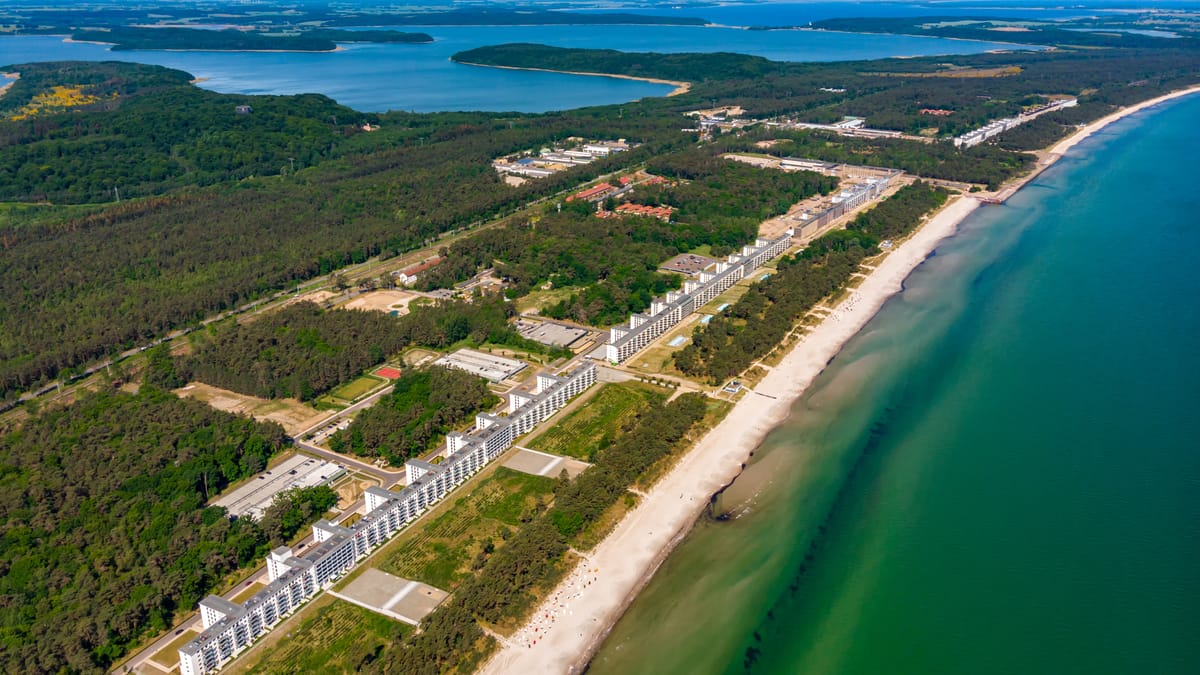
Rising from a thin line of trees, this gray beast is a true colossus—a sprawling leviathan, its spine stretching alongside the Baltic coast for 3 whole kilometers (or 1.8 miles). Clad in concrete, broken down in places, spruced up and renovated in others, it can be a melancholic sight. Just another part-abandoned, graffiti-tagged ruin in a world replete with them.
But this is no ordinary urban wasteland. No ordinary mix of the decaying and the gentrifying.
Rather, this monster is all that remains of a strange vision from the past. A dream hatched in the peak years of Nazi power and intended to project strength and purpose.
Its name is Prora. And it was once intended to be the Third Reich’s largest holiday resort.
Conceived in the mid-1930s as part of the Strength Through Joy program, Prora was envisaged as a place where ordinary German workers could mingle in their thousands—enjoying a form of tourism that had once been the preserve of the middle class.
But there was also a dark side to this dream. A side focused on manipulation, brainwashing, and social control.
Paradise for Pennies
Lying off the northeast coast of Germany—not far from the border with Poland—the island of Rügen is a little slice of Baltic paradise.
Lined with white beaches that lazily hug shores of pine forests, Rügen offers nearly a thousand square kilometers of scenic delights. Delights that long ago turned it into a magnet for tourists.
At the turn of the 19th Century, elites would travel the 200 km here from Berlin: then the beating heart of the German empire.
But while the genteel resort towns they frequented are still worth a look, they’re not what we’re focusing on. Rather, we want to focus on a later addition to this holiday island. An addition as unlike the imperial resorts as an outfit of black shirts and jackboots is unlike Lederhosen.
An addition known colloquially as the Colossus of Prora.
Built by the Nazi Party in the last years before WWII, everything about Prora lives up to its imposing nickname.
The longest building in the world, it originally sprawled over a staggering 4.5 km—or what those who prefer American measurements might call either 2.8 miles, or almost 50 football fields.
Making up this mass were 8 separate blocks, each 500 m long and six storeys high, connected by covered walkways. Made of concrete reinforced by steel, they contained a combined total of 10,000 rooms—all intended for use by package tourists.
But these would be no ordinary tourists. Rather than drunken Brits or loud Americans in cargo shorts, all those who stayed at Prora would be German citizens. Hale and hearty workers drawn from across the nation, bound together by a common thread: enrollment in the Nazi Party program known as Strength Through Joy.
We’ll discuss exactly what Strength Through Joy was shortly. But before we give you the historical context, let’s first spend some time simply gawping at Prora itself.
Because, as you’d expect for a 4.5km building, there’s a LOT to take in.
Let’s start with the rooms themselves—the key reason Prora is as large as it is.
All identically-sized and kitted out with uniform furniture, the heated rooms were the perfect distillation of the coming age of mass-tourism. A factory-made riposte to the grand hotels dotting Rügen’s other towns.
This focus on repetition stretched even to the views. Each room was designed to face the sea, so loyal Germans could drink in the air and be refreshed—a requirement which naturally dictated how long and thin the building had to be.
Not that anyone was expected to simply stay in their room.
Aside from the beach, Prora boasted two vast swimming pools with wave machines, two grand theaters, and a gigantic central hall where Party rallies could be held.
For those who preferred the simpler pleasures, each block hosted its own restaurant, designed to feed 2,500 people at once. And all of this was included in the price.
At just 20 Reichsmarks per week—or about a quarter of the average wage—Prora was designed to be the most-inclusive all-inclusive resort yet seen. Lower-middle and working-class people who’d never before experienced a true vacation could stay here for up to two weeks, surrounded all the while by 20,000 fellow German workers.
There would be communal games. Parades. Daily activities that focused on fitness, discipline, and affection for the fatherland—all part of the Nazi plan to mould ideal citizens. With kindergartens and playgroups onsite, you could even bring your children along for fun and indoctrination.
Nor would Prora be alone in shaping the minds of citizens.
Hitler’s original plan was to build five of these colossuses on the north German coast. Five shining examples of National Socialism’s might and munificence.
Yet, for all that might, this dream would never come to pass.
Of the five planned resorts, only Prora would ever be built. And even Prora would never see a single holidaymaker pass through its doors.
But before we get onto the project’s failure, we first have to turn our attention to something equally interesting: its origins.
Strength Through Joy
If you were a patriotic German worker in the 1930s, chances are you’d have encountered Strength Through Joy.
Known in German as Kraft durch Freude and often abbreviated to KdF, Strength Through Joy was a part of the German Labor Front under Robert Ley—a branch designed to help Germans organize their leisure time.
That meant getting involved with stuff like building Prora. But it also meant doing a lot of other, much-smaller stuff that reached into every corner of people’s non-working lives.
That meant running libraries. Putting on theater shows. Organizing hikes and weekend trips to the countryside.
It meant holding athletics events where people could build camaraderie. Forging links with fascist Italy for cultural exchange programs. It meant even running a line of cruise ships.
Basically, the program was central to the Nazi Party’s conception of a monolithic state. A state which would be looking after—and watching over you—both at work and at rest. A state which would become so all-encompassing that people would learn to love it as surely as Winston Smith learned to love Big Brother.
That meant spies embedded within KdF camps and activities. That meant a subtle yet ever-present focus on Nazi ideology at all these events.
Really, though, we’d be lying if we said the only reason anyone took part in Strength Through Joy programs was Party coercion.
By all accounts, KdF was a popular success.
By 1939, KdF had become the largest tour operator in the world, with upwards of 45 million package holidays and weekend trips sold.
Nearly 10 million Germans were participating in its schemes every year—a huge fraction of the population.
Of course, not everyone could take part in these activities. KdF was an organization as racist and anti-Semitic as the government that controlled it. Non-Aryans were forbidden, and those Germans who did attend came from a self-selecting sample of people with pro-Nazi sympathies.
Still, the numbers were big enough that—in 1935—the decision was taken to branch KdF out. To construct its first holiday resort.
And so the concept of Prora was born.
The opening months of 1936 saw a competition held between 11 regime-approved architects to win the honor of designing both the resort and the giant festival hall.
Judged by Adolf Hitler, the competition saw Clemens Klotz given the prize of designing Prora, while the festival hall went to Erich zu Putlitz. Just like that, work on the Colossus could begin.
The foundation stone was laid on May 2nd, 1936—the third-year anniversary of the deadly Nazi raids on Trade Union headquarters across Germany.
Since Prora was such a major project, the German press turned out in full for the occasion. Robert Ley made a speech, and celebrations were held.
But this was really just the symbolic start. Actual, serious building work wouldn’t begin until April, 1938—almost two years later.
By this time, Prora as a piece of design was already famous. It had won awards at the 1937 World Exhibition in Paris. Become the subject of numerous magazine articles.
Yet, for all the interest surrounding it, Prora would never be completed.
Come summer, 1939, the main bulk of the accommodation was nearing readiness, and work on the giant festival hall was well underway. Given just a few more months, it seems likely Prora would’ve been in good enough shape to welcome its first visitors.
But that moment would never come. Because, on September 1, 1939, something would happen that diverted men and materials away from the construction site. Something that would suddenly see Nazi high command occupied with much more important things than the building of a holiday resort.
We’re talking, of course, about the outbreak of war.
Life During Wartime
As German tanks poured over Poland’s borders, Prora was on the cusp of completion. Its skeletal structure sheltered by a roof, but lacking any windows to keep the elements out, or fittings to give it a sense of homeliness.
For a short while, an effort was made to complete the project—possibly in the naive belief that the war would soon be over.
With the construction companies rediverted to feed the Nazi war machine, Polish POWs were brought in as slave labor to work the site. Toiling away in all weathers as icy winds whipped in off the Baltic Sea.
By the time they’d finished, any illusions that Prora could fulfill its function as a holiday resort had been shattered.
For the next five years, this concrete behemoth would be subsumed entirely into Hitler’s plans of conquest.
Initially, that meant functioning as a training ground for special units of the Reich’s police forces—units that would be sent eastward into occupied territory. Six battalions were trained up in Prora between 1940 and 1942.
But that wasn’t the resort’s only function. Across the War, it would play all sorts of ever-shifting roles.
There was the period Prora spent under the control of Naval intelligence, training up new recruits to serve in the war at sea. The period, too, when the war began to turn and German casualties build up, that saw it transformed into a makeshift hospital.
Finally, and perhaps most-aptly, there was the form it took in the last months of fighting, as the Red Army closed in from the east, and the Allies pushed on from the west and south. As tens of thousands of traumatized and fleeing Germans raced for the protective embrace of their fatherland.
That’s right: Prora ended the War as a refugee camp.
In this way, we can trace the fortunes of Nazi Germany over six short years, just by looking at this one unfinished structure. From 1939’s confident, chest-thumping swagger of a nation on the move, to 1945’s shellshocked, traumatized country of displaced peoples.
When Hitler finally did the decent thing and shot himself on April 30, 1945, it marked not just the end of the Nazis’ bloodthirsty, genocidal dream, but also the end of Prora as a point of pride.
Instead, it would now become a near-indestructible reminder of Germany’s shame.
Still, that doesn’t mean it would be entirely abandoned.
As a giant building ready-made to house 20,000 people, Prora was simply too useful for anyone to suggest demolishing it.
The first people billeted there as the Third Reich collapsed were the Soviet soldiers who had newly-occupied Germany’s east and needed a place to stay.
As WWII began to recede and the occupation turned into the establishment of Communist-aligned East Germany, those Red Army troops were replaced by members of the GDR’s own armed forces.
Incidentally, it’s thanks to these guys that modern Prora is only 3 km long, instead of 4.5. During training exercises with the Soviet troops, whole blocks were used for target practice and destroyed.
Yet it wouldn’t be as a barracks or a training ground that Prora would find infamy in the GDR.
Rather, it would be thanks to the next set of guys to take it over: the Stasi.
East Germany’s feared secret police, the Stasi had Prora scrubbed from official maps. Barbed wire was strung along the beach. Armed guards patrolled the perimeter.
And so the former resort began to vanish from memory. No longer part of the German story, but a secretive place, hidden from public view.
Unless, that is, you were a construction soldier.
East Germany’s term for a conscientious objector, construction soldiers were young men who’d been conscripted into the army but refused to serve combat roles.
While this was illegal in most Communist states, the GDR made an exception, allowing them to instead work on construction projects—hence the name.
One of those projects, in the 1980s, was the Mukran Port near the town of Sassnitz on Rügen island. And what better place to house thousands of conscripted workers than a giant former tourist resort?
In these subtle ways over the decades, Prora stopped being just a part of Nazi history, and began to likewise entwine itself with that of East Germany.
Not that the GDR would be around much longer.
By the late 1980s, Prora was already preparing for its last stop on the train ride of history. The stop marked: Modern Germany.
Modern Times
The Fall of the Berlin Wall upended things for just about everyone in East Germany.
In the blink of an eye, decades of Communism evaporated, an international border was swept away, and—on October 3, 1990—the two Germanys officially merged back into one.
Amid such high political drama, it would’ve been crazy if Prora hadn’t been affected.
Yet the resort was more than just impacted by these events. It was nearly ended by them.
With the extinction of East Germany, there was no longer any need for the Stasi or a GDR army. In 1991, Prora was handed over to the Bundeswehr for decommissioning—a process that only took a few months.
That done, the Bundeswehr too left Prora. And, just like that, the structure was abandoned.
And that was it for the next three years. Three years in which Prora reappeared on maps, just as the building itself was returning to nature.
Indeed, the old resort came close to demolition. But a 1994 designation as a protected national monument saved it from this fate.
Yet, with a background associated with not just the Nazis but also the Stasi, it was clear that—while demolition may not be an option—neither was reconstruction.
Come the dawn of the 21st Century, the listed hulk known as Prora was mostly in ruins.
The windows had broken. The concrete cracked. Graffiti proliferated on every surface.
Even though investment company Binzprora would buy up the whole of Block III in 2005 for €350,000, no work would take place. It was just too controversial. Too like ripping a sticking plaster off a still-healing wound.
So the place simply sank into disrepair. Unloved. Semi-forgotten. A sad ghost from Germany’s haunted past.
But this wouldn’t be the end of the story.
As the 21st Century entered its second decade, the taboo surrounding Prora seems to have… well, not broken, exactly. More started to bend—softly at first, then increasingly.
2011, for example, saw the arrival of a 400-bed youth hostel, one equipped with both a disco and a small museum on Prora’s history.
Initially, the hostel’s opening caused a flurry of controversy. There was plenty of hand-wringing about young people partying in an old Nazi structure—something that only increased as the far-right began celebrating Prora becoming the holiday destination Hitler had wanted it to be.
Yet the controversy didn’t last. And, by 2016, Prora’s real estate had become desirable enough that upscale competitors to the hostel began opening. Two chic spa hotels that turned the original KdF concept on its head, marketing themselves to well-heeled travelers in need of an exclusive retreat.
And it’s here, finally—in the shadow of gentrification—that Prora’s story truly ends.
Today, the Colossus of Prora is an odd place: a mix of party hostels and designer hotels. Of luxury apartments and blocks that remain abandoned and broken, their empty rooms blasted by the frigid sea breeze.
While some in Germany still worry that Prora’s history is getting lost amid this transformation, there are few serious calls to stop development. After all, this is desirable land in a picturesque location.
Still, even as Prora slowly completes its transformation into respectable holiday destination, it’s important that we don’t lose sight of its history.
Here, a microcosm of eastern Germany’s 20th Century played out. A play that began with the Nazis and WWII, swept across decades of Communist repression… and finally ended on the shores of modern German capitalism.
It’s been a crazy ride. A reminder that—for all its slightly-dull reputation today—Germany has historically had a wild time.
We can only hope that, for now, that time has ended. That the future of Germany is like that of modern Prora: a shining utopia, built on the wreckage of a totalitarian past.
Key Takeaways
- Prora was a massive holiday resort built by the Nazis on the German island of Rügen.
- The resort was part of the Strength Through Joy program, aiming to indoctrinate German workers.
- Construction began in 1936, but the outbreak of WWII halted completion and shifted its use.
- Post-war, Prora served various roles, including a refugee camp and Stasi headquarters.
- Today, Prora is a mix of abandoned ruins and renovated hotels, sparking debate on its history.
Simon Whistler
Simon Whistler hosts MegaProjects, bringing engineering, infrastructure, and military-machine stories into clear narrative focus for viewers who want the systems, tradeoffs, and human decisions behind the build.
Frequently Asked Questions
What is the Colossus of Prora?
The Colossus of Prora is a massive, partially abandoned holiday resort located on the eastern shores of the German island of Rugen. It was intended to be the Third Reich’s largest holiday resort, stretching 3 kilometers along the Baltic coast.
What was the original purpose of Prora?
Prora was conceived in the mid-1930s as part of the Strength Through Joy program. It was intended to be a place where ordinary German workers could enjoy a form of tourism that had once been the preserve of the middle class.
How large was Prora originally planned to be?
Prora was originally planned to be 4.5 kilometers long, making it the longest building in the world at the time. It consisted of 8 separate blocks, each 500 meters long and six stories high, connected by covered walkways.
What was the Strength Through Joy program?
Strength Through Joy, known in German as Kraft durch Freude (KdF), was a part of the German Labor Front designed to help Germans organize their leisure time. It included activities like building Prora, running libraries, organizing hikes, and holding athletics events.
Why was Prora never completed?
Prora was never completed because the outbreak of World War II in 1939 diverted men and materials away from the construction site. The project was abandoned as the Nazi regime focused on the war effort.
What happened to Prora during World War II?
During World War II, Prora was used for various purposes, including training grounds for special units of the Reich’s police forces, a naval intelligence training site, a makeshift hospital, and eventually a refugee camp as the war ended.
What was Prora used for after World War II?
After World War II, Prora was used by Soviet soldiers, members of the GDR’s armed forces, and later by the Stasi for secretive purposes. It was also used to house construction soldiers working on nearby projects.
What is the current state of Prora?
Today, Prora is a mix of party hostels, designer hotels, luxury apartments, and abandoned blocks. It has become a desirable holiday destination, but efforts are made to preserve its historical significance.
What is the historical significance of Prora?
Prora serves as a microcosm of eastern Germany’s 20th-century history, reflecting the transitions from Nazi rule, through Communist repression, to modern German capitalism.
What controversies surround the modern use of Prora?
The modern use of Prora has sparked controversies, particularly with the opening of a youth hostel in 2011. There were concerns about young people partying in an old Nazi structure, and far-right groups celebrating it as a holiday destination.
Sources
- Original MegaProjects video: Colossus of Prora The Third Reichs Massive Holiday Resort
- http://www.proradok.de/en/historical-place/
- https://www.ft.com/content/1b3c2a6f-4c62-4072-898f-d483ce224726
- https://www.uncubemagazine.com/magazine-14-10751259#!/page48
- https://www.historyhit.com/tourism-and-leisure-in-nazi-germany/
- https://www.npr.org/sections/nprberlinblog/2011/07/20/138163279/the-colossus-of-prora-sandy-beach-vacation-or-history-lesson
- Hero image source by Ralf Roletschek / openverse, by-sa.