
Stealth aircraft like the B-2 Spirit and the F-22 Raptor are famous for their ability to slip undetected past enemy radar and deliver devastating payloads to unsuspecting targets; however, the amount of technology that is used to make them so effective obviously did not come about by chance. They are the result of decades upon decades of research, prototyping, advanced computer-generated modeling, and, of course, trial-and-error.
Behind them, you will see hundreds—if not thousands—of different ventures into the world of stealth technology by dozens of companies. Today we’ll be looking at one of the more unique aircraft that was instrumental in testing what was, at the time, breakthrough technology that had the potential to alter the way planes are designed and built: The Boeing Bird of Prey.
Development and Design
The Boeing Bird of Prey, also known as the YF-118G, was a predecessor to certain aircraft that use active camouflage technology to disguise themselves from enemy radar. With active camouflage, the craft’s surface color and brightness were able to shift to match its surroundings, thus making it nearly invisible to the naked eye. But the Bird of Prey’s stealth capabilities were not what made it unique as there were several other planes testing similar techniques around the same time.
Instead, it was the craft’s single-piece, composite construction and the way in which it was designed that set it apart. Using a newly developed, computerized schematics program, the Bird of Prey was designed by computers and assembled using disposable tooling. It was a proof-of-concept for using computer generated graphic designs to model effective planes on a scale that had never been attempted.
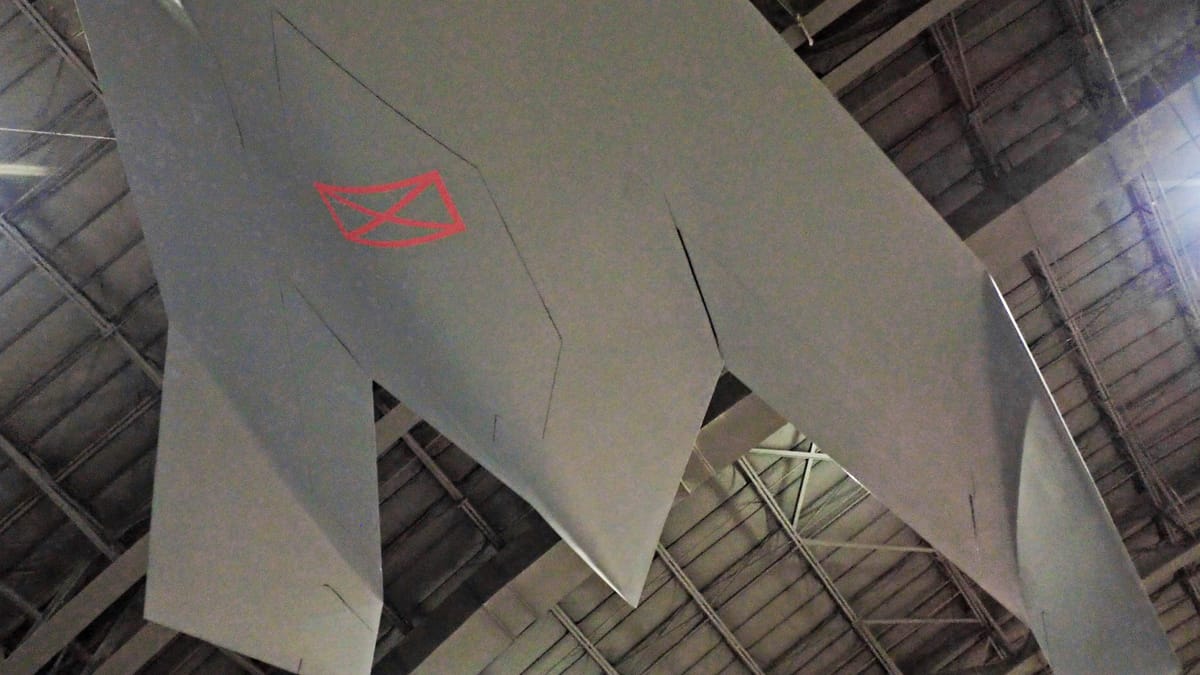
Development for the Bird of Prey was started in 1992 by the Boeing Phantom Works division at the infamous Area 51. It was one of many highly classified Black Projects funded by the US government, and if you have ever been curious as to why rumors involving alien activity at Area 51 have persisted for so long, it’s because of secret projects like this one. Aircraft such as the F-117 Nighthawk, the U-2 Dragon Lady, and many others with nonstandard designs, were tested over the now-famous base which resulted in its extraterrestrial reputation. Most of the designs tested looked nothing like a standard American aircraft, and the arrowhead shape of the Bird of Prey was no exception. In fact, the reason that it is called the Bird of Prey is because it bears a resemblance to the Klingon Bird of Prey from Star Trek.
Its budget was a mere $67 million, which when compared to something like the Northrop Grumman B-2 Spirit, which cost roughly $929 million each in 1997, is extraordinarily cheap. One of the primary reasons for its relatively low price was the fact that it used many off-the-shelf parts that would have eventually been upgraded to proprietary ones, had the aircraft been selected for active use. But as I said, this would never happen because it was not designed for large-scale production, but as a technology demonstrator. It used a generic turbofan engine, all manual controls, and an adapted landing gear from a Beech King Air.
After going through several new revisions, the final design had a wingspan just shy of 23 feet, a length of about 47 feet, and weighed 7,400 pounds (about 3,356 kg). Its cockpit had room for a single pilot, and sitting behind that cockpit, a small, triangular intake provided air for a Pratt & Whitney Canada JT15D-5C engine. This single engine allowed it to reach speeds of up to 260 knots (or 299 MPH). Its maximum altitude was approximately 20,000 feet, and it possessed no tailplane or horizontal rudder of any kind, instead opting to rely on drag rudders for yaw control.
Taking Flight
The Bird of Prey’s first successful flight took place in 1996. Because, as I mentioned earlier, the controls were entirely manual, it had to be flown without the use of computer-assisted stabilization software. To make this task easier, engineers took advantage of chines—the flat-looking, sharpened-edge shape that we often associate with stealth aircraft to this day. These chines provided additional stability at lower speeds while also mitigating reflections that can be picked up by enemy radar.
To understand what made the Bird of Prey unique, you need to first understand how radar works and how stealth planes are normally built. Longtime viewers of this channel are probably familiar, but if you aren’t, allow me to give you a quick rundown:
Keeping things as simple as possible, radar technology works by transmitting short bursts of electromagnetic waves into the air. If a plane occupies the airspace that is being monitored, the body of the plane will reflect these waves back toward the radar, which can then be detected by a receiver. Based on how much of that signal is returned and detected, the radar software can quickly determine a rough estimation of the size of what reflected it.
Stealth aircraft seek to cut down on the number of returned electromagnetic waves by redirecting them in a safe direction where they cannot be detected. That’s why the shape of a stealth plane is so important. Some of them do this so well that when the waves hit them just right, they appear no larger than a bird. However, it’s not just the shape.
Every part of a stealth plane has the potential to reflect electromagnetic waves. Ridges and points of contact where panels connect to one another are notorious for this as they interfere with the otherwise smooth surface.
This is where the Bird of Prey was most unique. Its body was constructed from a single piece of material. It had no ridges, meaning it was even less likely to ping a radar. In the few places where the aircraft was joined together, special sealing treatment was used that would also prevent detection. In addition to that, the only service panels on the entire body of the craft were located inside the landing-gear wells where they too would be safe from radar.
This single-piece composite structure, as it is referred to, is difficult to achieve even to this day, but they did it on a small scale in 1996 by using primitive “virtual reality” software that allowed them to design a 3D model of the aircraft before building it.
Declassification
In 1999, after a total of 38 flights, Boeing retired the project; its research was done. Three years later, in 2002, it was declassified and given the designation Boeing YF-118G; however, most people who know of it continue to use its much catchier moniker. Only one prototype was ever built, and it is now housed within the United States Air Force Museum just outside of Dayton, Ohio.
Today, the US Military has gotten stealth fighter technology mostly locked down while many smaller countries continue to struggle with it, and this is thanks in no small part to little, unique, nearly forgotten projects like the oddly shaped Boeing Bird of Prey.
Key Takeaways
- The Boeing Bird of Prey was a stealth aircraft prototype developed in the 1990s to test advanced stealth technologies.
- Its unique design featured a single-piece composite structure, reducing radar detection by eliminating ridges and seams.
- The aircraft was designed using early computer-generated modeling and assembled with disposable tooling, pioneering new methods.
- Developed at Area 51, the Bird of Prey contributed to the base’s reputation for testing unconventional aircraft designs.
- The project was retired after 38 flights in 1999 and declassified in 2002, with the prototype now in the Air Force Museum.

Simon Whistler
Simon Whistler hosts MegaProjects, bringing engineering, infrastructure, and military-machine stories into clear narrative focus for viewers who want the systems, tradeoffs, and human decisions behind the build.
Frequently Asked Questions
What is the Boeing Bird of Prey?
The Boeing Bird of Prey, also known as the YF-118G, was a stealth aircraft developed by Boeing Phantom Works. It was a technology demonstrator that tested active camouflage and single-piece composite construction.
What made the Boeing Bird of Prey unique?
The Bird of Prey was unique due to its single-piece, composite construction and the use of computer-generated graphic designs for modeling. It also featured manual controls and off-the-shelf parts.
When and where was the Boeing Bird of Prey developed?
Development for the Bird of Prey started in 1992 by the Boeing Phantom Works division at Area 51.
What was the budget for the Boeing Bird of Prey?
The budget for the Boeing Bird of Prey was $67 million, which was relatively low compared to other stealth aircraft of the time.
What were the dimensions and specifications of the Boeing Bird of Prey?
The Bird of Prey had a wingspan of just shy of 23 feet, a length of about 47 feet, and weighed 7,400 pounds. It could reach speeds of up to 260 knots and a maximum altitude of approximately 20,000 feet.
When did the Boeing Bird of Prey have its first successful flight?
The Bird of Prey’s first successful flight took place in 1996.
How did the Boeing Bird of Prey achieve stealth capabilities?
The Bird of Prey achieved stealth capabilities through its single-piece composite structure, which had no ridges or points of contact that could reflect electromagnetic waves. It also used special sealing treatments and chines for stability and radar mitigation.
What happened to the Boeing Bird of Prey after its retirement?
After a total of 38 flights, the Bird of Prey was retired in 1999. It was declassified in 2002 and is now housed within the United States Air Force Museum in Dayton, Ohio.
What was the significance of the Boeing Bird of Prey in stealth technology?
The Bird of Prey was significant in testing breakthrough technology that had the potential to alter the way planes are designed and built. Its research contributed to the advancement of stealth fighter technology.
Why is the Boeing Bird of Prey called the Bird of Prey?
The Bird of Prey is called so because it bears a resemblance to the Klingon Bird of Prey from Star Trek.
Sources
- Original MegaProjects video: The Boeing Bird of Prey
- Hero image source by James St. John / openverse, by.