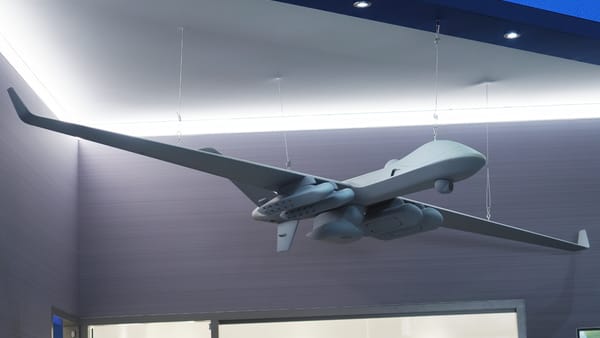


It’s one of the great predators of the sky. A gray-winged angel of death, gliding over the modern battlefield.
On paper, the Bayraktar TB2 may not seem particularly impressive. A Turkish-manufactured drone (or UAV), it’s about the size and shape of a crop duster, with top speeds to match. Although armed with four laser-guided bombs, it seems like the sort of thing any halfway competent military should be able to knock out of the sky with ease.
And yet—somehow—this doesn’t happen. Or at least it happens rarely enough that the remaining drones are still able to find their targets.
When they do, it’s game over for whatever happens to be in their way.
Intensely lethal, TB2s have played pivotal roles in multiple recent conflicts. In Nagorno-Karabakh, they allowed the Azeris to claim victory. In Ethiopia, they stopped Tigrayan forces from reaching the capital. In the early days of the Ukraine War, they helped unleash chaos on Russia’s ill-prepared troops.
How is this possible? How is it that these budget drones—the UAV equivalent of Ryanair—are able to dominate the modern battlefield?
The Budget Predator
At first glance, it looks like little more than a small, gray airplane. The sort of one-propeller thing you might see floating over the crop fields of the Midwest.
But this is no ordinary light plane. It’s an unmanned aerial vehicle (or UAV). Specifically, a “Medium Altitude Long Endurance Tactical” UAV armed with laser-guided bombs.
And while it may pale in comparison beside sophisticated American drones like the Predator or Reaper, the Bayraktar TB2 is no poor man’s knock-off.
Since 2016, it has been influencing the outcome of conflicts across the globe.
According to the manufacturer, there are currently 257 TB2s in operation worldwide. Most are owned by Turkey, Qatar, Ukraine, and Azerbaijan, but other nations have put in orders too.
Right now, Poland has a contract to purchase 24 of them. Romania is buying 18, Morocco 13, Niger at least six, Kosovo five—and then a whole bunch of nations, from Albania to Burkina Faso, have placed smaller orders for just three.
What’s driving these nations—from Europe, to Africa, to Asia—to splurge on this one drone is a combination of things. Fears of missing out on a technological breakthrough. The bad record of Chinese-made UAVs, particularly in Africa.
But a big part of it is surely the TB2’s impressive history.
Open-source intelligence blog Oryx lists 913 confirmed targets destroyed by Bayraktar TB2s in the seven years they’ve been militarily active. This includes in conflicts ranging from the Middle East, to the Caucuses, to West Africa, to the battlefields of Ukraine.
Undoubtedly, that number will soon skyrocket. Unlike the United States, Turkey attaches no conditions to those it sells drones to. That means they could soon be cropping up in conflicts on nearly every continent.
Technical Specifications
Standing at 2.2m with a wingspan of 12m (or 39 ft), the first thing to note about the TB2 is that it’s relatively small. Only slightly over half the size of American Reaper drones.
That means it can be easily transported on the back of a regular truck. Not that owners have to get too close to the frontlines to launch.
With a communication range of 300 km—or nearly 190 miles—TB2s can stay aloft for a maximum of 27 hours and 3 minutes. Cruising at 128 km/h a full seven and a half thousand meters above the Earth.
That’s just cruising speed, though. If necessary, these UAVs can accelerate to 222 km/h—equivalent to 120 knots.
Again, this is nothing compared to what a top of the range US military drone can achieve. But, then, that’s sort of the point.
Compared to other UAVs on the market, the TB2 is intended to be the budget option. The Walmart of unmanned flying death machines.
According to a New Yorker profile of the drone’s creator, TB2s “are sold as a ‘platform,’ along with portable command stations and communications equipment.”
The same piece went on to note that a typical price might be that paid by Ukraine in 2019: sixty-nine million dollars for six TB2s, plus command stations, training, and servicing.
Now, $69m is obviously a ton of money. The sort of money most of us will never see in our lifetimes.
For a national military, though, it represents a bargain. Buying half a dozen Reaper drones will set you back almost six times as much—and you’ll have to be on Uncle Sam’s “nice” list to even make an offer.
Turkey, meanwhile, will sell drones to just about anyone. Sometimes with a steep discount, if—like Nigeria—you’ve got minerals Ankara is desperate to get its hands on.
In return, buyers get one of the most terrifying things to ever grace the sky.
Death From Above
One of the weirdest things about the Bayraktar TB2 is that it really shouldn’t work at all.
Despite its top speed of 222 km/h, the craft’s regular cruise speed is significantly slower. So slow that “lumbering” is an adjective frequently used to describe it.
Nor does its maximum altitude compare to an American Reaper, which can reach 15,000m (or around 50,000 ft).
And that should be a problem. Because drones have been around for so long now, most militaries have countermeasures. Not just air defenses, but also jamming and electronic warfare systems.
When the TB2 first appeared on a battlefield—bombing Kurdish militants—experts assumed it was useful for counterinsurgency operations, but would suck in conventional war. Flying so low and so slow that enemies would just blast it out of the sky.
Fast forward seven years, though, and it’s clear this simply doesn’t happen—at least, not on the scale everyone foresaw.
Now, that’s not to say TB2s are never downed by enemy fire. In the Ukraine War alone, Oryx has documented 18 shot down.
Still, the original assumption wasn’t that some TB2s would be shot down in a serious conflict, but all of them.
Instead, the UAV has proven remarkably adept at not just evading advanced air defenses, but destroying them. As Oryx summed it up:
“(TB2s have) successfully combatted systems such as the S-300PS, Buk-M2, Tor-M2 and Pantsir-S1 even when used in conjunction with electronic warfare (EW) systems like the Avtobaza-M, Repellent-1, Borisoglebsk-2 and Groza-S.”
In this, the TB2 is helped by both its weapons, and its software.
On the software side, each UAV contains around 40 computers, all of which receive multiple monthly updates to keep them ahead of improvements to air defenses.
On the weaponry side, the four guided bombs each carries are terrifyingly accurate. In tests in 2015, the bombs were able to hit something the size of a picnic blanket from a distance of 8 km. Nor do they just fly straight there. Each one can change trajectory while in mid-air.
For a budget option, this is really rather nifty. As a consequence of stuff like this, the 43-year-old designer of the TB2—Selçuk Bayraktar—is today something of a celebrity in Turkey.
To be fair, it probably helps that he’s married to the daughter of long-time ruler Recep Tayyip Erdoğan. But at least part of it has to be with the performance of his drone, which has become a major tool of Turkish diplomacy.
Just look at Ukraine. There, the successes of the TB2 in the first few months of the war were so legendary that people wrote folk songs about it. Animals in Kyiv zoo were named Bayraktar in honor of the machine’s designer.
It’s not the only time something similar has happened in the Ukraine War. A giant mural named Saint Javelin likewise appeared in Kyiv, in honor of the anti-tank missile.
Nonetheless, it does speak to the peculiar way people view the TB2. With a combination of awe, affection… and stone-cold fear.
Confirmed Kills
It was April, 2016, when the TB2 hit an important milestone for any weapons platform.
That month, it recorded its first confirmed kill.
The setting was Turkey’s mountainous southeastern region. The context was the ongoing counterinsurgency by the Kurdish separatists PKK against the Turkish state.
Over the course of multiple flights, TB2s used their precision missiles to take out something in the region of 20 PKK leaders, badly damaging the organization—a terror group proscribed by the US, EU, and UK.
By this point, the drone had been in the manufacturing and testing stage for about two years. But its origin could be traced back even further. Perhaps as far back as a decade.
That’s because it was in the mid-2000s that Selçuk Bayraktar’s company, Baykar Defense, began to concentrate on building drones for military purposes.
The original in this category had been something called the Mini UAV.
Rather than an attack drone, the Mini was a simple reconnaissance device. One that weighed under 10 kg, and could stay aloft for slightly more than an hour.
Considering that the first commercial drones were by then already becoming available, this wasn’t super-impressive. Yet it was just the start.
As newer versions of the Mini were made, improving upon the original, it began to work better and better as a spy drone. Eventually, it got so good that Qatar would place an order.
But the real change would be when the company switched its focus from reconnaissance to attack.
Come 2014, the first TB2 prototype was undergoing flight tests, ahead of its modification to start carrying bombs.
In many ways, it was the timing that would make the UAV such a hit.
About 20 years ago, Ankara seems to have realized that its own defense industrial base was sorely lacking, leaving it reliant on allies to provide kit.
What followed was a government drive to grow the local arms industry. In two decades, the sector would grow by a factor of ten, as the Turkish military desperately tried to onshore production of as much stuff as possible.
That meant Baykar Defense was perfectly placed to ride this wave of money, becoming Ankara’s go-to company for UAVs.
And that meant the first TB2s would be ready for the military to use as soon as it needed them.
The same year the UAV scored its first kill against the PKK, ISIS unleashed a wave of terror across Turkey—culminating in a gun and bomb attack on Istanbul airport that killed nearly fifty people.
Shortly after, the first TB2s to run missions outside Turkey’s airspace took to the skies. Their destination? Syria, where the chaos of the civil war had allowed a brutal caliphate to metastasize.
The following years saw the drones rain death down upon Islamic State, just as they had upon the PKK. With brutal efficiency, their guided bombs dispatched jihadists as part of Turkey’s anti-ISIS campaign.
Yet, while the TB2s performed well, it was hard to imagine them doing otherwise.
Like the PKK, ISIS were an irregular group of fighters. One that managed to seize large reserves of gold and weapons, but far from an advanced army.
No, if the TB2 was going to prove itself in battle, it would need to do so against a real military. One backed by a nation state. One fielding anti-aircraft systems designed to knock UAVs out of the sky.
As the 2010s gave way to a new decade, the TB2 would finally get its chance.
Lord of War
To call the relationship between Turkey and Russia “complicated” would be like calling the Hindenburg Disaster “a bit of a bummer.”
While Ankara buys Moscow’s military equipment and nuclear power technology, the two also have a frequently-brutal rivalry that comes from trying to shape themselves as major regional powers.
Famously, this has included backing different sides in multiple wars. Multiple wars in which the TB2 has helped give Turkey’s candidate the necessary edge.
The first major time this happened was across the years 2019–2020.
As the decade of the 2010s closed out, Libyan warlord Khalifa Haftar decided to make a move against the internationally-recognized government in Tripoli.
In this, he was backed by powerful regional allies Egypt and UAE, as well as Vladimir Putin in Moscow. As his Libyan National Army advanced, Haftar must’ve assumed sweet victory was mere days away.
But it wasn’t to be.
While the Russians furnished Haftar with Pantsir-S1 air defense systems, TB2s were still able to attack—ultimately destroying nine of them.
This punched a hole in the LNA’s air defenses, allowing direct attacks on convoys approaching the Libyan capital. Backed up by Turkish warships firing surface-to-air missiles from the Mediterranean, the Tripoli government was eventually able to chase Haftar all the way back to his powerbase in the east of the country.
It was an astonishing victory. One rightly celebrated by the Libyan government.
And while it would be going too far to give the TB2 all the credit, it certainly played a major role in ending Haftar’s offensive.
Just two years later, TB2s would help deliver a similar outcome in a completely different war. This time, the drones helped stop a 2021 advance on the Ethiopian capital of Addis Ababa by the Tigray People’s Liberation Front—perhaps the key battle in the bloody and horrifying Tigray War.
But it would be in a conflict that landed between these two African civil wars that the TB2 really made its name. When it arrived in international consciousness in much the same way as the word “blitzkrieg” did in 1939.
When the TB2 almost single-handedly won Azerbaijan the Second Nagorno-Karabakh War.
The ins and outs of the war are super complicated—involving ethnic Armenians trapped inside Azerbaijan’s borders after the fall of the USSR forging their own breakaway state with Yerevan’s backing.
The important part is that Armenia was backed by Moscow, and operating Russian equipment. Azerbaijan, meanwhile, was backed by Turkey.
And that meant—when war broke out in fall of 2020—that Baku was fielding a fleet of TB2s.
The outcome of the war was perhaps best summed up by Oryx with the following statement:
“In the course of this short but intense conflict, a handful of Azerbaijani Bayraktar TB2 UCAVs essentially broke the back of the Armenian military.”
Their team documented the destruction of 549 ground targets by the drones, ranging from 22 SAM systems, to 126 armored fighting vehicles—a tally that includes 90 T-72 main battle tanks.
A huge part of this was the element of surprise. Analyst Rob Lee has written on how Azerbaijan used its drones to destroy Armenia’s air defenses within hours of the war starting.
But an equally big part was sheer technological superiority.
Despite the size and slowness of the drones, Armenia was unable to shoot most of them down. At times, radar and jamming equipment appeared to fail at its job while within eyesight of TB2s.
By the end of the six-week conflict, things had gotten so bad that Armenian soldiers no longer hid from the UAVs, but simply walked out in the open while keeping a vast distance from comrades. The reasoning being that—since they couldn’t escape the UAVs—they might as well show the operators that they were alone. And, thus, not worth the expense of a missile.
Impressive as the TB2’s record in the conflict was, though, the war was also notable for something else.
As the scale of the UAVs’ successes became apparent, Azerbaijan’s dictator started playing footage of strikes on giant screens in the nation’s capital.
It was perfect foreshadowing of the strange fame the TB2 would achieve in its next great conflict.
Blue and Yellow
The first weeks of the Ukraine War were like a greatest hits replay of everything anyone had ever said about the TB2.
As the first missiles crashed into Kyiv on February 24, 2022, analysts and experts lined up to declare that the lumbering Turkish drones would be unable to match the firepower of Russia’s forces. That, within hours, all 20 UAVs that Ukraine had purchased would be destroyed.
Of course, many of these were the same people who said that Ukraine would fall within 72 hours. Who assured us that there was literally no way Moscow’s military could fail.
So, you can probably guess how their TB2 prediction went.
What followed were several weeks in which the UAVs seemed to repeat their successes from Libya, Ethiopia, and Nagorno-Karabakh. Flying low, evading radar, and only appearing to strike Russian air defenses or advancing columns.
At one point, things got so bad that the Russian ambassador in Ankara felt compelled to lash out against Turkey’s government, declaring:
“Explanations like ‘business is business’ won’t work, since your drones are killing our soldiers.”
The weirdest part? Russia knew Kyiv had access to these UAVs. Prior to the full-scale invasion of Ukraine, it had spent months training pilots to knock them out of the sky.
And now here they were: blowing up Russian trucks. Killing Russian soldiers. All while the Kremlin flailed around, unable to stop the carnage.
For Ukrainians, the drone’s effectiveness turned the TB2 into a legend.
In this era, in the early days of the war, the sight of TB2s annihilating Russian convoys was a source of hope. Something residents of Kyiv could take comfort in as they waited in air raid shelters for the missiles to stop falling.
This was when folk songs began to be written about the UAV. When zoo animals and pets were named Bayraktar.
There was even a concerted campaign in neighboring Lithuania to raise five million euros to buy Ukraine an extra TB2. When the money was raised in just three days, the manufacturer waived the fee and sent the drone to Kyiv for free.
Spectacular as all this was, though, it didn’t alter the main, fundamental rule of war.
No matter how great a technological leap, a well-funded army will eventually find a way to counter it.
Today, deep into the Ukraine War’s second year, we no longer hear so much about the role of TB2s.
Partially, that’s because the nature of the war has shifted—from a hurried defense against rolling columns of armor; to grinding advances and trench warfare reminiscent of WWI. From combat on fields and roads, to close-quarters urban fighting.
Partially, though, it’s also because Moscow’s abilities at jamming and electronic warfare have dramatically improved. Although there remains a place for larger combat drones, they are no longer as effective as they once were.
Even in retrospect, the role of TB2s in the opening days of the war is no longer seen in quite the same light.
Whereas videos on Twitter and TikTok in early 2022 focused on the damage done to Russia’s forces by drones, Javelin missiles, and NLAWs, the 2023 assessment is that it was good old-fashioned artillery that saved Kyiv from conquest.
The Future of Automated Warfare
Still, that doesn’t mean the story of the TB2 is over.
As you read this, countries all around the world are scrambling to buy this sky-based killing machine. To prepare themselves for the future of combat in a world where war will only become ever-more automated.
That means the next few years should feature more conflicts where this ingenious, budget UAV stalks through the skies, looking for prey. A UAV that can tilt the balance of power away from an expected victor.
There’s no doubt that, eventually, the TB2 will become outmoded. Replaced by better models, as happens to all kit.
For now, though, it remains a fascinating, deadly weapon. A new kind of platform, driving innovations in a whole new kind of warfare.
Where that will lead the militaries of the world next is something we shall have to wait to find out.
Key Takeaways
- The Bayraktar TB2 drone has played pivotal roles in multiple recent conflicts, including Nagorno-Karabakh, Ethiopia, and Ukraine.
- Despite its modest size and speed, the TB2 has proven effective in evading and destroying advanced air defenses.
- The TB2’s success is attributed to its precise laser-guided bombs and frequent software updates, keeping it ahead of countermeasures.
- Turkey’s willingness to sell TB2s to various countries, without conditions, has led to its widespread use in conflicts globally.
- The TB2’s impact has been significant in shifting power dynamics, but advancements in jamming and electronic warfare are reducing its effectiveness.

Simon Whistler
Simon Whistler hosts MegaProjects, bringing engineering, infrastructure, and military-machine stories into clear narrative focus for viewers who want the systems, tradeoffs, and human decisions behind the build.
Frequently Asked Questions
What is the Bayraktar TB2?
The Bayraktar TB2 is a Turkish-manufactured drone, or UAV, about the size and shape of a crop duster. It is armed with four laser-guided bombs and has played pivotal roles in multiple recent conflicts.
How many Bayraktar TB2 drones are currently in operation worldwide?
There are currently 257 TB2s in operation worldwide, with most owned by Turkey, Qatar, Ukraine, and Azerbaijan.
What are some of the conflicts where the Bayraktar TB2 has been used?
The TB2 has been used in conflicts in Nagorno-Karabakh, Ethiopia, Libya, the Tigray War, and the Ukraine War, among others.
What makes the Bayraktar TB2 effective in combat?
The TB2’s effectiveness comes from its software, which receives multiple monthly updates, and its guided bombs, which are highly accurate and can change trajectory in mid-air.
How does the Bayraktar TB2 compare to American drones like the Predator or Reaper?
The TB2 is smaller and less sophisticated than American drones like the Predator or Reaper, but it is designed to be a budget option and has proven effective in various conflicts.
What is the communication range and flight duration of the Bayraktar TB2?
The TB2 has a communication range of 300 km and can stay aloft for a maximum of 27 hours and 3 minutes.
How has the Bayraktar TB2 been received in Ukraine?
In Ukraine, the TB2’s successes in the early days of the war were so legendary that people wrote folk songs about it and named animals in Kyiv zoo after the machine’s designer.
What is the history of the Bayraktar TB2’s development?
The TB2’s development began in the mid-2000s with the Mini UAV, a reconnaissance device. The first TB2 prototype was undergoing flight tests in 2014, and it scored its first kill in April 2016.
How has the Bayraktar TB2 influenced Turkish diplomacy?
The TB2 has become a major tool of Turkish diplomacy, with its successes in conflicts like the Ukraine War leading to increased demand from other nations.
What is the future outlook for the Bayraktar TB2?
The TB2 is expected to continue being used in conflicts around the world as countries scramble to buy this sky-based killing machine, but it will eventually be replaced by better models.
Sources
- Original MegaProjects video: Bayraktar TB2: How Turkey’s Budget Drone Keeps Winning Wars
- https://www.newyorker.com/magazine/2022/05/16/the-turkish-drone-that-changed-the-nature-of-warfare
- https://www.baykartech.com/en/uav/bayraktar-tb2/
- https://www.oryxspioenkop.com/2021/09/the-conqueror-of-karabakh-bayraktar-tb2.html
- https://www.nytimes.com/2022/03/11/us/politics/ukraine-military-drones-russia.html
- https://www.oryxspioenkop.com/2021/12/a-monument-of-victory-bayraktar-tb2.html
- https://www.aljazeera.com/news/2022/7/19/turkish-firm-wont-supply-uavs-widely-used-by-ukraine-to-russia
- https://www.timesaerospace.aero/features/defence/armed-drone-makes-a-huge-impact-in-africa
- https://www.oryxspioenkop.com/2021/11/an-unmanned-interdictor-bayraktar-tb2s.html
- Hero image source by oscepa / openverse, by-sa.