

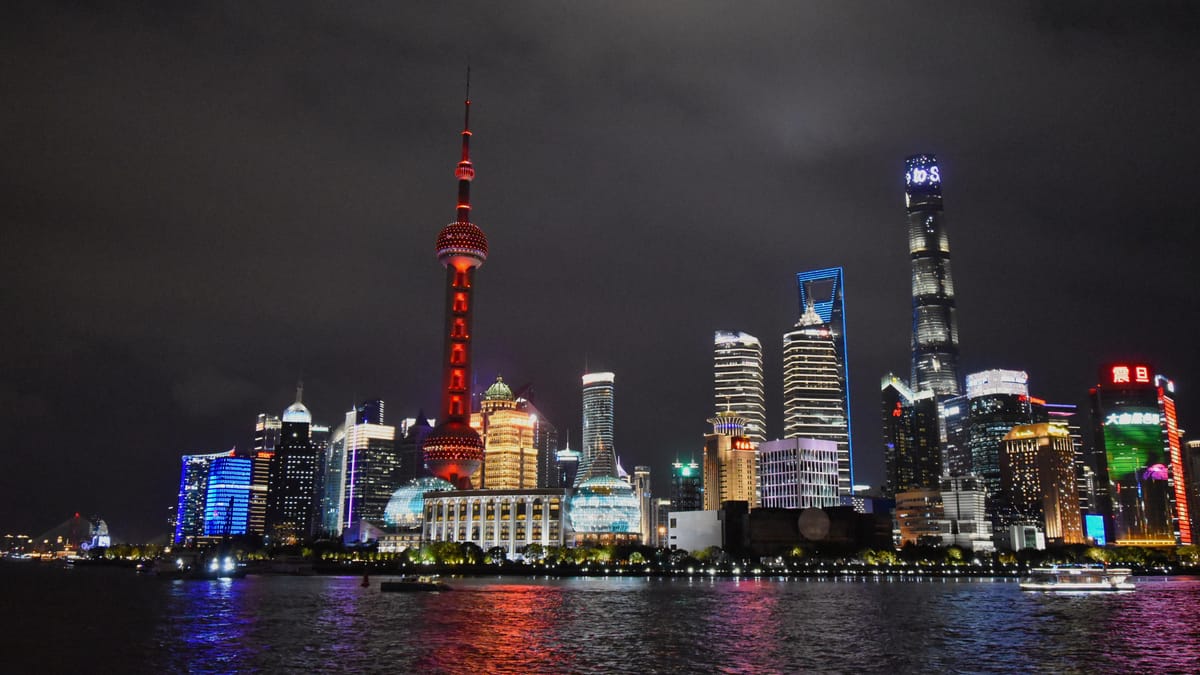
Shanghai Tower looks like the easy part of the story.
It rises from Lujiazui as a 632-meter spiral, the tallest building in China, the second tallest in Asia, and, by the Council on Tall Buildings and Urban Habitat’s current ranking, the third tallest building in the world. It sits beside the Jin Mao Tower and the Shanghai World Financial Center, completing the three-tower skyline that turned Pudong from development zone into postcard.
The more interesting story is that Shanghai Tower was never just a height contest. It was a bet that a megatall skyscraper could be a vertical city: offices, hotel rooms, restaurants, shops, sky gardens, observation decks, and public atria stacked inside a twisting double facade. It was also a bet that enough tenants would pay for the privilege.
- Height
- 632 m / 2,073ft
- Floors
- 128 aboveground
- Completed
- 2015
- Architect
- Gensler
- Rank
- Tallest inChina
- Observation
- 562.1m
The engineering mostly worked. The business case was harder.
The Third Tower in Lujiazui
Lujiazui did not always look inevitable. For much of Shanghai’s modern history, the area east of the Huangpu River was quieter and less developed than the Bund across the water. Beginning in the late 20th century, city planners pushed it toward finance, trade, and spectacle. A new skyline was part of the pitch.
Two anchor towers arrived first. Jin Mao Tower brought a tiered, pagoda-like supertall form to the district. Shanghai World Financial Center followed with the now-famous trapezoid opening near its top. Shanghai Tower was planned as the final and tallest member of the trio.
In 2006, the Shanghai Municipal Government opened an international design process. The brief was uncomfortable in the way serious architecture briefs often are. The tower had to be taller than 600 meters. It had to harmonize with its neighbors without disappearing behind them. It had to survive Shanghai’s soft ground, typhoon winds, seismic risk, and the practical problem of moving thousands of people up and down a building that would function more like a small city than a conventional office block.
Gensler won the design competition. Construction began in November 2008.
Building on Soft Ground
The first major challenge was not the height. It was the ground.
Shanghai sits on the Yangtze River Delta, which makes foundation design for heavy buildings a serious engineering problem. The script for the original MegaProjects video points to the 2009 collapse of a nearby apartment building during separate excavation work as the kind of failure the Shanghai Tower team could not afford even to resemble. That collapse was not caused by Shanghai Tower, but it made the local risk easy to understand: move too much earth, misjudge the soil, or create uneven pressure, and ordinary-looking construction can become catastrophic.
Shanghai Tower’s answer was scale and distribution. CTBUH lists five basement floors and a 128-floor tower above. Architectural Record described the main structural system as a concrete core and composite supercolumns resting on a thick concrete mat and more than a thousand bored piles. The point was not simply to hold the tower up. It was to spread load, limit differential settlement, and keep the building’s enormous mass from behaving badly in soft delta soil.
Once the foundation work was in place, the concrete core rose using a slip-forming process: a moving construction platform that climbs as each new level is poured. The script describes an average pace of roughly one floor every five days. By 2014 the tower had reached its full height. CTBUH records completion in 2015.
The Twist Was Not Just Decoration
Shanghai Tower is famous for its 120-degree twist, but the twist is doing work.
The tower is organized into nine vertical zones. Each zone is slightly rotated from the one below it, giving the building its spiral profile. Gensler describes the result as a vertical city with public spaces, green zones, offices, hotel space, retail, and cultural functions held inside one superstructure.
The shape also helps with wind. CTBUH’s building profile notes that wind tunnel testing confirmed a 24 percent reduction in structural wind loading compared with a rectangular tower of the same height. That is not a minor architectural bonus at 632 meters. Less wind load means less structural material, lower cost, and less movement for the people inside.
The double-skin facade was another major design move. Instead of one glass wall separating office space from the weather, Shanghai Tower wraps an inner building with a second transparent skin. The cavity between them creates atria, gardens, and a thermal buffer. Gensler highlights the double-skin facade, sky gardens, LEED Platinum certification, China’s Three Star green rating, and hundreds of wind turbines as part of the tower’s sustainability package.
That is the ideal version: a megatall building that uses its envelope to save energy, bring in daylight, and make high-rise life less sealed-off and corporate.
The Fast Elevator Problem
A building can be beautiful, but if the elevators fail, the whole idea fails.
Mitsubishi supplied the record-setting vertical transportation technology that made Shanghai Tower usable at visitor scale. Mitsubishi materials describe ultra-high-speed elevators reaching 20.5 meters per second, or roughly 73.8 kilometers per hour. The fastest system could take passengers from the second basement level to the 119th floor in about 53 seconds.
That speed matters because Shanghai Tower is not only an office address. Its observation levels are part of the public attraction. CTBUH lists the observatory height at 562.1 meters, high enough that the elevator ride itself becomes part of the engineering show.
There is a strange intimacy to that detail. The tower is a national-scale symbol and a multi-billion-dollar project, but the visitor experience depends on something simple: step in, doors close, ears pop, city drops away.
The Cost of a Vertical City
The construction cost is usually given in the low billions of U.S. dollars. CTBUH’s 2020 water-leak item cites 14.8 billion yuan, about US$2.1 billion at its conversion. The original script uses an estimate of about US$2.4 billion. Either way, this was not a private vanity tower built on casual optimism. It was a state-backed megaproject meant to prove that Shanghai could build, operate, and fill a new kind of skyscraper.
The early operating story was messier.
Reports in 2017 and 2019 described poor tenant move-in, fire-permit delays, high costs, and whole floors sitting dark. The B1M later summarized the early operating record as low occupancy, noting that the tower had remained half empty until 2018. The script also points to a practical design problem: the tower’s spiraling geometry and double envelope made some floor plates awkward. A facade that produces energy benefits and dramatic public atria can also create corners, edges, and lease areas that are less efficient than tenants expect from premium office space.
That is the uncomfortable tradeoff in Shanghai Tower. The features that made it architecturally interesting also made it more complex to rent, price, furnish, permit, and operate.
The Leak That Became a Symbol
In July 2020, the tower had another public embarrassment. CTBUH reported that videos surfaced after tenants from the 9th to the 60th floors found themselves dealing with leaking water. Shanghai Tower said the incident was caused by equipment failure, that staff began emergency repairs, and that a comprehensive inspection would follow. Some elevators were temporarily shut down.
The incident was real. Some of the social-media panic around it was not. The tower’s management pushed back against unrelated viral videos that appeared to show more dramatic ceiling collapses elsewhere.
That distinction matters. A water leak does not prove a 632-meter tower is structurally fraudulent. But the reason the story spread is obvious. Shanghai Tower had already become a convenient argument about China’s building boom: world-record ambition on the outside, expensive operational headaches inside.
The phrase “tofu-dreg” construction gets used loosely online for shoddy or corrupt building work. Applying it casually to Shanghai Tower is too strong for what the public evidence supports. The better criticism is narrower and more useful: a megatall building can be an engineering triumph and still be financially, operationally, and commercially difficult.
What Changed After the Dark-Floor Years
The story did not end in 2019.
The J Hotel Shanghai Tower opened to the public in 2021, putting a luxury hotel high in the building and giving the upper floors a more visible commercial use. The observation decks remain a major visitor draw. CTBUH’s 2025 recognition of the tower with a 10-Year Award also shows that the architectural profession has not treated Shanghai Tower as a failed building.
That still does not erase the early lesson. Shanghai Tower was designed as a vertical city, not just an object. Objects can succeed by being admired from the Bund. Cities have to work every day.
For a tower like this, success is not only height, awards, or photographs. It is tenant occupancy, elevator reliability, fire permits, maintenance, lease efficiency, visitor flow, hotel demand, and whether the public spaces actually feel public rather than just rendered as public in a competition image.
The Real Megaproject
Shanghai Tower is impressive because it solved several problems that could have killed it. It stands on difficult ground. It handles wind with shape rather than brute force alone. It made a double-skin facade work at a scale where almost nothing is simple. It moves people at absurd speed. It gave Shanghai a skyline marker that is instantly recognizable.
It is also a reminder that megaprojects do not end when construction ends.
The easy version of the story says Shanghai Tower is a symbol of China’s rise. The cynical version says it is a government-funded overreach with empty floors. The more accurate version is less tidy. Shanghai Tower is both a real engineering achievement and a case study in what happens when architecture, economics, urban branding, and daily operations all have to fit inside one twisting shape.
The tower was built to show that Shanghai could reach higher than almost anyone else. It did. The harder question was always whether reaching higher would be enough.
Key Takeaways
-
Shanghai Tower stands 632 meters tall with 128 above-ground floors, making it China’s tallest building and the third tallest building in the world by current CTBUH ranking.
-
Gensler’s design uses nine rotated vertical zones and a 120-degree spiral form; CTBUH notes that wind tunnel testing showed a 24 percent reduction in structural wind loading compared with a rectangular tower of the same height.
-
The tower uses a double-skin facade, atria, sky gardens, LEED Platinum certification, China’s Three Star green rating, and integrated sustainability systems to support the “vertical city” concept.
-
Mitsubishi’s fastest Shanghai Tower elevators reached 20.5 meters per second and could travel from the second basement level to the 119th floor in roughly 53 seconds.
-
Early tenant move-in, fire-permit, floor-efficiency, and vacancy problems made the building’s business case much harder than its skyline image suggested.
-
The 2020 water leak was an operational incident, not proof that the tower was structurally unsound, but it reinforced public doubts about the building’s cost and complexity.

Simon Whistler
Simon Whistler hosts MegaProjects, bringing engineering, infrastructure, and military-machine stories into clear narrative focus for viewers who want the systems, tradeoffs, and human decisions behind the build.
Frequently Asked Questions
How tall is Shanghai Tower?
Shanghai Tower is 632 meters, or 2,073 feet, tall to its architectural top. CTBUH currently ranks it as the tallest building in China, second tallest in Asia, and third tallest in the world.
Is Shanghai Tower still the second tallest building in the world?
No. It held the second-place position for years, but Merdeka 118 in Kuala Lumpur has since moved ahead of it in CTBUH rankings. As of June 6, 2026, Shanghai Tower is third worldwide.
Why does Shanghai Tower twist?
The twist gives the tower its visual identity, but it also reduces wind loading. CTBUH describes wind tunnel tests showing a 24 percent reduction in structural wind loading compared with a rectangular building of the same height.
What is the purpose of the double-skin facade?
The double-skin facade creates a buffer between the inner building and the outside climate. That space helps with energy performance, daylight, atria, gardens, and public zones, but it also contributes to floor-plate complexity.
Did Shanghai Tower have empty floors?
Yes, early reports described major vacancy and move-in problems. The building later gained more visible uses, including the J Hotel Shanghai Tower, but the early vacancy became central to the debate about whether the project was economically justified.
What happened during the 2020 water leak?
CTBUH reported that tenants from the 9th to the 60th floors were affected by leaking water in July 2020. Shanghai Tower said the cause was equipment failure, emergency repairs were made, and inspections followed. Some unrelated viral videos were reportedly misattributed to the tower.
Is Shanghai Tower a failure?
Not in a simple sense. It is an engineering and architectural landmark that still defines Shanghai’s skyline. The fairer judgment is that it succeeded as a symbol and a technical project while exposing how difficult it is to make a megatall vertical city work commercially.
Sources
Related Projects
Japan’s Flood Defences
From Tokyo's underground cathedral of floodwater to the Great Wall of Japan's tsunami defences, discover how Japan out-engineers disaster with some of the most staggering civil engineering projects on Earth.
Pioneering Spirit
Discover the Pioneering Spirit, the biggest, heaviest vehicle ever made. This twin-hulled behemoth can lift 48,000 metric tons and is revolutionizing offshore oil rig installation and removal.
Stad Ship Tunnel
Norway is building the Stad Ship Tunnel, a 1.7-kilometer tunnel beneath a peninsula that will allow cargo ships, ferries, and cruise vessels to bypass the treacherous Stadhavet Sea. Learn about this groundbreaking maritime engineering project.
.jpg)