

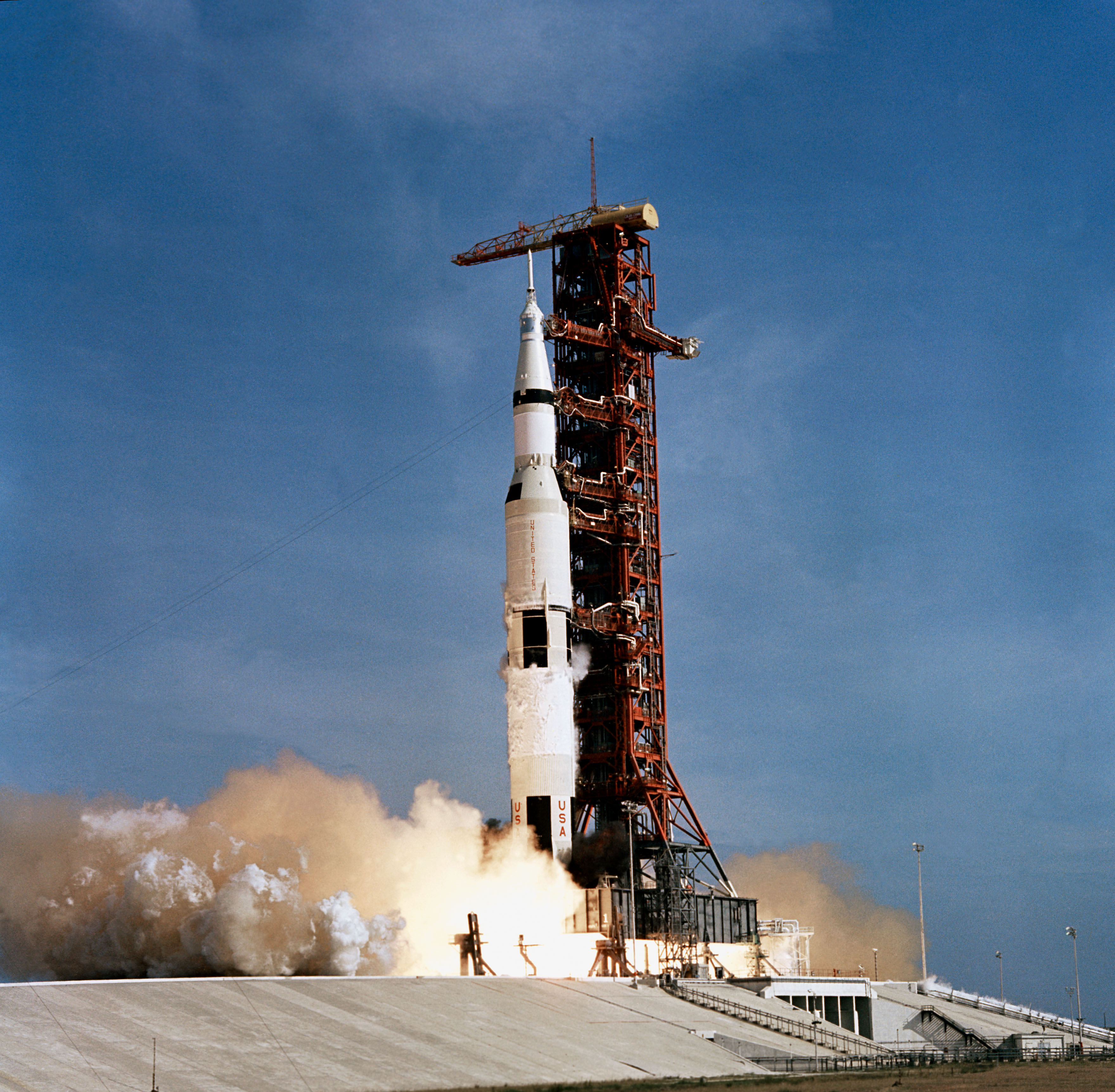
“We choose to go to the Moon in this decade and do the other things, not because they are easy, but because they are hard.” When John F. Kennedy delivered those words as President of the United States in September of 1962, he was making his case to the American public: that it was time for humanity to step foot on the Moon, and time for the United States to be the nation that did it.
It was a mission of incredible ambition, undertaken at incredible risk to the astronauts who chose to take part, and built by a union of some of the most celebrated minds of the era. It was Kennedy’s moonshot, quite literally — one that would place the United States at the forefront of space exploration for decades to come.
This is the story of the Apollo Program: the mission to put a man on the Moon, and bring him home.
- Saturn V height
- 363feet
- Apollo astronauts selected
- 32
- First Moon landing
- July 20, 1969
- Crewed speed record (Apollo 10)
- 24,791mph
- Program cost
- ~$25billion (~$250B today)
- Apollo Moon landings
- 6
A Space Race Comeback
The story of Apollo is one of groundbreaking space exploration, but it’s impossible to tell without first dealing with a far more terrestrial matter: the Cold War. After World War II, both the United States and the Soviet Union set out to prove they were the world’s dominant superpower. Rather than attack each other and destroy the planet with their nuclear arsenals, they engaged in a sort of hypercompetitive chess match — alliances, technological advancement, ever-bigger weapons, and anything else they could turn into a contest — until one side eventually collapsed under the strain.
For the Soviet Union, one of those arenas was space exploration, and they got a head start with the launch of humanity’s first satellite, Sputnik. Sputnik itself didn’t do much, but the fact that the Soviets could put it into orbit signalled two things: that they were ahead of the Americans, and that the same rocket which launched Sputnik would be terrifying with a nuclear warhead strapped to it. Meanwhile, under President Dwight D.
Eisenhower, the United States had treated space rocketry as a strictly military matter — how to put missiles in orbit before dropping them on adversaries — and largely behaved as though the space race didn’t exist. The public perception that America was lagging behind was enough to push the country toward a public space exploration arm of its own.
The answer was a civilian agency: the National Aeronautics and Space Administration, better known as NASA. Its birth came at the right moment to win strong support from Congress and ease the pressure on the U.S. military to start scoring wins in a race it still wouldn’t admit existed. NASA was also finding its footing just as Eisenhower departed and John Fitzgerald Kennedy arrived.
From the campaign trail, Kennedy had emphasized his wish to achieve American superiority over the Soviets in space — and in the tightly related field of missile defense. He called out Eisenhower’s inaction and pledged to make aerospace development a priority, not only for its military benefit but for the prestige it would lend the United States at home and abroad. Despite the big talk, though, Kennedy didn’t hit the ground running on space when he took office.
Luckily for him, NASA was already waiting with a proposal. Drawn up in the waning days of the Eisenhower presidency, the plan was named Apollo, in homage to the Greek god of the Sun. Its objective: to ferry groups of three astronauts into space — first to a space station, then on flights around the Moon, and eventually to a landing on the lunar surface. Apollo had already been announced as an exploratory program, NASA had sketched out how a spacecraft might look, and that October, weeks before Kennedy took office, the government awarded study contracts to several companies.
When Kennedy began poring over the plans, his reaction was skeptical. The program would be bloody expensive, and even if his administration could foot the bill, it demanded a depth of technical understanding he would have to work up to. He didn’t know what he didn’t know — a scary proposition for an incoming president navigating the Cold War. When NASA’s administrators asked for more funding, Kennedy was hesitant, and he seemed unlikely to take the dramatic leaps the public had been hoping for.
That changed on April 12, 1961, when the Soviets did it again. This time it wasn’t a probe but a man — Yuri Gagarin — who went up, orbited the Earth, and came home safely. With another Soviet victory on the board, the Kennedy administration realized it could no longer simply hope the space issue would solve itself. Congress offered immediate support for a crash program, and while Kennedy didn’t take that exact offer, he sent Vice President Lyndon Johnson to find out what NASA could do.
The news Johnson brought back wasn’t what Kennedy wanted to hear. The Soviets had beaten the Americans repeatedly and were too far ahead for a quick reversal. Cheaper, easier milestones — a space station, or flying a probe or even a person around the Moon — weren’t going to upset the balance.
To pull off a comeback, Kennedy would need previously unthinkable levels of investment in one bold solution. By Johnson’s estimate, if Kennedy wanted the biggest comeback on the closest timeline and was willing to spend the taxpayer’s dollars to get it, the target was clear: Americans would have to set foot on the Moon, and they would have to start immediately.
Just over a month later — fresh off Freedom 7, the first American crewed spaceflight — Kennedy announced his proposal in an address to Congress: “I believe that this nation should commit itself to achieving the goal, before this decade is out, of landing a man on the Moon and returning him safely to the Earth.” With a nod to the astronomical costs and the technical difficulties, he made his pitch to a Congress that had been waiting to hear it. The countdown clock had begun, and there was now no way to stop it except to step an American foot onto lunar soil.
To Perform the Impossible
Kennedy’s pledge was a major opportunity for NASA — and it came with inconveniences, not least that NASA did not actually know how to get to the Moon. They had ideas, but at the time of the speech, ideas were all they had.
As NASA worked it out, there were three basic routes. First, they could put a single large spacecraft into Earth orbit, fly it to the Moon, land, take off again, and fly home — but this required rockets the U.S. didn’t have and didn’t expect until at least 1970, beyond Kennedy’s deadline. Second, a spacecraft carrying the crew could reach Earth orbit and dock with a separate propulsion unit launched independently — but two launches sent costs through the roof.
The third option, the one the U.S. chose, used a powerful rocket the country did expect to have: one that could fire directly at the Moon and place a spacecraft on a lunar trajectory. That spacecraft had three sections — a command module where the astronauts sat, a service module holding fuel and power, and a lunar module attached to the nose. On reaching lunar orbit, two of the three astronauts would crawl into the lunar module and descend to the surface, leaving behind the descent stage and lifting off again in the ascent stage to rendezvous with the command and service modules for the journey home.
This lunar-orbit rendezvous approach had key advantages: it was cheaper, needing only one rocket, and it could ditch the lunar module in space rather than carrying it home, meaning less fuel overall. It also notched another first — because the lunar module would begin and end its mission in the vacuum of space without ever touching the atmosphere, the U.S. could claim the first true spaceflight in history.
Settling on an approach was just one of about a million items on NASA’s new to-do list, which grew so long that many employees doubted from the outset that Kennedy’s deadline could be met. NASA threw out the feasibility studies it had commissioned and proceeded with internal designs by engineer Maxime Faget, who had already designed the Mercury spacecraft. North American Aviation — maker of the P-51 Mustang and eventually the B-1 Lancer — was chosen as a manufacturing partner, and money poured in from all sides.
So much money, in fact, that with continued investment, Apollo would constitute the largest peacetime resource allocation by a single nation in world history. With the money came people — hundreds of thousands of them — and the combined might of American industry and academia.
NASA had to upsize itself dramatically. The program moved into a site in Houston, Texas — today the Lyndon B. Johnson Space Center — where NASA would locate all its human spaceflight training, along with a mission control center that took over from Cape Canaveral. The site was completed in 1963, alongside a pair of launch complexes for Saturn I and IB rockets.
In Florida, on Merritt Island, NASA built an even bigger launch site where a launch vehicle and spacecraft could be assembled on premises, then moved by a slow, gargantuan crawler platform to one of two launchpads.
Even with all this, American leaders understood they were still doing the easy part. Far harder were the innumerable technical issues standing between the crew and a safe, survivable mission. Politically, the work was complicated by Jerome Wiesner, Science Advisor to the President, who opposed the chosen launch arrangement and actively undermined the mission.
Technically, the time crunch made everything worse, because any delay on a single element delayed the whole program. NASA had to write software and program it into an onboard guidance computer and a lunar module — groundbreaking at the time — and invent everything from flight-suit components to module and rocket parts. The demands placed on NASA’s researchers, scientists, and private partners were immense.
By 1963, things looked grim. With a solo American Moon mission seeming harder by the day, even JFK appeared to concede defeat. That September he made a forceful appeal to the Soviet Union to combine forces in a joint lunar program — an address before the UN General Assembly, less than a year after the Cuban Missile Crisis, that shows just how dire the situation had become.
The Soviets initially rejected the proposal, though the son of then-Premier Nikita Khrushchev has since said they considered coming to the table afterward. Critics across the federal government were closing in on Apollo, which increasingly looked like a bloated drain on American resources. Kennedy had tried to cope by pushing NASA to drop scientific goals and speed up the timeline, but it was clear that even across two terms, no man would land on the Moon within his presidency — and his successor would likely score political points by cancelling the project.
Then everything changed. Just after noon on November 22, 1963, John F. Kennedy was assassinated in Dallas, Texas. Lyndon Johnson assumed the presidency, and Johnson — long an Apollo proponent — adopted the mission as a national tribute to Kennedy’s legacy.
Cape Canaveral was renamed Cape Kennedy, and the program’s value to the American consciousness rose sharply. In his first budget proposal, Johnson slashed funding for defense, agriculture, and more, yet allocated more to NASA than ever before, and a grieving Congress agreed. In a tragic twist of fate, Kennedy’s own death shielded Apollo from future political opposition and recommitted a once-skeptical public to the dream of landing a man on the Moon.
The Spacecraft and the Astronauts
The mid-1960s were a renaissance for American aerospace design. The demands of Apollo forced a level of collaborative innovation not seen since the later years of World War II, and the spacecraft, launch vehicles, and lunar modules all had to be designed from the ground up.
First was the Apollo spacecraft itself. On its nose sat the command module, a conical design just big enough for three suited astronauts. With a dry weight of about 11,000 pounds and twelve reaction-control motors, it was the only part of the spacecraft built to return to Earth. It held a pressurized cabin where astronauts could remove their helmets, the instrument panel they would fly with, guidance and navigation systems, a communications array, batteries, and a computer that handled some tasks autonomously. It had five windows, a docking hatch, a side hatch, and storage for food and water — plus a heat shield and parachutes for atmospheric reentry.
Behind it was the service module, an unpressurized compartment housing its own propulsion engine. This engine did the bulk of the work getting Apollo in and out of lunar orbit, with 22,000 pounds of thrust on the main engine and sixteen reaction-control motors. From its dock with the command module to the rear of its engine, it measured about 22 and a half feet — just large enough for fuel cells, radiators, oxygen stores, and a directional antenna. Critically, the engine was built to restart, so it could be shut down in lunar orbit to conserve fuel. It stayed with the command module until just before reentry, when it was jettisoned.
Finally there was the lunar module, a separate vehicle unlike anything humans had designed before. Built in a spider-like form — with what we’ll colloquially call a head, abdomen, and legs — it was made for sustained operation on the surface. It had a descent stage, left behind on the Moon, and an ascent stage, which would ascend. The descent stage carried landing gear, surface-mapping radar, a propulsion system that could fire in reverse to prevent a crash, and just enough fuel to land safely, plus cargo compartments for experiments, a television camera, sample boxes, and tools. The ascent stage held a crew cabin, instrument panels, a docking port, guidance, radar, communications, and just enough fuel to power a second rocket engine for the rendezvous with the command capsule.
The three-part spacecraft was connected by the spacecraft-lunar module adapter, a conical structure holding the lunar module inside. Its narrow top connected to the service module and its wider bottom to the rest of the rocket. Once in the vacuum of space — where the awkward lander created no drag — the adapter opened outward in a flower-petal design. Built less than two inches thick and coated in cork and paint to resist overheating, it was controlled by the astronauts in the command capsule. If those controls failed, explosive charges would separate it by force, because failure to do so would leave the crew stranded in Earth orbit with no rescue coming.
Atop the command capsule sat the launch escape system, a smaller rocket designed to pull the capsule clear of the launch vehicle in an emergency. It could be triggered manually or by a tripwire system that fired automatically if something went wrong below, carrying the crew capsule up and away from the much larger — and potentially exploding — rocket before deploying parachutes. If it wasn’t needed, it jettisoned itself roughly twenty to thirty seconds after the second-stage boosters ignited. Thankfully, it never had to be used.
After the spacecraft came the launch vehicles, planned by the rocket teams of Wernher von Braun. The little Little Joe II, basically a single booster about eighty-eight feet tall, handled early flight testing. The real work belonged to the Saturn series: the liquid-burning, two-stage Saturn I was the testing workhorse, giving way to the larger and more powerful Saturn IB, and finally to the Saturn V — a 363-foot-tall behemoth that launched in three stages and produced truly unprecedented thrust.
Then there were the astronauts: thirty-two in total, of whom three-quarters would eventually reach space and half would walk on the Moon. Among the most famous: Neil Armstrong, a Navy aviator and experimental test pilot who had led the first docking of two spacecraft in orbit; Buzz Aldrin, an Air Force pilot who had helped develop spacewalk procedures; Michael Collins, an Air Force test flight officer who would become a brigadier general; Charles “Pete” Conrad, already a space-travel veteran; Alan Shepard, the first American in space in 1961 and chief of the astronaut office; Charles Duke, a retired Air Force brigadier general; and Eugene Cernan, a Navy man who first flew on Gemini 9.
These thirty-two trained at NASA’s facilities and in parts of the American Southwest and the wider world that geologically and visually resembled the Moon. Much of it was essentially manual labor — collecting and analyzing samples, digging trenches, taking soil cores, photographing, and perfecting their labeling — done with a strong priority on muscle memory so they could move fluidly during their short time on the surface. Some sites were blasted into craters and coated to mimic the lunar surface; others, like the Grand Canyon, were major geological zones of interest.
They practiced flying the lander in a simulator that used upward-facing turbofans to mimic the Moon’s gravity, and learned to walk, run, and jump in their heavy spacesuits. They lacked today’s sophisticated tools, but NASA took every possible measure to equip them — and equipped, they were.
The Missions
For the program’s first crewed flight, three explorers were chosen: Gus Grissom, Ed White, and Roger Chaffee. They were to perform a low-Earth-orbit test of the command and service modules. But tragedy struck. In a launch rehearsal test less than a month before the planned mission, a cabin fire broke out inside the command module and killed all three.
An electrical fault sparked a blaze that spread on nylon material, made far worse by a cabin atmosphere saturated with oxygen at high pressure. The astronauts couldn’t be reached in time — sealed in by that same pressure, the capsule took five minutes to open, by which point all three had died.
The accident caused major political fallout, bad enough to risk ending Apollo entirely — an end that might have come had Lyndon Johnson not lent his personal support. Inside NASA, the deaths prompted a reckoning over how quickly the program had begun looking past safety issues, and a new cultural expectation for mission control: to be “tough and competent,” and settle for nothing less than perfection. The accident drove major redesigns of the command capsule and spacesuits, and a name change. Originally designated the test flight Apollo-Saturn 204, it would be immortalized as Apollo 1 — the name the crew themselves had intended to use.
The next numbered flight was Apollo 4, following an announcement by NASA’s Dr. George Mueller. An uncrewed mission, it let the team practice reaching Earth orbit and reentering safely before splashing down in the Pacific. It was the first flight of the gargantuan Saturn V and a critical test of the command and service modules. Apollo 4 reached an altitude of over 11,000 miles, completed an eight-and-a-half-hour flight that circled the world twice, then reentered at nearly 25,000 miles per hour — proving the heat shield ready to be trusted with human lives. Notably, it was the first rocket test in NASA’s history where every stage and every part of the spacecraft worked perfectly, showing the impact of the Apollo 1 disaster on the agency’s standards. Apollo 5 was similarly successful, testing the lunar module’s ascent and descent stages, and Apollo 6 finished the run of uncrewed flights — plagued by engine failures on the Saturn V, but still hitting the benchmarks to prove the rocket capable, at least in theory, of a lunar trajectory.
Then came Apollo 7, the program’s first crewed spaceflight, flown by Walter Schirra, Donn Eisele, and R. Walter Cunningham. As Eisele put it, “Coming on the heels of the fire, we knew the fate and future of the entire manned space program — let alone our own skins — was riding on the success or failure of Apollo 7.” Lifting off on a Saturn IB, the crew reached orbit, docked with an orbital target twice, broadcast back to Earth in a TV appearance that later earned a special Emmy, and demonstrated a redesigned command module that met expectations in every area. The mission wasn’t perfect — there were tensions with Mission Control over accepted risks like taking off in high wind or pushing objectives into sleep time, television obligations cut into mission time, and the crew spent much of their orbit sick. They insisted on splashing down with helmets off to avoid bursting their eardrums, contrary to procedure, which angered Mission Control. But after ten days, twenty hours, nine minutes, and three seconds, the mission was held a success — and a turning point in proving NASA could pull the whole thing off.
Apollo 8 went further, orbiting the Moon for the first time. Originally conceived as a repeat of Apollo 7, it was scaled up: get to the Moon, orbit it, and come home. The crew took sixty-eight hours to reach the Moon, then orbited it ten times in twenty hours, broadcasting back in what was then the most-watched television broadcast in history and cataloguing the surface with photographs. One astronaut got sick from what’s now believed to be space adaptation syndrome — a space traveler’s version of carsickness — leaving vomit and feces floating in the cabin. But the three men became the first humans to see the Moon up close, and the first to witness an Earthrise as the Earth appeared over the lunar horizon. Roughly 89 and a half hours in, Apollo 8 set a course for home, another success.
Apollo 9 and Apollo 10 followed suit. Apollo 9, in low-Earth orbit, qualified the lunar module for lunar operations — performing descent and ascent under crew control, rendezvousing with the command module, and demonstrating the portable life-support backpack outside the cabin. Apollo 10 was essentially a dress rehearsal: into lunar orbit, testing every component, doing everything short of landing. Its lunar module came within eight miles of the surface — barely higher than a commercial jet flies over Earth today — and on the way home set a speed record for any crewed vehicle: 24,791 miles per hour.
At last came Apollo 11, when the United States would achieve Kennedy’s goal. The crew were names you likely know: Neil Armstrong and Buzz Aldrin, joined by Michael Collins, who would pilot the command module in lunar orbit. The mission had been meticulously planned to the minute and the inch, and it captured the world’s attention — a full million spectators camped within view of the launch site. The astronauts’ tasks went beyond landing: deploy experiments, gather samples, take extensive photographs, and set up a television camera to beam signals home.
Launch came on July 16, 1969. Just over three days later, the crew began lunar orbit insertion. Aldrin and Armstrong climbed into the lunar module, dubbed the Eagle, and descended. Some 102 hours into the journey, the Eagle landed in the Sea of Tranquility, and about four hours later, Neil Armstrong stepped onto the surface: “That’s one small step for man, one giant leap for mankind.” Aldrin’s addition, when he exited a few minutes later, is lesser known — “Magnificent desolation.”
The two men set to work. They planted an American flag, took a phone call from President Richard Nixon, and learned to walk in true one-sixth gravity. They set up experiments and took samples, and left behind an Apollo 1 mission patch in memory of the three who had perished, two memorial medals for Soviet cosmonauts Yuri Gagarin and Vladimir Komarov, and a silicon message disk carrying goodwill messages from Eisenhower, Kennedy, Johnson, Nixon, and the leaders of 73 nations.
After a seven-hour rest, they ascended from the surface — knocking over the flag in the process — docked with the command module, and joined Collins for the trip home. After splashing down, the three spent a brief stint in quarantine before being cleared and beginning a world tour that would, in many ways, last the rest of their lives.
Like any good scientific venture, the next step was replication. Apollo 12, crewed by Pete Conrad, Alan Bean, and command-module pilot Richard Gordon, was a more harrowing trip — struck by lightning twice after blasting off on a rainy day, and losing its planned first color TV camera mid-mission. Still, the crew deployed experiments, took samples, raised another flag, and visited the Surveyor 3 probe that had landed years earlier. Apollo 12 proved that the first landing wasn’t luck but skill, science, and the people at NASA.
NASA’s Closest Brush With Catastrophe
Those bold claims were tested months later in Apollo 13, intended to be NASA’s third Moon landing. Crewed by Jim Lovell, Jack Swigert, and Fred Haise, it was meant to be a more serious foray into Moon geology, exploring the Fra Mauro region believed to contain material from both the Moon’s and Earth’s early history.
Catastrophe struck almost immediately. After an unexpected engine shutdown on the Saturn V’s second stage, the crew got back on track — and weathered a less serious mishap when Swigert realized he’d forgotten to file his taxes. But the levity evaporated when, about 210,000 miles from Earth, the crew heard a loud bang. One oxygen tank had exploded, causing a second beside it to fail too.
The blast knocked out the command module’s electricity, light, and water, and two of three fuel cells were lost. As the spacecraft vented its last oxygen into space, the crew sealed themselves off to conserve what remained. Apollo 13 had ceased to be a mission to the Moon; the only mission that mattered now was getting home alive.
Mission Control in Houston leapt into action, drawing up entirely new procedures, testing them in simulators, and relaying them once they were proven reasonably trustworthy. The crew would have to come home in the lunar module, firing its descent engine in a precise orientation to use minimal fuel. The module’s separate oxygen reserves were enough to keep everyone alive, and all nonessential electrical functions were shut down.
The main problem was water cooling — the module was projected to run out of water just hours before reentry. The crew rationed so intensely they lost a cumulative 31 and a half pounds before returning, and they jerry-rigged a mechanism to store the carbon dioxide they couldn’t otherwise filter out.
The lunar module then made slight but extremely precise calculations to slingshot around the far side of the Moon — an essentially unplanned maneuver worked out by mathematicians on the ground. The crew avoided smashing into the Moon and lined up for home. With the cabin dropping to just above freezing and supplies running toward nil, they climbed back into the command module — managing not to short-circuit it despite water droplets everywhere — shed the service and lunar modules, and touched down in the Pacific.
The crisis pulled the world back into Apollo after the novelty of Apollo 11 had worn off, watched in real time by well over a billion people and later immortalized in Ron Howard’s film Apollo 13. As Jim Lovell put it: “Nobody believes me, but during this six-day odyssey, we had no idea what an impression Apollo 13 made on the people of Earth. We never dreamed a billion people were following us on television and radio.” Inside NASA, the incident prompted more redesigns and led many to wonder whether, if Apollo went on long enough, people really would be killed.
Ending Apollo
Apollo 13 didn’t end the program, but it changed things — reigniting an element of mortal fear and the uncomfortable understanding that this really was dangerous work. Four more missions would launch, all landing successfully on the Moon.
Apollo 14, commanded by Alan Shepard, overcame significant malfunctions that could have doomed the program, explored the lunar highlands, collected nearly 100 pounds of Moon rocks in the geologically rich Fra Mauro formation, and carried several hundred seeds that would later be grown into the so-called Moon trees. Apollo 15 used a specially made rover to travel farther from the module, while the command-module astronaut performed humanity’s first deep-space spacewalk — though the mission was marred when the world learned the crew had brought several hundred unauthorized postal covers, later sold at high prices. Apollo 16 passed without controversy but not without problems: a main-engine issue nearly forced an abort and cut the visit a day short. Its crew spent just under three days on the surface, drove their rover some sixteen and a half miles, and collected 211 pounds of rock — including Big Muley, the largest sample of the Apollo missions. And Apollo 17 brought NASA’s first professional geologist to the surface, ran biological experiments on a few mice, recovered volcanic soil, and smashed the records for duration (12 days, 14 hours) and sample return weight (254 pounds), splashing down just four miles from the recovery ship.
Apollo 17 was the last mission of the program — and, to date, the last time any person has set foot on the Moon. Apollo 18, 19, and 20 were planned but never detailed enough to know what they might have been. In truth, calls to cancel had dogged the program for years; NASA’s budget began shrinking soon after Apollo 11, and by 1971 all three remaining landings had been cancelled. Richard Nixon had wanted to cancel even Apollo 16 and 17, though NASA convinced him to keep the two budgeted expeditions.
Apollo had lost its appeal to the American taxpayer long before it ended. In the public consciousness, the program had always been about the space race — and that race had been won, conclusively, when an American flag was planted on the Moon. After that, the cost was seen as too high to justify work most people didn’t care about. The Vietnam War was guzzling funds, American cities faced crises, and the environment wasn’t doing great either.
In all, the program cost some $25 billion at the time — over $250 billion in today’s money.
Enthusiasts had hoped Apollo would launch a golden age of exploration — Moon bases, space stations, Mars — but it had the opposite effect. The public had hungered for a trip to the Moon, gotten one, and had its hunger satisfied. They had also seen the risk of death to the people brave enough to go, and for a country already losing too many young men abroad, sending more to die in space wasn’t reasonable.
Subsequent efforts like Skylab and Apollo-Soyuz became a slow, quiet end to the space race, and NASA traded much of its expected Apollo funding to secure the Space Shuttle program. Apollo had become a political liability — and that was all most politicians needed to know.
But Apollo’s legacy on Earth was more than a Space Race trophy. Its technologies have permeated everyday life: thermal blankets, vacuum-sealed food, fireproof firefighting uniforms, and modern insulin pumps all trace back to the program, as do LASIK and scratch-resistant lenses. Apollo spurred advances in photovoltaic cells, tire composition, and even mattress construction — the program’s couches eventually gave us memory foam.
The modern GoPro, the cell-phone camera, and the digital handheld all owe their genesis to the demands placed on Apollo’s cameras. Athletic shoes, LED lights, 3D food printing, the computer mouse, and the fly-by-wire systems on modern aircraft all got their start here. Even the humble Dustbuster traces its motor to one Black & Decker built for the Apollo 11 landing.
And the explorer’s spirit Apollo may not have fully cultivated in practice was nonetheless given a massive boost. Apollo was a cultural turning point — a series of moments shared by unbelievably large proportions of the world’s population — and a catalyst for hundreds of thousands, if not millions, to dedicate their lives to science and engineering. If any single legacy stands above the rest, it’s that: the people who took Apollo as their reason to apply their own minds to exploration and discovery, who now form the bedrock of the world’s scientific ambition.
Return to the Moon
Before Apollo’s story can really close, there’s one more subject: the next Moon missions, and the Apollo successor already underway. Its name is Artemis, and it carries on the same mission that concluded a full half-century earlier — to walk across the lunar surface again.
NASA has had fifty years to learn from Apollo’s successes and failures, and to reap game-changing technological development on Earth. This time, NASA will make a focused, steady, intentional march toward safe, sustainable Moon landings — and it isn’t going alone. In the 21st century, NASA is partnering with private organizations like SpaceX and Blue Origin, alongside international partners including Germany, Japan, Canada, Israel, Italy, and the European Union, and other countries bound together in a pact known as the Artemis Accords.
Artemis 1 has already concluded. An uncrewed test, it launched the Orion spacecraft — an analogue to the Apollo spacecraft, with its own crew and service modules. Orion completed a flyby of the Moon, released several satellites, made a second flyby, and crashed back to Earth to demonstrate its heat shield. The mission was a success, and the readouts on three sensor-laden, astronaut-like mannequins inside showed the cabin environment was as NASA had hoped.
Artemis 2 will be a crewed mission performing a close flyby of the Moon, carrying a team of four: Reid Wiseman, Victor Glover, and Christina Koch from the U.S., and Jeremy Hansen of Canada. They’ll fly a mission of up to 21 days, a more technologically advanced encore of the Apollo 8 feat. Unlike that mission, Artemis 2 won’t enter lunar orbit — and it doesn’t need to, since the onboard equipment has become so sophisticated that even a single flyby will yield incredible amounts of data.
Then comes Artemis 3, the big one. It will take a team of four astronauts to the Moon aboard an Orion spacecraft, two of whom will transition to a lander known as Starship HLS. Starship will bring those two to the surface, where they’ll perform multiple spacewalks, sample water ice, and carry out experiments — all at the Moon’s south pole. Unlike Apollo 11, they’ll find equipment already waiting, including caches of supplies and an unpressurized rover that can be ridden or controlled remotely. They may also rendezvous with the Lunar Gateway, a planned space station — humanity’s first in an extraterrestrial environment. Placed in lunar orbit and solar-powered, the Gateway is envisioned as part communications relay, part laboratory, and part short-stay motel, serving as a staging point for future robotic and crewed exploration.
After Artemis 3, the plans accelerate: more landings, resupply of the Lunar Gateway using Falcon Heavy rockets, and work alongside the VIPER rover, intended to explore permanently shadowed craters at the south pole and look for water ice. Eighteen American astronauts now train full-time for Artemis, with the rest of NASA’s 42-member Astronaut Corps eligible to join. With luck, Artemis will lead to the Artemis Base Camp, a lunar base envisioned near the end of the 2020s, with a surface habitat, a pressurized rover for trips of up to two weeks, and constant resupplies from autonomous ships. Six Artemis missions have already been scheduled, with another five in discussion — all the way out to Artemis 11.
Other nations are following Apollo’s legacy too. India hopes to expand its growing lunar program; Russia and China have claimed they’ll collaborate on a joint lunar base; and SpaceX hopes to get its Starship — a super-heavy-lift vehicle with the potential to carry 100 or more people to space — ready to fly paying customers around the Moon. From the Moon, the hope is to bridge the gap to Mars, and from there, it’s impossible to say.
All of it exists in the warm afterglow of the mission that came before. The Apollo program was a truly historic venture, a mad dash to break boundaries that had seemed all but impenetrable less than a decade before Apollo smashed through them. It’s quite possibly the most pivotal space exploration program of all time, among the most remarkable things human beings have ever done — and it leaves a legacy that has kept humanity gazing upward for all the decades that followed, and many yet to come.
Key Takeaways
- Apollo was born out of the Cold War space race; after Sputnik and Yuri Gagarin’s orbital flight, Kennedy committed the U.S. in 1961 to landing a man on the Moon and returning him safely before the decade was out.
- NASA chose the lunar-orbit rendezvous approach — a single rocket sending a three-part spacecraft (command, service, and lunar modules) — as the cheapest, fastest route to meet Kennedy’s deadline.
- The program became the largest peacetime resource allocation by a single nation in history, costing roughly $25 billion at the time (over $250 billion today) and employing hundreds of thousands of people.
- The fatal Apollo 1 fire reshaped NASA’s safety culture; Apollo 11 achieved the first Moon landing on July 20, 1969, and Apollo 13’s near-disaster became NASA’s closest brush with catastrophe.
- Six crewed missions landed on the Moon between 1969 and 1972; Apollo 17 was the last, and no human has set foot there since.
- Apollo’s spin-off technologies — from memory foam and cordless vacuums to LASIK and modern cameras — and its inspiration of a generation of scientists may be its most enduring legacies, now carried forward by the Artemis program.
Eliot Harper
Eliot Harper writes about grids, launch infrastructure, complex fabrication, and the operational constraints that make modern megaprojects succeed or stall.
Frequently Asked Questions
Why did the United States start the Apollo program?
The program grew directly out of the Cold War space race. After the Soviet Union launched Sputnik and then sent Yuri Gagarin into orbit, the U.S. felt it was falling behind. Vice President Lyndon Johnson concluded that only a Moon landing could deliver the comeback Kennedy wanted, leading the president to commit the nation in 1961 to landing a man on the Moon before the decade was out.
How did NASA decide to get astronauts to the Moon?
NASA weighed three approaches and chose lunar-orbit rendezvous: a single powerful rocket would fire a three-part spacecraft toward the Moon. Two of the three astronauts would descend in the lunar module while the third stayed in the command module, and the lander’s descent stage would be left behind. This was cheaper than the alternatives and used less fuel because the lunar module was ditched in space rather than brought home.
What was the Apollo 1 disaster and how did it change NASA?
During a launch rehearsal test, a cabin fire broke out inside the command module, killing astronauts Gus Grissom, Ed White, and Roger Chaffee. An electrical fault sparked a blaze that spread on nylon material in a high-pressure, oxygen-saturated cabin, and the crew couldn’t be reached in time. The tragedy drove major redesigns of the capsule and spacesuits and instilled a new mission-control culture of being “tough and competent.”
When did humans first land on the Moon?
Apollo 11 launched on July 16, 1969, and landed in the Sea of Tranquility about 102 hours into the journey. Neil Armstrong stepped onto the surface on July 20, 1969, with the words “That’s one small step for man, one giant leap for mankind,” followed by Buzz Aldrin. Michael Collins remained in lunar orbit piloting the command module.
Why was Apollo 13 considered NASA’s closest brush with catastrophe?
About 210,000 miles from Earth, one of the spacecraft’s oxygen tanks exploded and caused a second to fail, knocking out the command module’s electricity, light, and water and crippling its fuel cells. The crew used the lunar module as a lifeboat, rationed water and air, and slingshotted around the far side of the Moon to get home. They splashed down safely after a crisis watched by over a billion people.
Why did the Apollo program end?
In the public mind, Apollo was about winning the space race, and that race was seen as won once the U.S. landed on the Moon. With the cost running to about $25 billion, the Vietnam War draining funds, and the dangers of spaceflight made vivid by Apollo 13, support collapsed. By 1971 the remaining planned landings had been cancelled, and Apollo 17 in 1972 became the last crewed mission to the Moon.
What is the Artemis program?
Artemis is NASA’s Apollo successor, aiming to return humans to the Moon for safe, sustainable landings. Artemis 1 was an uncrewed test of the Orion spacecraft; Artemis 2 will carry four astronauts on a close lunar flyby; and Artemis 3 plans to land astronauts at the Moon’s south pole using a Starship HLS lander. NASA is pursuing it with partners like SpaceX and Blue Origin and international allies under the Artemis Accords.
Sources
Related Projects

FAST: China’s Half-Kilometer Telescope Built to Hear the Universe
How China built FAST, the half-kilometer Sky Eye radio telescope, with an active dish, a suspended feed cabin, and a protected radio-quiet valley.
Project 921: China’s Thirty-Year Mission to Space
From a single orbiting satellite to a permanent crewed space station, Project 921 charts China's remarkable three-decade journey to become only the third nation to send humans to space.