

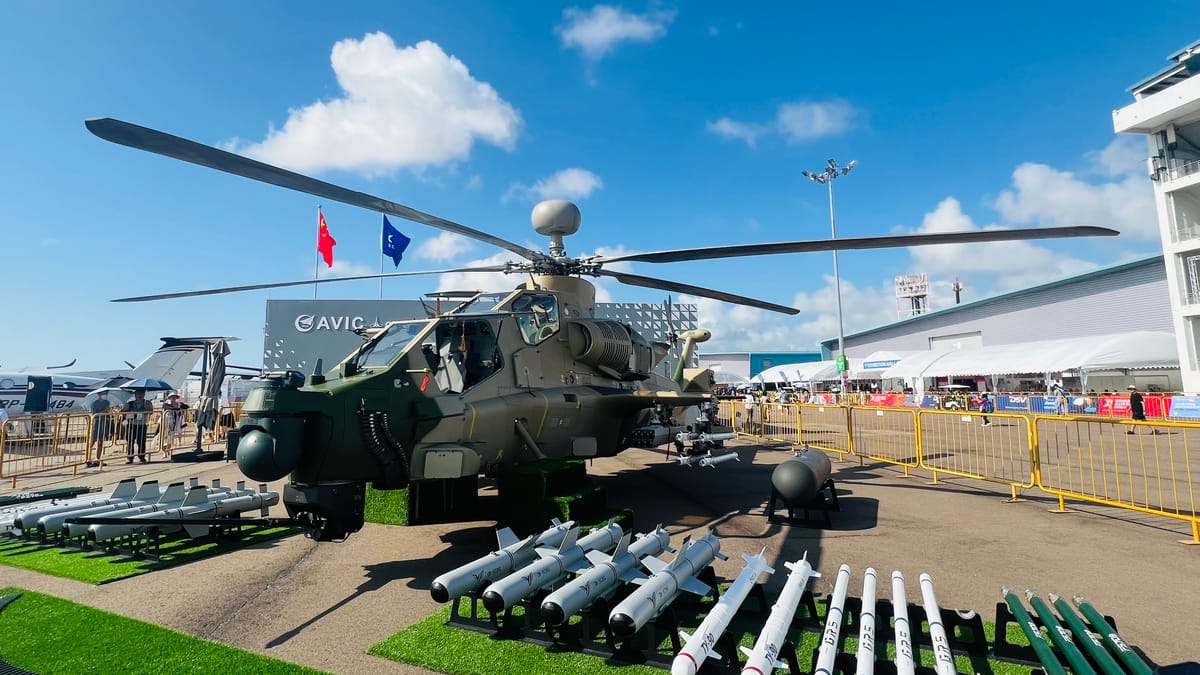
It looks like an Apache. It flies like an Apache. But it’s not American. It’s Chinese — and it might just be the most capable attack helicopter you’ve never heard of.
Meet the Changhe Z-10: the spearhead of China’s push to catch up with, and maybe even surpass, the West in battlefield aviation. Born from desperation, developed in secret, and refined with a cocktail of Russian blueprints, smuggled Western tech, and Chinese ingenuity, the Z-10 is a sleek, lethal platform built for the high-altitude frontlines of the Himalayas, the humid shores facing Taiwan, and everything in between.
It hasn’t seen combat yet — but that doesn’t mean it isn’t ready. Today, the Z-10 is flying missions, running drills, and quietly becoming a mainstay of China’s growing military machine. So how did a country with no attack helicopters at all manage to build something like this? And just how close did they come to catching the original? Let’s take a closer look and find out.
- First prototype flight
- 29 April 2003
- Entered service
- 2009
- Top speed
- 290km/h
- Range (internal fuel)
- ~800km
- Main gun
- 23 mm PX-10Aautocannon
- Gross weight
- 5,540kg
Origins and Development
The story of the Z-10 begins in the 1980s, when China’s People’s Liberation Army (PLA) finally started taking attack helicopters seriously. Up to that point, the PLA had relied on Soviet hand-me-down transport helicopters repurposed as makeshift gunships — Mi-4s, Mi-8s, things like that. It didn’t have a single purpose-built attack helicopter, the kind the Americans fielded in the AH-1 and the Soviets in the Mi-24.
And given that the attack helicopter as a concept had been rather vindicated of late — see the Vietnam War and the Iran-Iraq War for the details — this gap in capability was a serious cause for concern in Beijing. The PLA needed an attack helicopter, and it needed it yesterday.
That realization, however, was one thing; actually building a world-class gunship from scratch was another matter altogether. China lacked experience in designing helicopters at all, never mind top-of-the-line attack ones. It’s the very reason they were leaning on Soviet hand-me-downs and indigenously produced variants thereof.
A history that hollowed out the engineering base
As for why China was so far behind, that comes down to the Great Leap Forward. Meant — at the risk of oversimplifying — to rapidly grow the economy and “Communist-ise” the nation in one fell swoop, what it actually became was a human catastrophe of a scale that can barely be conveyed: as many as 60 million deaths and the near-total collapse of the economy. Even China today, still governed by the same party that implemented the policy, doesn’t try to claim it wasn’t a disaster, with the official line being one of “a failure we learned from.”
The bit we’re interested in specifically is the anti-intellectual aspect of the campaign — the one that saw clever people who had done a bit too much thinking put up against a wall. Aerospace engineers were among those targeted, and that didn’t exactly do wonders for the nation’s military modernization. One advanced aerospace project after another faltered and died; for other examples, see the Shanghai Y-10 airliner and the Chengdu J-9 interceptor.
Then, a few years later, China did much the same thing again with the Cultural Revolution, a political effort to reinforce Chinese Communism that, among other things, let loose hordes of ideologically charged students — the “Red Guards” — to target anyone they identified as anti-communist. This left many aerospace engineers dead and, once again, did nothing to help advanced projects reach completion.
And China couldn’t even ask the Soviets to bail it out. Thanks to the 1961 Sino-Soviet Split, which saw the two former friends fall out to the point of near war, Moscow simply wasn’t returning Beijing’s calls.
Project 941 and the road to a prototype
As a result, no real progress was made on the dream of a Chinese attack helicopter — beyond a few “wouldn’t this be cool” sketches — until 1995. By then the Soviet Union was a thing of the past, and the famed Kamov Design Bureau, from now-independent Russia, was hired to draw up preliminary designs under the codename “Project 941.”
The project was headed by Chief Designer Sergey Mikheev, and the result was a concept for a two-seat, tandem-layout rotorcraft in the six-ton class, tailored for anti-tank warfare. By 1998, Kamov had finished the design and even wind-tunnel tested it, then handed the blueprints to China, wished them luck, and headed home, leaving them to make it a reality under their own steam.
Armed with that preliminary outline, China’s 602nd Aircraft Design Institute, under the Aviation Industry Corporation of China (AVIC), finished the work and began prototyping the Z-10 in the late 1990s. And despite a post-Tiananmen Square arms embargo, China quietly secured Western assistance: Eurocopter helped with the main rotor, AgustaWestland supported the transmission, and Pratt & Whitney Canada supplied PT6C-67C turboshaft engines rated at 1,530 shaft horsepower, with Hamilton Sundstrand contributing digital engine controls. These were all shipped under the guise of civilian applications.
1998 also saw the program formally designated the Special Armed Helicopter Project. A full-scale testbed was completed by 2001, and on 29 April 2003 the first prototype flew, powered by the Canadian engines. The first five prototypes would use them exclusively, as the indigenous WZ-9 engine intended to power the aircraft was not yet ready.
The engine problem that defined the early fleet
Engine troubles would dog development. In the early 2000s, Pratt & Whitney was found to be supporting the project, and under pressure from the US government, the company pulled all support. This forced China to fall back on the WZ-9 as it then was — and pray they could improve it down the line. The WZ-9 produced 1,250 shaft horsepower, nearly 300 less than the Canadian engines, which left the Z-10 suddenly overweight.
As a result, all further prototypes — and many early production models, since the finalized WZ-9C wouldn’t be ready until the late 2010s — were produced without external armor plating.
Despite the setbacks, a second test phase concluded in 2004, and by 2005 low-rate production began. By 2009, the first Z-10s entered service with PLA Army Aviation — though the program stayed classified until a 2012 public reveal at the Zhuhai Airshow.
Design and Technical Features
At first glance, the Z-10 looks exactly like what it is: a modern, no-nonsense attack helicopter. It follows the classic formula pioneered by the likes of the Cobra and Apache — tandem cockpits, a slim fuselage, main rotor up top, tail rotor at the back.
The fuselage has sloped sides and a tapered tail boom, a modest attempt at radar-signature reduction. A stealth helicopter it is not, however, and the Chinese don’t claim it is. It’s a conventional helicopter that has simply had some of its radar-reflecting fat trimmed — because why not?
The gun and the hardpoints
Mounted under the nose is the chin turret for the main gun: a 23 mm PX-10A autocannon. This is smaller than the Apache’s 30 mm offering, but offsets that with a higher rate of fire — around 1,000 rounds per minute versus roughly 600 — making it better suited to strafing infantry, light vehicles, and soft targets, where volume of fire matters more than raw per-shot punch. The choice reflects a doctrinal preference for versatility and suppression over sheer armor penetration, ideal for the kind of rapid, multi-role missions the Z-10 is expected to perform across China’s varied terrain.
That said, the Z-10 isn’t short of heavy-hitting capability — its real punch comes from what’s strapped to the four external hardpoints, two per side, on its stub wings. For ground targets, that usually means HJ-10 anti-tank missiles, China’s counterpart to the American AGM-114 Hellfire. A typical combat load is eight missiles, two per pylon, broadly the same as an Apache.
In theory, that’s enough to decimate a small armored column or provide sustained anti-vehicle firepower during an assault. Earlier HJ-8 and HJ-9 anti-tank missiles were often seen on earlier Z-10s, but recent images and footage suggest those legacy systems have been largely phased out in favor of the more capable HJ-10.
For aerial threats, the Z-10 can carry TY-90 air-to-air missiles, designed specifically for helicopter-on-helicopter combat. To be very clear, these aren’t meant for dogfighting jets — China isn’t sending Z-10s out to hunt fixed-wing fighters — but they give the helicopter a real edge in rotary-wing engagements. Each launcher typically carries two to four missiles, meaning a fully loaded Z-10 could carry up to 16 TY-90s across all four hardpoints.
That’s a notable distinction from the Apache, which, while technically able to carry Stinger or AIM-92 air-to-air missiles, almost never does in practice — and when it does, it’s usually just two or four. In short, where the Apache’s anti-air capability is more of an afterthought, the Z-10 seems purpose-built to shoot back at enemy helicopters if needed.
Protection and survivability
All that firepower wouldn’t mean much without protection, and the Z-10 comes equipped with a modern self-protection suite: radar warning receivers, laser warning detectors, and missile approach sensors covering the full threat spectrum. When locked onto or fired upon, it can automatically deploy chaff and flares to confuse incoming missiles. Newer variants add Directed Infrared Countermeasure (DIRCM) turrets — essentially infrared laser jammers designed to blind missile seekers — and upgraded engine exhausts angled upward into the rotor wash to reduce heat signature and IR vulnerability.
There’s old-school protection too, in the form of armor plating. On a modern model — one with the upgraded engine — that means a composite armored cockpit resistant to full-size rifle rounds and shrapnel, plus supplementary bolt-on protection that improves things further.
By comparison, the Apache takes a similar approach but leans harder into brute survivability. Its crew compartment is famously protected by a titanium “bathtub” designed to withstand 12.7 mm rounds and even 23 mm shell fragments, giving it a slight edge in pure armor resilience. It also features redundant systems, crash-resistant fuel tanks, and a comprehensive countermeasure suite of its own. In essence, both helicopters are tough — but the Apache is built like a flying tank, while the Z-10 opts for a balance of protection, weight savings, and agility.
Power, speed, and range
As for power, the finalized Z-10 uses the WZ-9C engine — and it uses two of them, jointly connected to the single rotor by a main gearbox and transmission system that synchronizes their output, ensuring consistent power delivery and redundancy if one engine fails mid-flight. Each produces around 1,600 shaft horsepower, for a total of roughly 3,200 in a single airframe. That affords a top speed of 290 km/h and a cruising speed of 230 km/h — a smidge slower than an Apache, which can eke out 293 km/h flat out and sustain 265 cruising. Not bad, given that the Apache is much, much heavier: a typical gross weight of 8,006 kg against the Z-10’s 5,540.
Where the Z-10 has a clear advantage is range, and it’s entirely down to its lighter weight: it can manage around 800 km on a single internal tank. That’s a bigger deal than it sounds, because in operational terms it means the Z-10 can patrol further, loiter longer, or strike deeper without relying on external fuel tanks or forward refueling points. That’s a huge logistical advantage in a country as geographically vast — and tactically diverse — as China, especially when operating in remote regions like the South China Sea against Taiwan, or the Himalayas against India, where ground support may be sparse.
As for which is outright better, that’s a difficult question. The Apache has a proven track record of excellence in combat; the Z-10, as we’ll get into, has yet to fire a shot in anger. We can’t discount it on that alone, but neither can we write it off as junk — because, as you’ve seen, it genuinely seems to be a cutting-edge and well-built machine despite its difficult, drawn-out birth. It’s a welterweight versus a heavyweight.
And which is the better fighter? Well, you only find out on the day — if they ever square off in the ring.
Variants and Upgrades
Like any sophisticated piece of military hardware, the Z-10 hasn’t remained frozen in time. From its first service entry in the late 2000s to the thoroughly modernized examples flying today, the helicopter has gone through a steady cycle of refinement — some of it driven by battlefield need, some by export ambition, and some just by the natural urge to make the thing better.
The Z-10K
One variant of note is the Z-10K. This isn’t a radically different machine, but a modified version requested by the PLA Air Force’s Airborne Corps — in other words, the Chinese Air Force, as opposed to the Army Aviation branch, wanted some Z-10s tailored for its paratrooper and rapid-deployment units.
The details are murky, since the PLA isn’t keen to go into depth on cutting-edge hardware, but the Z-10K likely includes communications and Identification Friend-or-Foe (IFF) gear optimized for Air Force service, plus possibly minor tweaks to make the helicopter easier to transport and deploy with airborne troops. It’s analogous to how the US Marines might take an Army helicopter and add their own radios and salt-water corrosion proofing — not a big redesign, just a variant optimized for a different service’s needs. Visually, a Z-10K looks just like a regular Z-10. As for service entry, 2016 is the year typically cited.
The Z-10ME and the upgrade wave
The most important developments came with an upgrade package unveiled around 2018, first shown off as an export-oriented model called the Z-10ME (“ME” reportedly standing for Modernized Export). China was eyeing international customers, and to entice them it rolled out a suite of improvements.
The Z-10ME prototype featured a laundry list of enhancements: a new missile approach warning system (MAWS), improved infrared exhaust suppressors, a larger belly ammunition magazine for the chin gun, and all-new bolt-on armor panels made from a ceramic-graphene composite. It also introduced the new WZ-9C engine.
On top of that, the ME variant offered a mast-mounted radar, new datalink-capable anti-tank missiles, an upgraded electronic warfare suite with multiple active electronically scanned array (AESA) radar panels for threat detection and jamming, and an improved navigation/IFF system. In short, the Z-10ME is what the original Z-10 probably would have been if China had had all the tech and engine power ready back in 2003.
Now, “export variant” might make it sound like these goodies were only for foreign buyers. But in reality, the PLA itself began adopting many of the upgrades as soon as they were tested. Older Z-10s in service were retrofitted to what some observers call the Z-10 “Kai” (modified), or simply the upgraded Z-10 standard.
By the late 2010s and early 2020s, older Chinese Z-10s were receiving the WZ-9C engines, adding the missing armor plates on the cockpit sides and engine cowling, installing the new MAWS sensors, and fitting infrared jammers and low-signature exhaust nozzles. The domestic fleet essentially caught up to Z-10ME spec — safer for the crew, deadlier to the target, and more survivable against modern threats.
Export customers
So what about buyers outside China? For years, the most interested party was Pakistan. They evaluated the Z-10 as far back as 2015, even receiving a few on trial. They liked the firepower but found the helicopter — then sporting the older WZ-9 — underpowered for the hot-and-high conditions of their frontier.
As a result, Pakistan temporarily shelved the idea and pursued the Turkish T-129 ATAK instead — but that deal fell through when the US blocked the engine exports the Turkish helicopters relied on. So Islamabad came back to China. By this time the Z-10ME was available, and with all the boxes now ticked, Pakistan formally announced plans to acquire the Z-10ME in 2022, with reports of the first batch arriving by 2023. The exact numbers aren’t public, but it’s believed Pakistan may eventually field up to two dozen.
Aside from Pakistan, no other confirmed export deals have emerged as of the time of writing — though interest from nations like Thailand, Bangladesh, and a few in the Middle East continues to bubble in the rumor mill. Frankly, you can see why: what China offers with the Z-10 is a seemingly capable and modern attack helicopter at a price point many analysts believe would undercut Western and Russian rivals — although it must be noted that true pricing has never been publicly revealed.
Operational Service and Deployment
All the tech specs and export brochures in the world mean nothing if the machine hasn’t actually been used in the real world. And that, annoyingly — or perhaps thankfully, since war tends to be an unpleasant affair — is where we come up short with the Z-10: it has not fired a single shot in anger.
But there are still insights to decipher, because just because it hasn’t seen combat doesn’t mean it’s been sitting idle in a hangar collecting dust. Quite the opposite — the PLA has been getting some serious practice in with it, particularly since 2020.
Drills, exercises, and the hunter-killer team
The Z-10 is now a regular feature in combined-arms drills and live-fire exercises, flying alongside tanks, IFVs, artillery, and infantry in set-piece scenarios. One common pairing is with the lighter Z-19 scout helicopter, which handles target spotting and forward observation while the Z-10 stays back to deliver the pain — a classic hunter-killer combo, not unlike the old Kiowa-Apache teams of the US Army.
In 2024, Z-10s took part in high-altitude combat drills on the Tibetan Plateau, conducting live-fire missile strikes against simulated targets at over 4,000 meters above sea level. These weren’t gentle hover-and-fire displays; they were fast-paced, combined-asset training events designed to prove the Z-10 could operate effectively in thin air and cold temperatures. It wasn’t lost on anyone that the drills took place not long after renewed tensions with India — a country that happens to have Apaches of its own.
Near-misses and amphibious ambitions
And speaking of India, it was in a border flashpoint with India that the Z-10 very nearly made its combat debut. During the 2020 Ladakh border standoff, a sizeable but unconfirmed number were forward deployed to airbases in western Tibet — a move matched tit-for-tat by India stationing its Apaches across the line.
The Z-10 hasn’t stayed landlocked, either. Since 2014, PLA pilots have been testing deck landings aboard amphibious assault ships, and the Z-10 has since become a recurring guest star in amphibious assault drills simulating an invasion of Taiwan. There it plays the classic gunship role: flying ahead of the landing force, neutralizing beach defenses, and loitering overhead to provide close air support.
The Z-10 isn’t strictly navalized — it lacks folding rotors or saltwater corrosion resistance — but it’s evidently rugged enough for limited operations at sea, especially when flying from helicopter docks or repurposed cargo decks. That makes it a valuable tool in the PLA’s growing amphibious playbook; if a Taiwan operation ever came to pass, you can bet the Z-10 would be overhead from day one.
A vote of confidence in Hong Kong
Domestically, the Z-10 has found its way into nearly every Theatre Command in China, assigned to Army Aviation brigades where it operates in mixed units alongside Z-19s and utility helicopters like the Z-8 and Z-20.
The most notable domestic deployment came in 2022, when the Z-10 was sent to the PLA Hong Kong Garrison. Why does that matter? Thanks to the disproportionate number of foreign bankers and English teachers who call the surprisingly small city home, the PLA uses the garrison to show off, sending only its most dependable and high-end kit there, knowing it’ll be more visible to the outside world. This deployment — coming a full 13 years after the Z-10’s introduction — sent a clear message: the helicopter had finally graduated from promising prototype to fully trusted frontline asset.
A Cautious Conclusion
Rather than a tidy recap, it’s worth putting a proviso on all of this, because there’s a not-insignificant chance that time will overtake some of what’s been said here.
As of the time of writing, Pakistan remains the Z-10’s only export customer, and the helicopters it has taken delivery of remain unblooded. But with tensions flaring once again along the Line of Control — both sides mobilizing, rhetoric reaching a boil — there’s a very real possibility that those very Z-10s could end up flying combat missions against Indian forces. If that happens, certain facts stated and conclusions reached here will no longer hold.
We’re not prophets or fortune-tellers, so there’s nothing we can do about that. All we can do is hope everything stated remains accurate — and not just to avoid looking foolish, but for the far more important reason that if it does, it means India and Pakistan’s sons and daughters won’t be bludgeoning each other to death under the banners of leaders who don’t even know they exist.
Key Takeaways
- The Changhe Z-10 is China’s first purpose-built attack helicopter, born from a country that had no indigenous helicopter design experience and an aerospace base hollowed out by the Great Leap Forward and Cultural Revolution.
- It was developed using a Russian Kamov-drawn concept (Project 941) plus quietly obtained Western help — Eurocopter, AgustaWestland, and Pratt & Whitney Canada engines — before US pressure forced a switch to the less powerful indigenous WZ-9.
- The first prototype flew on 29 April 2003; the type entered PLA Army Aviation service in 2009 and was publicly revealed at the 2012 Zhuhai Airshow.
- Lighter and more agile than the heavier Apache, the Z-10 trades raw armor for versatility, a high-rate-of-fire 23 mm gun, HJ-10 anti-tank missiles, dedicated TY-90 air-to-air missiles, and a longer internal-fuel range of around 800 km.
- The modernized Z-10ME, with its WZ-9C engine and upgraded armor and electronics, has been exported to Pakistan, with deliveries reported from 2023 and a fleet possibly reaching two dozen.
- Despite extensive high-altitude and amphibious drills, the Z-10 has yet to see combat — though Pakistani examples near the India border could change that.

Simon Whistler
Simon Whistler hosts MegaProjects, bringing engineering, infrastructure, and military-machine stories into clear narrative focus for viewers who want the systems, tradeoffs, and human decisions behind the build.
Frequently Asked Questions
What is the Changhe Z-10?
The Z-10 is China’s first purpose-built dedicated attack helicopter, developed by the 602nd Aircraft Design Institute under AVIC. It follows the classic Cobra/Apache formula with tandem cockpits, a slim fuselage, and a main rotor up top, and is built for anti-tank and multi-role battlefield missions. It entered PLA Army Aviation service in 2009.
How does the Z-10 compare to the American Apache?
The Z-10 is lighter and more agile — roughly 5,540 kg gross weight versus the Apache’s 8,006 kg — which gives it a slight range advantage. The Apache is faster, more heavily armored thanks to its titanium “bathtub,” and combat-proven, while the Z-10 favors a balance of protection, weight savings, and versatility. The article frames it as a welterweight versus a heavyweight whose true matchup is untested.
What weapons does the Z-10 carry?
Its main gun is a 23 mm PX-10A chin-mounted autocannon firing around 1,000 rounds per minute. Across four external hardpoints it typically carries eight HJ-10 anti-tank missiles, and it can also be fitted with TY-90 air-to-air missiles for helicopter-on-helicopter combat — up to 16 in theory.
Why did China struggle to develop its own attack helicopter?
China lacked any indigenous helicopter design experience, and its aerospace engineering base had been devastated by the anti-intellectual purges of the Great Leap Forward and the Cultural Revolution, which killed or sidelined many engineers. The 1961 Sino-Soviet Split also cut off Moscow’s help. Real progress only began in 1995 when Russia’s Kamov Design Bureau was hired to draw up a preliminary concept.
Has the Z-10 ever been used in combat?
No. As of the time of writing, the Z-10 has not fired a shot in anger. It has, however, been heavily exercised — including 2024 high-altitude live-fire drills above 4,000 meters on the Tibetan Plateau, amphibious assault rehearsals, and a tense forward deployment during the 2020 Ladakh border standoff with India.
Which countries operate the Z-10?
Beyond China’s PLA, Pakistan is the only confirmed export customer, acquiring the modernized Z-10ME after the Turkish T-129 deal collapsed over blocked US engine exports. Deliveries were reported from 2023, with the fleet possibly reaching up to two dozen. Interest from Thailand, Bangladesh, and parts of the Middle East has been rumored but not confirmed.
What is the Z-10ME?
The Z-10ME (“Modernized Export”) is an upgraded variant unveiled around 2018, featuring the new WZ-9C engine, a missile approach warning system, improved infrared exhaust suppressors, ceramic-graphene composite armor, and an upgraded electronic warfare suite with AESA radar panels. Many of these upgrades were also retrofitted onto the existing Chinese fleet.
Sources
Related Projects
Boeing E-4: America’s Advanced Airborne Command Post
How the E-4 Nightwatch became America's airborne command center, built to keep national command authority alive through nuclear war, disasters, and crises.
The Convair B-36 Peacemaker: The Absolute Unit That Carried America Into the Cold War
The Convair B-36 Peacemaker was the largest combat aircraft ever built — a six-engine nuclear behemoth whose real mission was to never be used at all.
The Dassault Rafale: The Plane that Beat the F-16
How France walked away from NATO's joint fighter program and went it alone — producing one of the world's most capable fourth-generation combat aircraft.


_Aviation_Industry_Corporation_of_China_Changhe_Z10-ME_Z10ME-02_@_Singapore_Airshow_2024-02-25.jpg)